



Lucemburk
Luxembourg City is the capital of the Grand Duchy of Luxembourg and one of the three official seats of European Union institutions, alongside Brussels and Strasbourg. Its old town sits on a sandstone plateau cut by two river valleys and ringed by centuries of fortifications, which is why UNESCO listed it as a World Heritage Site. The result is a compact capital that mixes medieval streets, deep river gorges, and a modern financial and EU quarter, most of it within a short walk or a free bus ride of each other.
The city suits a stay of two or three nights: the old town can be explored on foot in a day, and castles and wine villages in the surrounding countryside make easy day trips. Robert Schuman, one of the founding architects of the European Union, was born in the Clausen district and is honoured today with a small memorial at his birthplace there.

Lucemburk – Plánuješ výlet?
Sestav si itinerář den po dni v aplikaci Tripomatic.


Kdy navštívit
Spring and autumn are mild and good for walking the ramparts. Summers are warm with occasional afternoon storms, and winters are cold with regular snow.
Time a visit around the Schueberfouer, a large funfair that takes over the Glacis grounds for around three weeks from late August into September. Held almost every year since 1340, it is one of the oldest funfairs in Europe and the largest in the country.
Nejlepší doba k návštěvě: červen, červenec, srpen, září
Hlavní památky

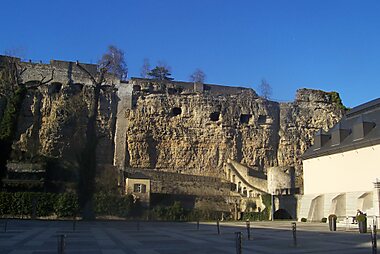

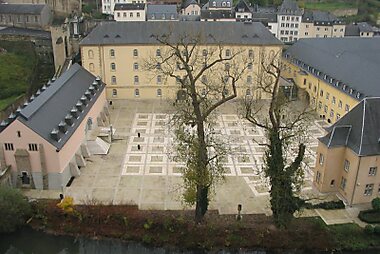
Fortress of Luxembourg is why UNESCO listed Luxembourg City's old town as a World Heritage Site. Walk the surviving ramparts, towers and casemates of what was once one of Europe's strongest fortresses.
Bock Casemates tunnels through the Bock cliff, where Siegfried, Count of Ardennes, built the city's founding castle in 963. The galleries once sheltered thousands of soldiers and their horses.
Chemin de la Corniche is a rampart-top walkway nicknamed "the most beautiful balcony in Europe." It looks out over the Alzette valley and the Grund district below.
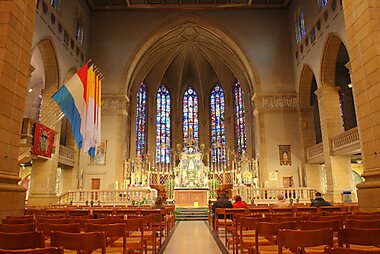
Notre-Dame Cathedral blends Gothic, Renaissance and Baroque styles and holds the crypt of the Grand Ducal family.
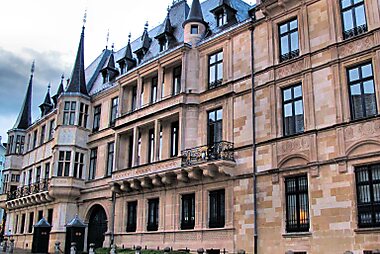
Grand Ducal Palace was built in the 1570s as the city hall and later became the official residence of Luxembourg's head of state.
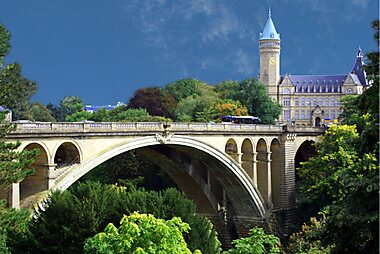
Adolphe Bridge is a double-decked arch bridge over the Pétrusse valley, linking the old town to the modern Gare district.
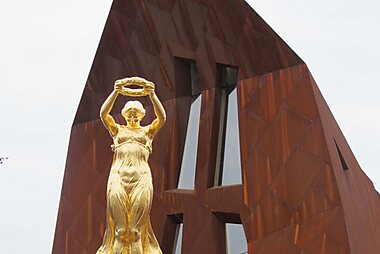
Monument of Remembrance (Gëlle Fra), known locally as the Gëlle Fra, honours the Luxembourgers who volunteered with Allied forces in both World Wars.
Mudam Luxembourg, designed by I. M. Pei, shows contemporary art on the Kirchberg plateau near the EU institutions.
Doporučené výběry


Luxembourg City Essentials
Luxembourg City's UNESCO World Heritage status centers on its formidable fortifications and historic quarters. This selection features the Bock Casemates' subterranean defense tunnels and the Chemin de la Corniche promenade, often called Europe's most beautiful balcony. The list includes 17th-century Spanish watchtowers, the glass Pfaffenthal elevator for valley views, and several centuries-old trees designated as natural monuments, alongside the central Place Guillaume II square.
10 míst


Co zažít
- Ride the free Pfaffenthal Lift down into the Alzette valley for a quick change of perspective on the old town above.
- Browse the wooden chalets of the Christmas market on Place Guillaume II and Place d'Armes in the weeks before Christmas, with mulled wine and local crafts.
- Join the crowds on the evening of 22 June, the eve of Luxembourg's National Day, when fireworks light up the Pétrusse valley below the old town.
Prohlídky a aktivity
Lucemburk – Mapa

 Otevřít interaktivní mapu
 Jednodenní výlety
Luxembourg City sits close to castles, wine country and hiking trails, most reachable in under an hour.
- Esch-sur-Alzette — about 25 minutes by train. Luxembourg's second-largest city, a former steel town rebuilt around the reclaimed Belval blast furnaces and a lively university campus.
- Moselle wine villages (Remich, Wormeldange) — about 25–35 minutes by car or bus. Riverside towns producing crisp Rieslings and Crémant sparkling wine, with towpaths along the river.
- Echternach and the Mullerthal — about 45 minutes by bus. Luxembourg's oldest town and the gateway to "Little Switzerland," a region of sandstone gorges and waymarked hiking trails.
- Vianden — about an hour by car, or bus and train combined. A hilltop castle rebuilt from a 10th-century fortress, reached from the town below by chairlift.
Jak se tam dostat
- By air: Findel Airport (LUX) is Luxembourg's only commercial airport, about 6 km from the centre. Bus route 16 runs into town in about 20 minutes and, like all public transport in the country, is free; a taxi takes about 15 minutes.
- By train: Luxembourg railway station has direct trains to Brussels, Metz, Nancy, Trier and Koblenz, plus a TGV service to Paris in around 2 hours.
- By bus: Long-distance coaches, including Flixbus, use the bus station beside the railway station, with routes to Brussels, Frankfurt and other regional cities.
Doprava na místě
- Public transit: All buses, trams and second-class trains within Luxembourg have been free nationwide since 2020, so there is no ticket to buy. The Luxtram line runs from the Kirchberg EU quarter through the centre to the railway station. Mobiliteit.lu journey planner
- Taxi: Metered taxis are available at ranks and by phone; ride-hailing coverage is limited compared to larger cities.
- On foot: The old town is compact, but it sits on a plateau above two deep valleys, so reaching the Grund and Clausen districts means stairs or a lift ride.
Řízení auta
- Is a car worth it?: Not for the city itself — the centre is compact and public transport is free — but a car makes trips into the Moselle valley and the Ardennes easier.
- Parking: Underground car parks ring the old town (Knuedler, Rond-Point Schuman, Monterey); pay by app or at the machine, at rates of a few euros per hour.
- Restrictions: None of note for visitors — there is no low-emission or congestion zone in the city.
Jídlo a pití
Luxembourg's kitchen blends French technique with German and Belgian portions, and Luxembourg has more Michelin-starred restaurants per person than almost any other country.
The Grund district along the Alzette, home to Neumünster Abbey, is the most atmospheric place for dinner and drinks, with restaurants and bars built into the old fortifications. For something quicker, the weekly market on Place Guillaume II, held Wednesday and Saturday mornings, sells local cheese, bread and produce.
Bezpečnost a zdraví
Luxembourg City is one of the safer capitals in Europe for visitors. The main risks are pickpocketing around the railway station and on crowded buses, and theft from parked cars near hiking trailheads outside the city. Tap water is safe to drink throughout the city.
Historie
Siegfried, Count of Ardennes, built the first castle on the Bock promontory in 963, the founding act of Luxembourg City. Its position above two river valleys made it easy to defend, and over the following centuries Habsburg, Spanish, French and Prussian rulers all added to its defences, until it was known as the "Gibraltar of the North." Much of what survives today, including Bock Casemates, dates from this period.
The 1867 Treaty of London declared Luxembourg neutral and forced the demolition of most of the fortress, though the casemates cut into the rock were left largely intact. Grand Ducal Palace, originally the city hall, later became the residence of the Grand Ducal family. The story of the city and its fortress is told at the Luxembourg City History Museum and the National Museum of History and Art, both in the old town.
Fakta o zemi
Quick practical facts for Luxembourg at a glance:
- Měna
- euro EUR € · Platby kartou · Široce přijímány
- Nouzová čísla
- 112
- Elektřina
- 230 V · 50 HzTyp C / Typ F
- Jazyky
- němčina, francouzština, lucemburština
- Voda z kohoutku
- Pitná
- Strana jízdy
- Vpravo
- Předvolba
- +352


Lucemburk – Naplánuj si jednotlivé dny
Proměň místa z tohoto průvodce ve skutečný itinerář s chytrým plánováním tras, časovými odhady a vším, co potřebuješ pro bezstarostný výlet.




