


Ravenna
Ravenna is a calm, compact city in Romagna, close to the Adriatic coast. It holds one of the world's most important collections of early Christian and Byzantine mosaics. Eight of its monuments, built in the 5th and 6th centuries, form a single UNESCO World Heritage site. In that period Ravenna was the capital of the Western Roman Empire, then of the Ostrogothic kingdom, and then the Byzantine seat in Italy.
Most sights sit within a short walk of each other in a flat, mostly pedestrian centre, so two or three days are enough to see them without rushing. The poet Dante Alighieri died here in exile, and his tomb is still a place of pilgrimage. The city suits travelers who love art and history and like a slower pace. Beaches, pine forests and the lagoons of the Po Delta are close by for a change of scene.

Ravenna – Planlægger du en rejse?
Opbyg din dag-for-dag rejseplan i Tripomatic-appen.


Bedste rejsetidspunkt
Spring and early autumn are the best times: mild, with fewer crowds than in summer. Summer is hot and humid, and the nearby beaches fill up. Winter is cool, damp and often foggy, but the mosaics are indoors and the monuments are quiet.
The biggest event of the year is the Ravenna Festival, a major classical music and arts festival held from late spring into July. Concerts take place in theatres, basilicas and the courtyard of the old Venetian fortress. Book tickets and rooms early if you plan to go.
Bedste rejsetidspunkt: maj, juni, juli, august, september, oktober
Topseværdigheder


The eight UNESCO monuments are the reason to come. Five of them in the centre share combined tickets for 2, 4 or 5 monuments, valid for 7 days. Booking a time slot online is wise: same-day tickets depend on availability, and visitors with a booking get priority.
- Basilica di San Vitale is the masterpiece of Ravenna. Its 6th-century apse shows the emperor Justinian and the empress Theodora with their courts, in gold and colour.
- Mausoleum of Galla Placidia stands in the same garden. It is a small brick building from the 5th century, with a deep blue vault covered in gold stars.
- Basilica di Sant'Apollinare Nuovo was built under the Ostrogoth king Theodoric. Long processions of saints and virgins line both walls of the nave.
- Battistero Neoniano is the oldest of the monuments. Its dome shows the baptism of Christ, surrounded by the twelve apostles.
- Arian Baptistery was built for the Arian Christians of Theodoric's court. It has a similar baptism scene in its dome, and a visit takes only a few minutes.
- Cappella Arcivescovile is a tiny private chapel of the bishops from around 500 AD. It is reached through the Archiepiscopal Museum, next to the Duomo di Ravenna.
- Mausoleum of Theodoric stands in a park a short walk north of the centre. The king's tomb is roofed with a single huge block of stone.
- Basilica di Sant'Apollinare in Classe stands about 5 km south of the centre, in Classe. Its green apse with sheep and a large cross is one of the most peaceful mosaics in Ravenna.
- Tomba di Dante is a small neoclassical temple from the 18th century. It sits in a quiet zone next to the Basilica di San Francesco.
- Domus dei tappeti di pietra lies under a church, about three metres below street level. Walkways pass over the patterned floor mosaics of a Byzantine-era house, found in 1993.
Beyond the UNESCO sites, the Museo Nazionale di Ravenna fills the old monastery next to San Vitale with Roman and Byzantine finds. The MAR Museo d'Arte della città di Ravenna shows paintings and a collection of modern mosaics.
Fremhævede lister


Oplevelser
These activities are typical of Ravenna and hard to find elsewhere.
- Make your own mosaic: several mosaic workshops in the city offer short classes. You cut glass and stone pieces and set a small panel to take home.
- Watch the fish in a flooded crypt: the crypt under the Basilica di San Francesco lies below the water table and is always flooded. Fish swim over the old mosaic floor.
- Cycle to the pine forest and the sea: flat cycle routes lead out to the old pine forests and the beaches of Marina di Ravenna and Punta Marina.
- Spend an evening in the Venetian fortress: in summer, the walls of the Rocca Brancaleone host open-air concerts and films.
- Spend a day at a theme park: Mirabilandia, one of Italy's largest, is about 15 km south of the city. It is a good break for families after the monuments.
Ture og aktiviteter
Ravenna — Kort

Dagsture
Ravenna sits between the sea, the lagoons and the hills of Romagna. These trips are easy in a day, listed from closest to farthest.
- Cervia (≈25 min by train or car): a seaside town with historic salt pans. Flamingos often feed in the salt marsh.
- Faenza (≈30 min by train): the town that gave its name to faience pottery. It has a large ceramics museum and many workshops.
- Comacchio (≈40 min by car): a small lagoon town with canals and bridges. It is the gateway to the wetlands of the Po Delta, good for birdwatching and boat trips.
- Brisighella (≈50 min by car or train via Faenza): a hill village with a medieval fortress, a clock tower and a covered lane built into the old walls.
- Ferrara (≈1 hour 15 min by train): a Renaissance city with a moated castle and long walls you can walk or cycle on.
- Bologna (≈1 hour 15 min by train): the regional capital, known for its arcades, towers and food.
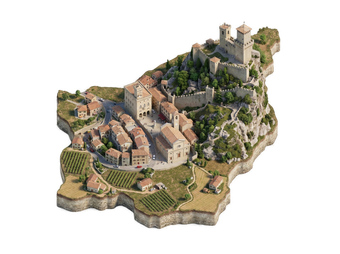
- San Marino (≈1 hour 30 min by car): a tiny republic with three towers on a mountain ridge and wide views to the sea.
Områder at udforske
Ravenna is one of several historic cities in Emilia-Romagna linked by fast regional trains.
Ankomst
- By air: the main gateway is Bologna Guglielmo Marconi Airport. Take the Marconi Express monorail to Bologna Centrale station, then a train to Ravenna; allow about 1.5–2 hours in total. Forlì Airport, about 30 km away, has a few low-cost flights.
- By train: Ravenna station is at the edge of the historic centre, a 10-minute walk from the main sights. Regional trains run to Bologna (about 1–1.5 hours), Rimini (about 1 hour) and Ferrara (about 1 hour 15 minutes). Check times on Trenitalia.
Transport
- On foot: the historic centre is flat and small. All central monuments are within a 15-minute walk of each other.
- By bike: Ravenna is a cycling city, and bikes are the local way to get around. Cycling is easy and pleasant, and several shops near the station rent bikes.
- By bus: local buses are run by Start Romagna. On most city buses you can pay on board by tapping a contactless bank card or phone on the green validator. Otherwise, buy a ticket before boarding. Buses are most useful for Classe and the beaches. See Start Romagna.
- To Classe: regional trains and local buses stop near Sant'Apollinare in Classe, about 10 minutes from the centre.
Kørsel
- Is a car worth it?: not for the city itself, which is best on foot or by bike. A car helps for the Po Delta lagoons and the hill villages.
- Parking: use the paid car parks around the edge of the historic centre and walk in. Free parking is easier to find farther out, near the station area and the ring road.
- Restrictions: the historic centre is a limited traffic zone (ZTL) watched by cameras. Do not drive in without a permit, or you will receive a fine by post.
Mad og drikke
Ravenna eats like the rest of Romagna. Look for piadina, a thin flatbread filled with ham, cheese or greens and sold at roadside kiosks. Try cappelletti (small stuffed pasta), passatelli in broth, and fresh squacquerone cheese. Seafood is good on the coast. Local wines include red Sangiovese and white Albana.
The renovated Mercato Coperto, the covered market near Piazza del Popolo, is a good place for a quick lunch and local products. The lanes around Piazza del Popolo and Via Cavour have many traditional trattorias and wine bars.
Sikkerhed og sundhed
Ravenna is a very safe city. Petty crime is rare. If you rent a bike, always lock it. In summer, mosquitoes are common near the lagoons and pine forests, so bring repellent. Tap water is safe to drink.
Historie
Ravenna began as a town in the marshes, and the Romans built a large naval port at nearby Classe. In 402 AD the emperor Honorius moved the capital of the Western Roman Empire here from Milan, because the marshes made the city easy to defend. His half-sister Galla Placidia ruled for years as regent, and Mausoleum of Galla Placidia dates from this time.
After the Western Empire fell in 476, the Ostrogoth king Theodoric made Ravenna his capital. He built Basilica di Sant'Apollinare Nuovo, Arian Baptistery and his own tomb, Mausoleum of Theodoric. In 540 the Byzantine army took the city. Ravenna became the seat of Byzantine power in Italy, and Basilica di San Vitale and Basilica di Sant'Apollinare in Classe were completed. The Lombards ended Byzantine rule in 751.
The sea slowly moved away, and the port at Classe silted up. You can learn about it at the Classis Ravenna museum. Dante Alighieri spent his last years here and died in 1321, and his remains rest in the Tomba di Dante. Venice ruled the city in the 15th century and built the Rocca Brancaleone. The English poet Lord Byron lived here from 1819 to 1821. In 1996 the eight early Christian monuments were added to the UNESCO World Heritage list.
Fakta om landet
Quick practical facts for Italy at a glance:
- Valuta
- euro EUR € · Kortbetaling · Bredt accepteret
- Nødnumre
- 112
- Elektricitet
- 230 V · 50 HzType C / Type F / Type L
- Sprog
- italiensk
- Postevand
- Kan drikkes
- Kørselsside
- Højre
- Landekode
- +39


Ravenna – Planlæg dine dage
Gør stederne fra denne guide til en rigtig rejseplan med smart ruteplanlægning, tidsestimater og alt hvad du behøver for en perfekt rejse.


Relaterede destinationer




Data: © OpenStreetMap contributors, Wikidata, Wikipedia, Tripomatic, Official websites, geoBoundaries (CC BY 4.0). Tours by GetYourGuide. We earn commission from bookings. Travel guide generated with AI.
Planlæg din rejse med Tripomatic
- AI-drevet planlægningLad kunstig intelligens opbygge din rejseplan, besvare rejsespørgsmål og gemme dine bookingdokumenter direkte i din rejse.
- RejsevarslerOfficielle rejsevejledninger, voldsomt vejr, strejker og naturkatastrofer for stederne på hver dag af din rejse.
- Helligdage og begivenhederSe helligdage, festivaler og lukkedage på datoerne for din rejse, og hvad de betyder for dine planer.
- PrisestimeringAI-drevne overslag over rejseudgifter, så du ved, hvad du skal budgettere med, før du rejser.
- Ture og billetterBook guidede ture, forbi-køen-billetter og aktiviteter direkte i din plan.