



Lanzarote
Lanzarote is the most easterly of the Canary Islands, about 125 km off the coast of Africa. It is a dry volcanic island with black lava fields, red and ochre craters and white villages. Eruptions in the 18th century covered a large part of the island, and the landscape still looks new and raw.
The island is also shaped by the artist César Manrique, who was born here. He turned caves, lava tubes and viewpoints into art spaces and helped keep high-rise hotels away from most of the coast. Lanzarote suits a relaxed beach holiday in Puerto del Carmen, Playa Blanca or Costa Teguise, with day trips to volcanoes, art centres and wineries. Distances are short, so you can see most of the island in a few days.

Lanzarote – Planst du eine Reise?
Erstelle deine Reiseroute Tag für Tag in der Tripomatic-App.


Beste Reisezeit
Lanzarote is warm and dry all year, with very little rain. Winter is mild and the most popular time for northern Europeans. Summer is warmer but rarely very hot, because the trade winds blow almost every day. The wind is strongest in summer, which is good for surfers but can make some beaches less comfortable.
If you visit in mid-September, plan around the Fiestas de Los Dolores in Mancha Blanca. Pilgrims from across the island walk to the village on the Saturday before the main feast day, 15 September. The island's largest craft fair takes place in the village at the same time.
Beste Reisezeit: Februar, März, April, Mai, Juni, Juli, August, September, Oktober, November, Dezember
Top-Sehenswürdigkeiten


Islote de Hilario - Montañas del Fuego is the heart of Timanfaya National Park. Staff show how hot the ground is: dry brush catches fire, and water poured into a hole shoots up as steam. A coach tour from here follows the Route of the Volcanoes through the lava fields. Book tickets online in advance, because they are not sold on site.
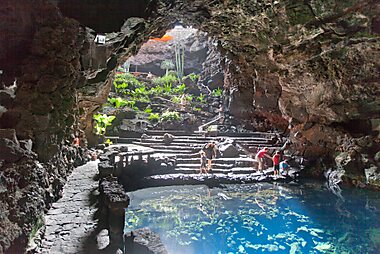
Jameos del Agua is a collapsed lava tube that César Manrique turned into a garden, pool and concert hall. A clear saltwater lake inside the cave is home to tiny blind white crabs.
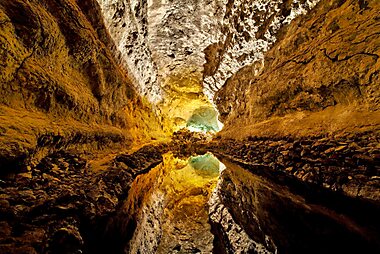
Cueva de los Verdes is part of the same lava tube. Guided tours lead about one kilometre through coloured lava caves, and the visit ends with a surprise that guides ask visitors to keep secret.
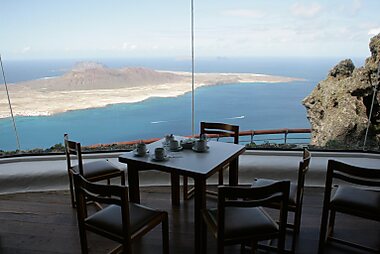
Mirador del Río sits on a cliff at the northern tip of the island. From its large windows you look down on the strait and the island of La Graciosa.
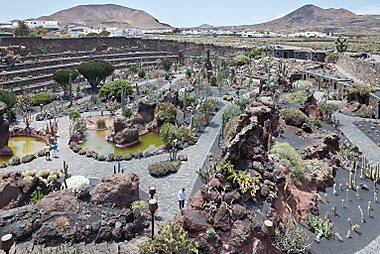
The Cactus Garden fills an old quarry near Guatiza with thousands of cacti from around the world. It was Manrique's last major project on the island.
Fundación César Manrique is Manrique's former home near Tahíche, built into five volcanic bubbles in a lava field. Today it shows his work and his private art collection. His later home, Casa-Museo César Manrique, stands in a palm grove in Haría.
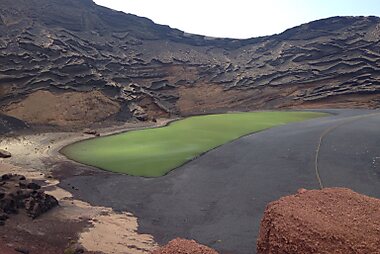
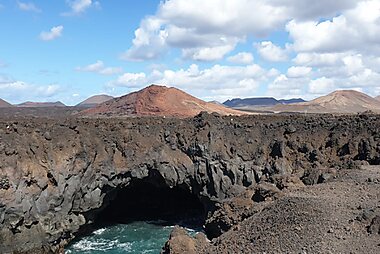
Laguna Verde is a bright green lagoon behind a black sand beach at El Golfo, inside a half-eroded volcanic cone. Nearby, waves crash into lava caves and channels at Los Hervideros, and Las Salinas de Janubio still produces sea salt in a colourful pattern of pans.
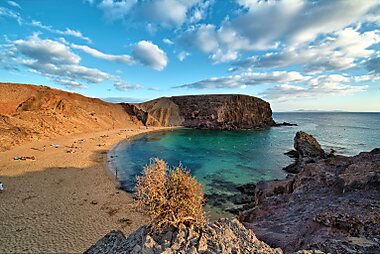
Papagayo Beach is the best known of a group of sandy coves at the protected southern tip of the island. The water is calm and clear, with views to Fuerteventura.
La Villa de Teguise was the island's capital for centuries. Its old streets, churches and palaces are quiet on weekdays and very busy during the Sunday market.
Empfohlene Listen


Volcanic Lagoons and Beaches
Lanzarote’s coastline is defined by its dramatic volcanic origins and diverse shorelines. This collection features the striking Green Lake, a lagoon formed within a volcanic crater, and Jameos del Agua, a natural cave system housing endemic blind crabs. The list covers the protected golden sands of the Papagayo area, the six-kilometer surfing stretch of Famara, and various clothing-optional beaches. From the sheltered, family-friendly waters of Playa Flamingo to the wave-heavy shores near Arrecife, these spots showcase the island’s unique geological and coastal variety.
13 Orte
Historical and Archaeological Sites
Lanzarote’s history is reflected in its diverse architecture, from the 15th-century Norman settlement at San Marcial del Rubicón to the 18th-century volcanic landscapes. This collection includes coastal defensive fortifications like the 16th-century Saint Gabriel Castle and the Piracy Museum at Saint Barbara Castle. It features significant religious landmarks such as the Church of San Ginés and the Ermita de los Dolores, alongside indigenous archaeological sites containing ancient wells, petroglyphs, and lithophones.
13 Orte

Erlebnisse & Aktivitäten
- Eat food grilled over volcanic heat at the El Diablo restaurant at Islote de Hilario - Montañas del Fuego, which César Manrique designed.
- Ride a camel up the slopes of Timanfaya. Short rides start from the Echadero de los Camellos, on the road between Yaiza and the park.
- Browse the Sunday market in La Villa de Teguise. Every Sunday morning, the streets of the old capital fill with craft and food stalls and local music.
- Dive at the underwater museum. Atlantic Museum has more than 300 sculptures on the seabed off Playa Blanca, and dive centres in the area take divers down to see them.
- Walk into a volcano crater. An easy path leads around and into Caldera de los Cuervos, the crater where the great eruption began in 1730.
- Take a surf lesson at Playa de Famara. The long beach has steady waves, and the village of Caleta de Famara has many surf schools.
Touren & Aktivitäten
Lanzarote — Karte

Tagesausflüge
Two neighbouring islands are an easy day out by ferry. Leave early and check return times before you go.
- La Graciosa — ≈25 min by ferry from Órzola in the far north. This small island has sand tracks instead of paved roads, a quiet fishing village and some of the clearest water in the Canaries. Rent a bike or join a 4x4 taxi to reach the beaches.
- Fuerteventura — ≈25–35 min by ferry from Playa Blanca to Corralejo. The big sand dunes of Corralejo Natural Park start just outside the town.
Orte zum Entdecken
On Lanzarote
- Arrecife — the island's capital and main port, with two old castles and a tidal lagoon full of fishing boats.
- Timanfaya National Park — the protected lava fields created by the eruptions of 1730–1736.
Nearby islands
- La Graciosa — a small, car-free island off the northern tip of Lanzarote.
- Fuerteventura — long white beaches and dunes, a short ferry ride south.
- Gran Canaria — mountains, dunes and the historic city of Las Palmas.
- Tenerife — the largest Canary Island, built around the volcano Teide.
Anreise
- By air: César Manrique-Lanzarote Airport (ACE) is 5 km southwest of Arrecife. It has frequent flights from across Europe, mainland Spain and the other Canary Islands. Bus 22 (weekdays) and bus 23 (weekends) go to Arrecife in about 10–15 minutes. Bus 161 goes to Puerto del Carmen and Playa Blanca. Taxis wait outside the terminal. Lanzarote Airport
- By sea: Ferries connect the port of Arrecife with Gran Canaria and Tenerife, and a long ferry runs from Cádiz on mainland Spain. Fast ferries link Playa Blanca with Corralejo on Fuerteventura, and Órzola with La Graciosa.
Unterwegs vor Ort
- Island buses: Intercity Bus runs the buses (guaguas) between Arrecife, the airport, the resorts and the main villages. You can pay the driver in cash or with a contactless bank card. A rechargeable Bono card gives a small discount. Buses to the volcanoes and the north are rare. Intercity Bus Lanzarote
- Car: Renting a car is the easiest way to see the island. Roads are good and distances are short.
- Taxi: Taxis are easy to find in Arrecife, at the airport and in the resorts.
- On foot and by bike: The resorts and central Arrecife are easy to walk. Cycling is popular, but the wind is strong and there is little shade.
Autofahren
- Is a car worth it? Yes. Most top sights are in the countryside, and buses to them are slow and infrequent.
- Timanfaya: You can drive to the car park at Islote de Hilario, but you cannot drive the Route of the Volcanoes yourself. The coach tour is included in the ticket.
- Papagayo beaches: The access road is a dirt track, and there is a small fee per car to enter the protected area.
- Parking: Street parking in central Arrecife is limited and partly paid in blue zones. Car parks at the main sights are free with your ticket but fill up in the middle of the day.
Essen & Trinken
Lanzarote's food is simple and based on fresh fish, goat's cheese and potatoes. Try papas arrugadas, small potatoes boiled in salty water and served with red or green mojo sauce. Grilled local fish such as vieja and cherne is the classic lunch by the sea. Lanzarote is also known for its wine, especially dry and sweet white wine made from Malvasía grapes grown in volcanic ash.
For the best seafood, head to the line of fish restaurants on the seafront in El Golfo, or to the harbour of Arrieta in the north. In Arrecife, the bars and restaurants around the Charco de San Ginés lagoon are good for tapas. To taste the island's wine, drive along the road through La Geria, where many wineries have tasting rooms, including Bodega El Grifo.
Sicherheit & Gesundheit
Lanzarote is a very safe island. Petty theft is the main risk. Do not leave valuables visible in a parked car, especially at beach car parks and viewpoints.
The Atlantic can be dangerous. Famara and much of the north and west coast have strong currents and big waves. Swim only on beaches with a lifeguard, and never when a red flag is flying.
The sun is strong all year, and the wind can hide how quickly you burn. In Timanfaya, stay on the marked paths and follow the rules, because the lava fields are fragile and strictly protected. Tap water comes from desalination plants and is safe, but most people buy bottled water for drinking because of the taste.
Geschichte
The first people of Lanzarote, the Majos, came from North Africa and lived from goats and farming. In 1402, the Norman knight Jean de Béthencourt landed here for the Crown of Castile, and Lanzarote became the first Canary Island to be conquered. La Villa de Teguise grew into the capital. Pirates raided the island often, and islanders hid in lava caves such as Cueva de los Verdes. Castillo de Santa Bárbara was built on a volcano above the town to watch the coast.
From 1730 to 1736, a long series of eruptions began at Caldera de los Cuervos and buried about a quarter of the island under lava, including several villages. The new ash soil turned out to be good for farming, which gave rise to the vineyards of La Geria. Arrecife became the capital in the 19th century, guarded by Castillo de San Gabriel and the Castillo de San José, which today houses The Museum of Contemporary Art.
In the 1960s, César Manrique returned to his home island and worked to protect it from the mass building seen elsewhere. His work, including Peasant Monument at the centre of the island, still shapes how Lanzarote looks. In 1993, UNESCO declared the whole island a Biosphere Reserve.
Länderfakten
Quick practical facts for Spain at a glance:
- Währung
- Euro EUR € · Kartenzahlung · Weitgehend akzeptiert
- Notrufnummern
- 112
- Stromnetz
- 230 V · 50 HzSteckertyp C / Steckertyp F
- Sprachen
- Spanisch
- Leitungswasser
- Trinkbar
- Fahrseite
- Rechtsverkehr
- Telefonvorwahl
- +34


Lanzarote – Plane deine Tage
Verwandle die Orte aus diesem Reiseführer in eine echte Reiseroute mit intelligenter Routenführung, Zeitschätzungen und allem für eine perfekte Reise.




