

Athens Municipality
Athens is one of the world's oldest cities, with a written history stretching back more than 3,000 years. Ancient temples and marketplaces sit next to modern apartment blocks, cafes, and street art, so ruins from the age of Pericles and Socrates are never far from daily life. It suits travelers who want serious history without giving up modern comforts: markets, rooftop bars, and neighborhood restaurants sit a short walk from 2,500-year-old monuments.
Most visitors spend three to four nights here, using Athens both as a destination in its own right and as the gateway to the Greek islands.

Athens Municipality – Planning a Trip?
Build your day-by-day itinerary in the Tripomatic app.
When to visit
Spring (April–May) and autumn (September–October) are mild and the most comfortable times to visit. Summer is hot and dry, especially in July and August, while winter is cool and rainy but rarely freezing.
Plan around the Athens Epidaurus Festival, held from June to August, when ancient Greek drama, opera, and concerts return to the Odeon of Herodes Atticus under the Acropolis. Tickets for the best-known performances sell out early.
Best time to visit: April, May, June, September, October, November
Top sights
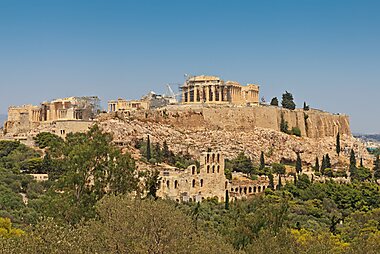
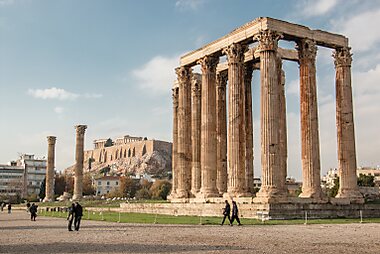
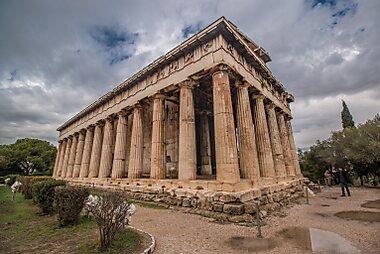
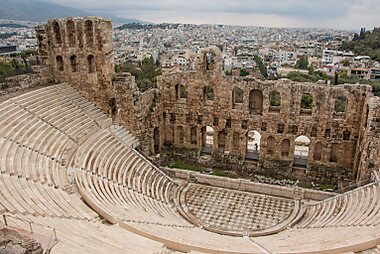
- Acropolis rises above the whole city and holds the ruins of ancient Athens' main temples. Buy a ticket online in advance and arrive at opening time to beat the heat and the crowds.
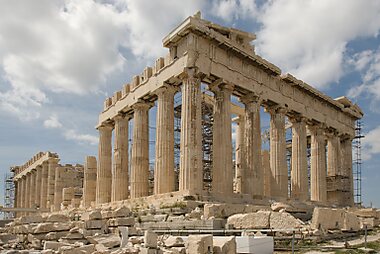
- Parthenon is the best-known building on the hill, a 5th-century BC temple to the goddess Athena and one of the most copied structures in the world.
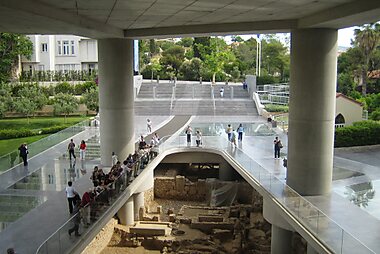
- Acropolis Museum sits at the foot of the hill and displays the statues and friezes found there, including a glass floor over an excavated ancient neighborhood.
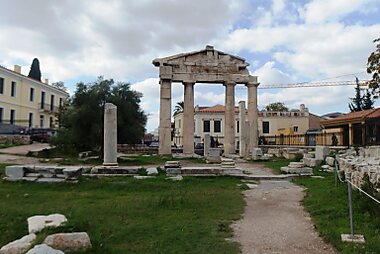
- Ancient Agora of Athens was the civic heart of ancient Athens, where markets were held and democracy itself first took shape.
- Temple of Olympian Zeus took over 600 years to finish; only 15 of its original 104 giant columns still stand.
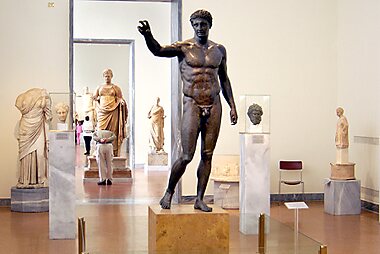
- National Archaeological Museum holds the largest collection of Greek antiquities anywhere, including gold funerary masks from Mycenae.
- Plaka is the oldest neighborhood in the city, with narrow lanes, neoclassical houses, and small squares below the Acropolis.
- Lycabettus Hill is the highest point in central Athens; a funicular runs to the top for views over the whole city and the sea.
Featured Lists


Historic Churches & Religious Sites
This collection highlights the religious and architectural diversity of Athens, ranging from the 10th-century Church of the Holy Apostles in the Ancient Agora to the Armenian Church in Neos Kosmos. The list includes medieval landmarks like the partially subterranean Agios Nikolaos Chostos and sites of national significance, such as Agios Demetrios ton Oplon, which is linked to the Greek War of Independence. These locations offer insight into Byzantine traditions, Eastern Orthodox worship, and local community heritage.
10 places


Athens Cafes & Bakeries
This collection features a mix of traditional Athenian bakeries, specialized confectioneries, and cafes with significant outdoor seating. Highlights include Sokolata 56 for high-quality chocolate drinks and Galaktompoureko 10 Me Tono, which specializes in the classic Greek custard pie. The list also includes established neighborhood spots like To Steki tou Ilia and Virinis, which offer regional Greek cuisine in garden or terrace settings, alongside local bakeries like To Ipirotiko and the artisanal desserts of Papagallino.
12 places


Audio Guides – Athens Municipality
Explore on foot with a self-guided audio tour that narrates each stop as you reach it.


Hear Athens Municipality's audio tours
1 walk in Audio Guides by Tripomatic


What to experience
Athens has a few rituals worth timing your visit around, beyond the ancient sites.
- Watch the Changing of the Guard in front of the Greek Parliament on Syntagma Square. The Evzones perform a slow, stylized march every hour, with a full band and a longer ceremony on Sunday at 11:00.
- Catch sunset from Areopagus, a bare rock beside the Acropolis where locals gather with a drink to watch the light change over the city.
- Browse the Sunday flea market at Monastiraki Flea Market for antiques, records, and odd finds — it spreads well beyond the shops into the surrounding streets only on Sundays.
- Join a rebetiko (Greek blues) night in a small taverna in the Psiri neighborhood, with live bouzouki and singing that goes on late.
Tours & Activities
Athens Municipality — Map

 Open the interactive map
 Day trips
Several worthwhile destinations sit within a few hours of Athens, from a quick countryside trip to a full day out.
- Marathon — about 45 minutes by car, or around 1 hour by bus. Site of the 490 BC battle that gave the marathon race its name; a burial mound marks the fallen Athenian soldiers.
- Cape Sounion — about 1 hour by car, or up to 2 hours by bus. The Temple of Poseidon stands on a cliff over the Aegean Sea, especially striking at sunset.
- Aegina — about 1 hour by ferry from Piraeus. A relaxed island known for pistachios and the well-preserved Temple of Aphaia.
- Corinth — about 1.5 hours by car or bus. Ruins of the ancient city sit beside the Corinth Canal, a narrow passage cut between the mainland and the Peloponnese.
- Delphi — about 2.5 hours by car or bus. A UNESCO World Heritage site in the mountains, once home to the most famous oracle of the ancient world.
Getting there
- By air: Athens International Airport "Eleftherios Venizelos" (ATH) is the main gateway, about 30 km east of the centre. Metro Line 3 runs directly to the centre in about 40 minutes for around 9 €; the X95 airport bus is a cheaper alternative, while the suburban rail (Proastiakos) costs about the same as the metro.
- By sea: Ferries from the Greek islands and other Mediterranean ports arrive at the port of Piraeus, connected to central Athens by Metro Line 1 in about 20 minutes.
- By train: Intercity trains from Thessaloniki (about 4–5 hours) and other Greek cities arrive at Larissa Station, a short walk from the centre and linked to Metro Line 2.
- By bus: Long-distance KTEL coaches from across Greece arrive at the Kifisos and Liosion bus terminals, both a short taxi ride from the centre.
Getting around
- Public transit: The Athens Metro (3 lines), tram, and buses are run by OASA. Tap a contactless bank card or phone directly at the metro gates — a single fare covers 90 minutes across metro, tram, and bus. Athens Metro & Tram (STASY)
- Taxi / ride-hailing: Beat is the dominant local ride-hailing app; taxis are also easy to hail on the street.
- On foot: The historic centre — Plaka, Monastiraki, Syntagma — is compact and walkable, though many streets are cobbled and the area around the Acropolis involves stairs and uneven ground.
Driving
- Is a car worth it?: No. Central Athens has heavy traffic, a confusing one-way system, and scarce parking — public transit and walking cover the sights better. Renting a car makes sense only for day trips outside the city.
- Parking: Paid street parking (blue-line zones) is metered by app or ticket machine; garages near Syntagma and Plaka are safer and easier for a short visit.
- Restrictions: A low-emission ring (Daktylios) limits some vehicles from entering the historic centre on weekdays; check before driving in if using a rental car.
Food & drink
Athens shares Greece's classic dishes — souvlaki, gyros, moussaka, and small fried fish called marides — but also has a strong taverna culture, with meals built around shared small plates (mezedes) rather than a single main course.
For an everyday meal, head to the backstreets of Plaka away from the main tourist strip, or the cluster of tavernas around Psiri. The area near Athinas Street and the Varvakios central market is a good spot for late-night grilled meat and fish.
Safety & health
Athens is generally safe for tourists, with low rates of violent crime. The main risks are pickpocketing on the metro (especially the airport line and around Monastiraki and Syntagma) and bar scams near busy tourist streets — walk away from anyone who insists on taking you to a specific bar or club.
Tap water in central Athens is safe to drink.
History
Athens takes its name from Athena, the goddess of wisdom, who — according to legend — won the city from Poseidon by gifting it an olive tree. The Ancient Agora of Athens was where Athenian citizens gathered to debate and vote, laying the groundwork for democracy as a system of government. The Acropolis and its temples were built in the 5th century BC under the statesman Pericles, funded partly by the treasury of the Delian League.
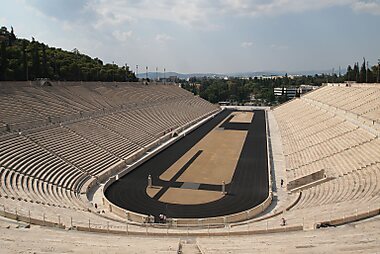
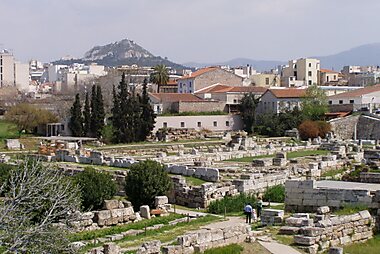
Nearby, the Archaeological site of Kerameikos served as the city's main cemetery and pottery district for over a thousand years, and the Temple of Hephaestus overlooking the Ancient Agora is the best-preserved Doric temple in Greece. Centuries later, in 1896, the Panathenaic Stadium — rebuilt on the site of an ancient stadium — hosted the first modern Olympic Games.
Country facts
Quick practical facts for Greece at a glance:
- Currency
- Euro EUR € · Card payments · Widely accepted
- Emergency numbers
- 112
- Electricity
- 230 V · 50 HzType C / Type F
- Languages
- Greek
- Tap water
- Drink with caution
- Driving side
- Right
- Calling code
- +30


Athens Municipality – Plan Your Days
Turn the places from this guide into a real itinerary, with smart routing, time estimates, and everything you need for a perfect trip.