



Bruges
Bruges is a small, walkable city in northwest Belgium where canals, cobbled squares, and medieval buildings survive almost intact. Its old centre is a UNESCO World Heritage Site, and it earned that status by staying frozen: after its harbour silted up in the late 15th century, the city lost its trading wealth and simply stopped growing. What was left behind is one of Europe's best-preserved medieval city centres.
The whole historic core can be crossed on foot in under 30 minutes, which makes Bruges an easy base for a short trip. It suits travelers who want gothic architecture, canal views, chocolate, and beer more than nightlife or shopping. The painter Jan van Eyck worked here in the 15th century, and his legacy, along with that of the other Flemish Primitives, still anchors the city's museums today.

Bruges – Tu prépares un voyage ?
Crée ton itinéraire jour par jour dans l'application Tripomatic.


Quand partir
Spring and autumn are mild and quieter than summer, and both are good times to walk the canals without crowds. Summer is warm and busy, with long daylight hours for evening walks. Winter is cold and damp, but the Markt fills with a Christmas market and an open-air ice rink.
Plan around Ascension Day, in spring, when the Procession of the Holy Blood carries the city's relic through the streets in a centuries-old pageant. It is inscribed on the UNESCO Representative List of the Intangible Cultural Heritage of Humanity, and it draws tens of thousands of visitors.
Meilleure période pour visiter: juin, juillet, août
Sites incontournables
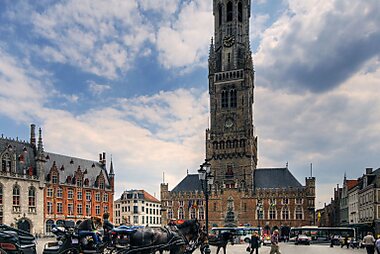
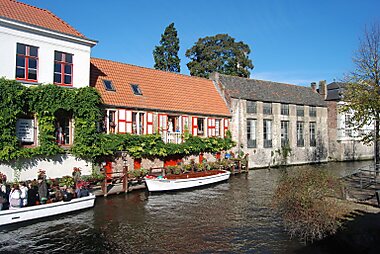

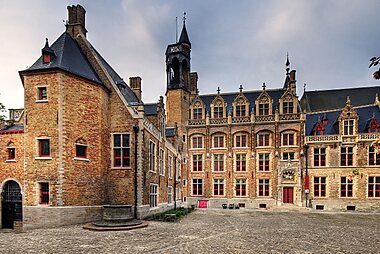
Market Square is the heart of the city, ringed by guild houses and dominated by the belfry tower. It hosts the weekly market and the winter Christmas market and ice rink.
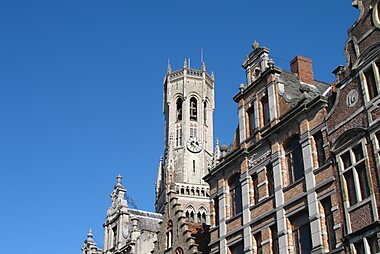
Belfry rises above the Markt and rewards the 366-step climb with a view over the whole old town. It was built as a watchtower and treasury for the medieval cloth trade, and it is still Bruges' defining silhouette.
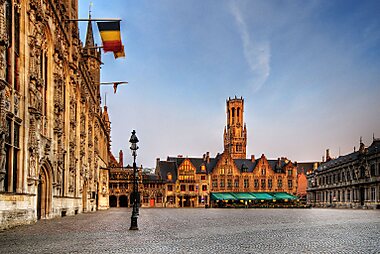
Burg Square is the city's historic administrative centre, lined by the ornate City Hall and the former courthouse. It feels smaller and quieter than the Markt, just steps away.
Basilica of the Holy Blood houses a relic venerated as the blood of Christ, brought back from the Second Crusade. The upper chapel's gilded interior is one of the most striking small spaces in the city.
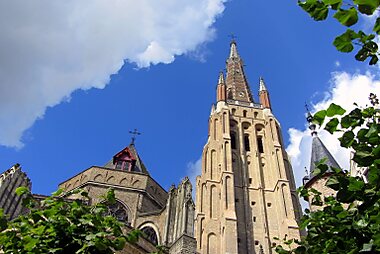
Church of Our Lady has the tallest brick tower in Belgium, and inside it holds Michelangelo's marble Madonna and Child — one of the few of his works to leave Italy in his lifetime.
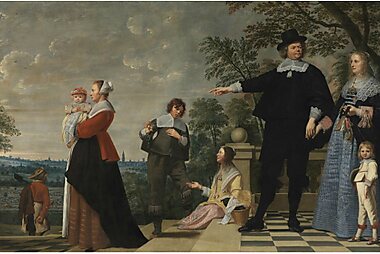
Groeningemuseum holds the city's finest collection of Flemish art, including work by Jan van Eyck and Hans Memling. It is compact enough to see well in an hour.
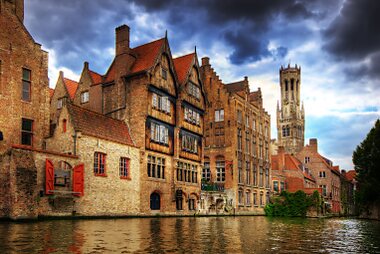
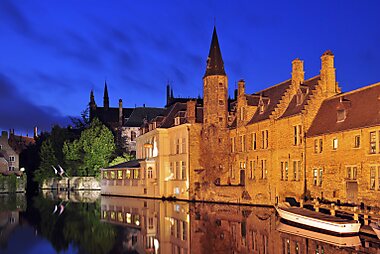
Rosary Quay is the classic canal viewpoint, where the Belfry and old guild houses line up above the water. It is one of the most photographed corners of the city, especially at sunset.
Begijnenhuis is the entrance to the city's béguinage, a walled community of whitewashed houses once home to lay religious women. Its quiet courtyard of poplar trees is a sharp contrast to the busy squares nearby.
Listes recommandées


Bruges' Sacred Sites
This collection spans the architectural evolution of Bruges, from the 12th-century Romanesque roots of the Basilica of the Holy Blood to the soaring Gothic spire of the Church of Our Lady, home to Michelangelo’s Madonna and Child. Beyond the historic center, the list includes the monumental parish church of Lissewege and serene neighborhood chapels like Stella Maris. These sites preserve significant religious relics, intricate Baroque altars, and regional heritage across the city and its surrounding polders.
20 lieux


Museums & Galleries
Bruges' cultural heritage spans from the Flemish Primitives to specialized collections. The Groeninge Museum houses masterpieces by Jan van Eyck, while the Church of Our Lady contains Michelangelo’s marble Madonna and Child. Historic sites like the 12th-century St. John’s Hospital and the Gruuthuse Museum offer insights into medieval medicine and applied arts. Unique local traditions are preserved at the Lace Center and the Friet Museum, while the Gent Gate explores the city’s medieval defensive architecture.
15 lieux
Parks and Green Spaces
Bruges' green belt follows the path of the city's second medieval defensive wall, creating a scenic promenade along the outer canals. This collection features sections of these historic ramparts, such as the Boeverievest and Katelijnevest, alongside central retreats like Koningin Astrid Park. Notable highlights include the modern 'Riders of the Apocalypse' sculptures at Hof Arents and the expansive Minnewaterpark, situated by the historic 'Lake of Love' at the city's southern edge. These spaces provide quiet walking paths and views of the city's water-bound perimeter.
8 lieux
Expériences à vivre
- Take a boat trip along the Bruges Canals, the classic way to see the city's gabled houses and bridges from the water.
- Ride in a horse-drawn carriage that departs from the Markt, a slow loop through the old town's quietest corners.
- Follow the path along the old city walls to Sint Janshuismolen, one of the working windmills still standing on the earthen ramparts.
- Walk to Lake of Love in Minnewater Park, named for a legendary girl who died there for love and was buried beneath the lake. Couples cross the bridge together for luck, and some throw a coin in her memory.
- In December and January, skate on the open-air ice rink and browse the wooden stalls of the Christmas market on the Markt.
Visites et activités
Bruges — Carte

 Ouvrir la carte interactive
 Excursions à la journée
Several easy trips fit into a single day from Bruges, from a short bike ride to villages just outside the city to Belgium's other major historic towns.
- Zeebrugge — ≈15 min by train. A working fishing port and beach town, with a large fish market and views of the North Sea ferries.
- Ostend — ≈15 min by train. Belgium's best-known seaside resort, with a long promenade, a fish auction, and fresh seafood right off the boats.
- Damme — ≈20 min by bike along the canal, or by seasonal boat. A tiny fortified town with a windmill and a market square, once Bruges' outer harbour.
- Ghent — ≈25 min by train. A larger canal city with its own medieval core, less crowded with tourists than Bruges and known for its castle and belfry.
- Ypres — ≈1.5 h by train, changing at Kortrijk. The center of the Western Front in the First World War, with the In Flanders Fields Museum and the nightly Last Post ceremony at the Menin Gate.
Où s'aventurer
Bruges sits in West Flanders, close to both the coast and quiet countryside.
On the coast, Knokke-Heist is an upscale beach resort with wide sandy beaches, and Zeebrugge is the working port town next to it.
Inland, Oostkamp is a quiet town just south of Bruges, good for a slower-paced countryside stop.
Many trips pair Bruges with Ghent or Antwerp for more canal-town atmosphere, or with Brussels for the capital's museums and grand squares.
S'y rendre
- By air: Bruges has no commercial airport of its own. Brussels Airport is the main gateway, with a direct train to Bruges station taking roughly 1.5 h. Brussels South Charleroi Airport, used by some budget airlines, is farther out; a direct coach to Bruges takes roughly 2 h.
- By train: Bruges railway station has frequent direct trains from Brussels (≈1 h) and Ghent (≈25 min), plus international Eurostar and Thalys connections that change in Brussels.
- By bus: Long-distance coaches (e.g. Flixbus) connect Bruges to other Belgian cities and some international routes, but the train is faster for nearly every trip.
Se déplacer
- On foot: the entire historic centre is walkable, and most sights are within a 15-minute walk of the Markt. This is the main way to get around.
- Bike: Bruges is flat and bike-friendly, with rental shops throughout the centre. Cycling is a practical way to reach Damme or the coast.
- Public transit: De Lijn buses cover the wider city and connect to nearby towns. Tap a contactless bank card or phone directly on the bus rather than buying a paper ticket in advance. De Lijn journey planner
- Taxi / ride-hailing: taxis wait at ranks near the station and the Markt, and can also be booked through Uber or Bolt.
Conduite
- Is a car worth it?: No. The historic centre is compact, largely pedestrianized, and easiest on foot or by bike; a car adds cost and hassle without saving time.
- Parking: Park at one of the guarded car parks on the edge of the centre (e.g. near the station) and walk or take a shuttle bus in; street parking inside the ring canal is scarce and metered.
- Restrictions: Large parts of the historic centre are closed to general traffic or access-controlled, with entry limited to residents, permit holders, and deliveries at set hours.
Gastronomie
Bruges is one of the best places in Belgium to try the national staples: mussels and fries, a waffle from a stall, and handmade chocolate from a specialist shop rather than a supermarket brand.
For something distinctive, tour Brouwerij De Halve Maan, a working brewery in the middle of the old town that still brews its own beer on site and pipes it out to a bottling plant through an underground pipeline. Otherwise, the streets around Wollestraat and the Markt cluster the best chocolate shops and frituurs — walk a few blocks and compare rather than settling for the first stall you see.
Sécurité et santé
Bruges is a very safe city for tourists. The main risk is pickpocketing in crowded spots like the Markt and on the busiest canal-side streets during peak season — keep bags zipped and in view. Cycle carefully: bikes share the road with cars on many streets, and cobblestones can be slippery when wet.
Tap water is safe to drink throughout the city.
Histoire
By the 13th century, Bruges was one of the richest cities in Europe, its wealth built on the cloth trade and a canal link to the North Sea. Merchants from across the continent settled here, and the city's guilds funded the grand buildings still standing around Market Square and Burg Square, including the Belfry, built as a symbol of that civic wealth and independence.
Basilica of the Holy Blood was built to house a relic of Christ's blood, brought back to Bruges after the Second Crusade in the 12th century. It has been venerated here ever since, and is still carried through the streets every Ascension Day.
Bruges' fortunes turned in the late 15th century, when the river connecting it to the sea silted up and larger ships could no longer reach the city. Trade shifted to Antwerp, and Bruges slipped into a long, quiet decline. That very stagnation is what saved it: with no reason to modernize, the medieval city centre survived largely untouched into the 20th century, when tourism rediscovered it.
Infos pays
Quick practical facts for Belgium at a glance:
- Devise
- euro EUR € · Paiements par carte · Largement acceptées
- Numéros d'urgence
- 112
- Électricité
- 230 V · 50 HzType C / Type E
- Langues
- néerlandais, français, allemand
- Eau du robinet
- Potable
- Sens de conduite
- À droite
- Indicatif téléphonique
- +32


Bruges – Planifie tes journées
Transforme les lieux de ce guide en un véritable itinéraire, avec des itinéraires intelligents, des estimations de temps et tout ce dont tu as besoin pour un voyage parfait.




