



Kirghizistan
Kyrgyzstan is a landlocked country in Central Asia, covered by the Tian Shan and Pamir-Alay mountain ranges. Nearly all of the land sits above 1,500 meters. Nomadic herding shaped the culture for centuries, and much of that heritage survives today in yurt camps, horse culture, and mountain pastures called jailoo.
The country suits travelers who enjoy hiking, horse trekking, and simple mountain life over polished sightseeing. Roads to remote valleys are often unpaved, and many of the best places require a homestay or a multi-day trek to reach. Kyrgyzstan sees far fewer tourists than its Central Asian neighbors, so much of it still feels unshaped by tourism.



Kirghizistan – Tu prépares un voyage ?
Crée ton itinéraire jour par jour dans l'application Tripomatic.


Argent et paiements
The currency is the Kyrgyzstani som.
ATMs are common in Bishkek and Osh but scarce in mountain villages and yurt camps. Carry cash for homestays, marshrutka rides, and rural markets. Community-based tourism stays and horse treks are usually paid in cash.
Listes recommandées

Kyrgyzstan Essentials
Kyrgyzstan's landscape is defined by the high-altitude Tian Shan range, featuring the 7,439-meter Pobeda Peak and the marble pyramid of Khan Tengri. Historical sites include the 11th-century Burana Tower and the ruins of Balasagun, key stops on the ancient Silk Road. The country's nomadic culture is preserved in yurt camps near Kochkor and the alpine valleys of Barskoon. High-altitude passes like Chyiyrchyk and climbing hubs like Ratcek Hut provide access to the rugged interior and glacial views.
10 lieuxVisites et activités
Kirghizistan — Carte

 Ouvrir la carte interactive
Pourboires
Tipping is not part of local custom but is increasingly common in Bishkek restaurants aimed at tourists. Round up the bill or leave 5-10% if service was good. Taxi drivers and homestay hosts do not expect a tip, though it is appreciated.
round up or 5–10 %
for multi-day treks and tours
Électricité
Kyrgyzstan uses Type C and F plugs at 220 V / 50 Hz — standard European-style outlets that work without an adapter for most chargers.
Langue
Kyrgyz is the state language, and Russian holds official status and is widely used in cities, business, and among older generations. Road signs, menus, and official documents often appear in both languages, sometimes only in Russian. English is limited outside hotels and tour operators in Bishkek and Karakol; a few words of Russian go a long way.
Kyrgyz and Russian both use the Cyrillic alphabet, which can make reading signs and menus difficult without preparation.
Rester connecté
Prepaid SIM cards are cheap and available at kiosks in Bishkek's Manas International Airport and in city centers; a passport is needed to register the SIM. Coverage is reliable in cities and along the Issyk-Kul shore but drops out in remote mountain valleys and at high-altitude lakes like Song-Kol Lake.
Sécurité et urgences
Kyrgyzstan is generally safe for tourists. Petty theft and scams targeting tourists are uncommon outside busy bazaars, where pickpocketing is the main risk. Political demonstrations occasionally occur in central Bishkek and are best avoided. Mountain travel carries its own risks — altitude sickness, sudden weather changes, and remote roads with little mobile coverage — so a local guide is worth it for multi-day treks.
Santé
Tap water is not safe to drink untreated; stick to bottled or filtered water, including for brushing teeth in rural areas. Pharmacies are common in Bishkek and Osh but limited in villages, so bring any regular medication. No vaccinations are mandatory for entry, but routine vaccines and hepatitis A are commonly recommended for travelers. Altitude sickness is a real risk above 3,000 meters — many trekking passes and lakes sit well above that — so plan for gradual acclimatization.
Visas et formalités d'entrée
Citizens of the EU, UK, US, and dozens of other countries can enter Kyrgyzstan visa-free for up to 30 days within any 60-day period; this allowance was cut from 60 days in 2026. Kyrgyzstan also offers an e-visa for many nationalities that do not qualify for visa-free entry. Travelers arriving overland from neighboring Central Asian countries should check border-crossing hours in advance, as some crossings close overnight.
Visa and entry requirements change frequently. Verify current requirements with the official immigration authority or your country's embassy before travel.
Savoir-vivre
Hospitality is a strong cultural value — a host will often insist on feeding a guest, even in a modest home. Remove your shoes when entering a home or a yurt. Dress modestly at mosques and cover your head if you are a woman visiting one; the Dungan Mosque in Karakol welcomes visitors outside prayer times. Ask before photographing people, especially at bazaars. Bargaining is expected at markets and with private drivers, but not in shops with posted prices.
Jours fériés et horaires
Public holidays can close banks and government offices for a day or more; shops and markets in cities usually stay open. The Nooruz spring festival in March is the most widely celebrated, with feasts, horse games, and closed offices nationwide.
Most shops in cities open daily, including Sundays; rural stores may close for a long lunch or on Sundays.
Se déplacer
- By air: Domestic flights connect Bishkek's Manas International Airport and Osh in about an hour, saving a full day of mountain driving — useful for a one-way south-to-north itinerary.
- By shared taxi and marshrutka: Shared taxis and minibuses (marshrutkas) link cities and towns and leave when full. They are the main way to reach smaller destinations without a rental car.
- By train: Kyrgyzstan has almost no passenger rail network worth using for travel between cities.
Conduite
- Mountain passes: Many high-altitude routes, including the road to Song-Kol Lake, are only open from June to September and close with the first snow.
- Road surfaces: Paved roads connect major cities, but routes to lakes, valleys, and trekking trailheads are often unpaved and require a high-clearance vehicle or 4x4.
- Fuel: Stations are sparse outside main towns; fill up before heading into the mountains. Petrol is labeled АИ-92/АИ-95 and diesel ДТ at the pump.
- Night driving: Avoid driving mountain roads after dark — livestock on the road and unmarked drop-offs are common hazards.
Gastronomie
Kyrgyz meals center on meat, dairy, and bread, reflecting the country's nomadic herding traditions. Breakfast is often bread, jam, and tea; the main meal of the day, eaten around midday or in the evening, tends to be heartier. Beshbarmak — boiled meat served over wide hand-cut noodles — is the closest thing to a national dish, traditionally eaten with the hands and shared from a communal plate. Manti (steamed dumplings), lagman (a noodle soup with meat and vegetables), and plov (rice pilaf) are common everyday dishes, all shared with other Central Asian cuisines.
Bread comes with almost every meal, and fresh tea is poured constantly, often before a guest can finish the cup. In summer, look for kymyz, fermented mare's milk with a sour, faintly alcoholic taste, sold roadside near mountain pastures. Bazaars are a good place to try snacks like samsa (baked meat pastries) and dried fruit and nuts.
Où s'aventurer
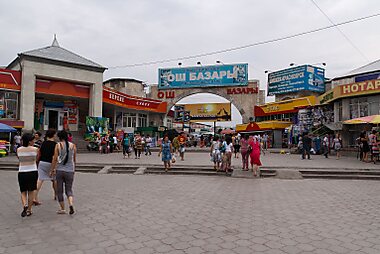
Bishkek and the Chuy Valley Kyrgyzstan's capital, Bishkek, is a green, low-rise city built around wide Soviet-era boulevards. Its main square, Ala-Too Square, anchors the city center, and the sprawling Osh Bazaar is the place to shop for local goods. An hour into the mountains south of the city, Ala-Archa National Park offers glacier views and day hikes without an overnight trip. East of Bishkek, the 11th-century Burana Tower marks the site of the ancient Silk Road city of Balasagun.
Issyk-Kul Issyk-Kul, one of the largest alpine lakes in the world, draws locals and visitors every summer, ringed by beach resorts, orchards, and mountain villages. On its northern shore, the Petroglyphs of Cholpon-Ata preserve thousands of Bronze Age rock carvings. Karakol, at the lake's eastern end, is the gateway to some of the country's best trekking and home to the wooden Dungan Mosque, built without a single nail.
Osh and the south Osh, Kyrgyzstan's second city, is older than Bishkek and was a major stop on the Silk Road. Sulaiman-Too Sacred Mountain, a UNESCO World Heritage site, rises above the city and has drawn pilgrims for over a thousand years.
Naryn and the high pastures The Naryn region holds some of the country's most remote scenery. Song-Kol Lake, a high-altitude lake surrounded by summer yurt camps, is a highlight of any horse-trekking trip. Nearby, the stone caravanserai of Tash-Rabat once sheltered Silk Road traders, and the ruined fortress of Koshoy Korgon sits further along the same valley.
Jalal-Abad The Jalal-Abad region is known for its walnut forests around Arslanbob and for two protected natural sites: Lake Sary-Chelek, a UNESCO biosphere reserve, and the Saimaluu Tash Petroglyphs, one of Central Asia's largest collections of rock art.


Kirghizistan – Ajouter à ton voyage
Crée un itinéraire de voyage détaillé avec des itinéraires intelligents, des estimations de temps et tout ce dont tu as besoin pour un voyage parfait.


Destinations associées
Data: © OpenStreetMap contributors, Wikidata, Wikipedia, Tripomatic, Official websites, geoBoundaries (CC BY 4.0). Tours by GetYourGuide. We earn commission from bookings. Travel guide generated with AI.