


Rügen
Rügen is a large island in the Baltic Sea, off the coast of Mecklenburg-Western Pomerania. It has white chalk cliffs, old beech forests, long sandy beaches and traditional seaside resorts.
The island suits a stay of three to five nights. Most visitors split their time between the cliff coast in the north-east, the resorts on the east coast and the quiet villages in between. Caspar David Friedrich painted the chalk cliffs here.

Rügen – Tu prépares un voyage ?
Crée ton itinéraire jour par jour dans l'application Tripomatic.


Quand partir
June to August is the main season, with the warmest weather and sea. Spring and autumn are quieter and good for walking in the forests and along the cliffs.
The Baltic stays cool for most of the year, so swimming is a summer activity. Winter is cold, grey and quiet.
Meilleure période pour visiter: juillet, août
Sites incontournables

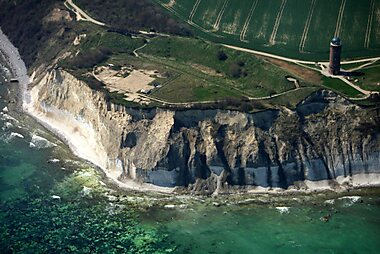
- Königsstuhl is a famous chalk cliff. It rises more than 100 m above the sea, and the National Park Centre is close by.
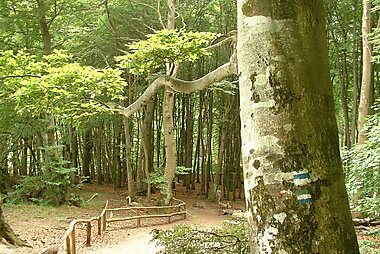
- Nationalparks Jasmund protects the cliff coast and its beech forest. The forest is part of a UNESCO World Heritage listing.
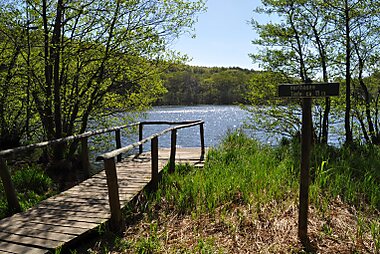
- Herthasee is a small lake in the beech forest near the cliffs. It is a quiet stop on a walk.
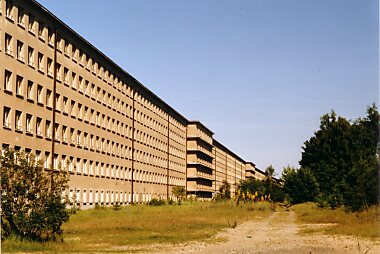
- Prora is a huge unfinished holiday complex on the beach. A documentation centre explains the site.
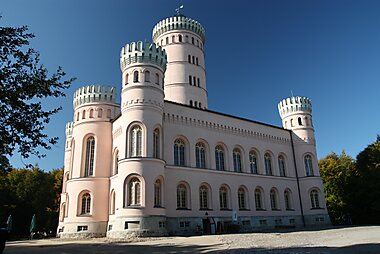
- Jagdschloss Granitz is a hunting lodge in the forest, built from 1838 to 1846 for a prince of Putbus. A central tower has a viewing platform, and on clear days you can see Usedom.
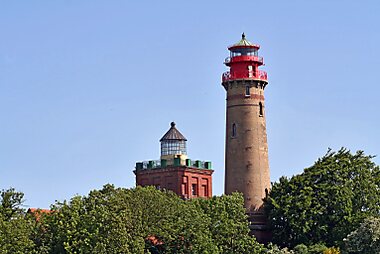
- Leuchtfeuer Arkona stands on Kap Arkona, the north tip of the island. The Schinkel tower and a navigation tower stand next to it, and all three towers have viewing platforms.
- Jaromarsburg is the site of a Slavic fortress and temple on Kap Arkona.
- Putbus is a planned town with a large park. The Rasender Roland stops here.
Listes recommandées


Castles, Ruins & Megaliths
Rügen’s historical landscape features diverse structures ranging from Neolithic megalithic tombs to 19th-century manor houses. This collection includes the Slavic Jaromarsburg earthworks at Cape Arkona and the monumental Nazi-era Prora complex. Explorers can find various Funnelbeaker culture dolmens near Lancken-Granitz and Burtevitz, the ruins of the once-grand Schloss Dwasieden, and the 19th-century Granitz Hunting Lodge. These sites trace the island's evolution from ancient spiritual centers to modern architectural relics.
20 lieux


Coastal Viewpoints and Lighthouses
Explore Rügen’s maritime history and coastal geography through its collection of elevated landmarks. This selection features the historic brick lighthouses of Cape Arkona, including the Schinkelturm designed by Karl Friedrich Schinkel, and the unique thin-shell concrete architecture of the Müther-Turm in Binz. From the chalk cliffs of Jasmund National Park at Victoria-Sicht to the pilot tower in Thiessow, these structures provide vantage points over the Baltic Sea, the Greifswalder Bodden, and the island's diverse shoreline.
9 lieux
Marinas and Piers
Rügen’s coastline is defined by its diverse maritime infrastructure, from the historic 370-meter Seebrücke Binz to the industrial heritage of Sassnitz’s harbor, which features Europe’s longest breakwater. This collection includes specialized marinas like the floating houses of Gustow, the historic fishing village of Vitt near Cape Arkona, and museum ships like the HMS Otus. These sites serve as essential hubs for Baltic sailing, ferry connections to Hiddensee, and coastal excursions across the island's lagoons and bays.
19 lieuxExpériences à vivre
- Walk the cliff-top trail through the Jasmund beech forest. It runs between Sassnitz and the Königsstuhl.
- Ride the Rasender Roland steam train for the journey itself.
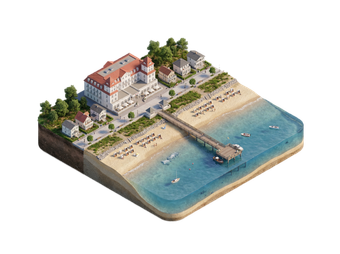
- Spend a beach day at Binz, Sellin or Göhren. The beaches are sandy.
Visites et activités
Rügen — Carte

Excursions à la journée
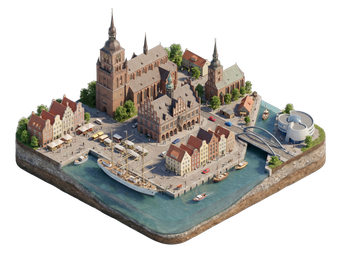
- Stralsund lies on the mainland, across the Strelasund. Its old town has Brick Gothic churches and a harbour. The Ozeaneum is an aquarium.
- Greifswald is a university town with a Baltic harbour. Caspar David Friedrich was born here.
Où s'aventurer
S'y rendre
- By train: Intercity trains run from Berlin and Hamburg via Stralsund to Bergen auf Rügen and Binz. Regional trains also run from Stralsund to Sassnitz. See Deutsche Bahn for tickets.
- By road: The Rügen Bridge crosses the Strelasund from Stralsund. A ferry also runs between Stahlbrode and Glewitz.
- By air: Hamburg and Berlin are the usual airports. Continue by train.
Se déplacer
- Rasender Roland: This steam narrow-gauge railway links Lauterbach, Putbus, Binz, Sellin and Göhren.
- Trains: Regional trains link Stralsund, Bergen, Sassnitz and Binz.
- Buses: VVR runs the regional buses on the island and has timetables and ticket information.
- Kap Arkona: The cape is car-free. Park in Putgarten and walk about 1.8 km, or take the road train or a bicycle. Boats also run from Binz and Sassnitz.
Conduite
- Is a car worth it? Trains and buses reach the main resorts. A car helps for villages in the north and east of the island.
Gastronomie
Fish is the main local food. Look for herring and Fischbrötchen (fish rolls) at harbour stalls. Sea buckthorn (Sanddorn) products are a regional speciality.
For eating out, go to the harbours in Sassnitz and Lauterbach and to the promenades in Binz.
Sécurité et santé
- Chalk cliffs erode and fall, especially after storms and thaw. Keep to marked paths and stay away from the cliff edge and the foot of the cliffs.
- Ticks live in grass and forest. Check your skin after a hike.
Histoire
- The Rani were a West Slavic people who ruled the island. Jaromarsburg was their temple fortress. The Danish king Valdemar I destroyed it in 1168.
- Sweden ruled the island from 1648 to 1815. Prussia took it over in 1815.
- Seaside tourism began in the early 19th century. Putbus had a bathing resort from 1816, Sassnitz followed in the 1860s and Binz in the 1880s.
- Nazi Germany built Prora from 1936 to 1939 as a mass holiday resort. It was never used for that purpose. Today it holds a youth hostel, hotels and apartments.
- The island was part of East Germany from 1949 to 1990.
Infos pays
Quick practical facts for Germany at a glance:
- Devise
- euro EUR € · Paiements par carte · Couramment acceptées
- Numéros d'urgence
- 112 Ambulance · Pompiers
- Électricité
- 230 V · 50 HzType C / Type F
- Langues
- allemand
- Eau du robinet
- Potable
- Sens de conduite
- À droite
- Indicatif téléphonique
- +49


Rügen – Planifie tes journées
Transforme les lieux de ce guide en un véritable itinéraire, avec des itinéraires intelligents, des estimations de temps et tout ce dont tu as besoin pour un voyage parfait.


Destinations associées
Data: © OpenStreetMap contributors, Wikidata, Wikipedia, Tripomatic, Official websites. Tours by GetYourGuide. We earn commission from bookings. Travel guide generated with AI.
Planifie ton voyage avec Tripomatic
- Planification avec l'IAObtiens une journée prête à l'emploi en un geste, laisse l'IA répartir ta liste de souhaits sur ton voyage ou planifie tout en discutant.
- Alertes de voyageAvis officiels, météo extrême, grèves et risques naturels pour les lieux de chaque jour de ton voyage.
- Jours fériés et événementsConsulte les jours fériés, festivals et fermetures durant ton voyage, ainsi que leur impact sur tes projets.
- Estimation des coûtsDétails des coûts de voyage générés par l'IA pour savoir quel budget prévoir avant de partir.
- Visites et billetsRéserve des visites, des billets coupe-file et des activités directement dans ton planning.