



Děčín
Děčín is a riverside town in northern Bohemia, where the Elbe cuts a deep sandstone valley just before it enters Germany. A large castle stands on a rock above the river, and steep cliffs rise straight from the water on both banks. The Elbe leaves the country a few kilometres downstream, and Děčín is the main gateway to Bohemian Switzerland.
Děčín suits a short stay that mixes a castle visit with walking, cycling and climbing. You can see the castle and its gardens in the morning, then hike to a viewpoint or ride the Elbe cycle route in the afternoon. The town has two historic halves: the castle side on the right bank and the Podmokly side, with the main station, on the left bank.

Děčín – Stai pianificando un viaggio?
Costruisci il tuo itinerario giorno per giorno nell'app Tripomatic.


Quando andare
Late spring to early autumn is the best time for hiking, cycling and river views. Summers are warm but rarely very hot. Winters are cold and grey, and many outdoor sights are quieter or close earlier.
The biggest annual event is the town festival, Městské slavnosti Děčín, from mid-May to mid-June. It includes a historical May market, concerts and a fireworks show. In spring, the castle also hosts the Děčínská kotva floristry competition, when the halls fill with flower displays.
Periodo migliore per la visita: giugno, agosto, settembre
Attrazioni principali



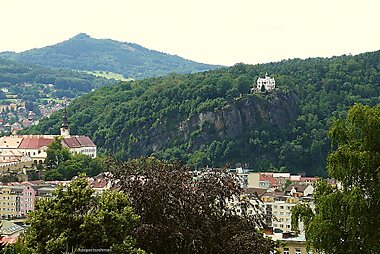
Děčín Castle stands on a rock above the meeting of the Elbe and the Ploučnice. The Thun-Hohenstein family owned it for about 300 years. You can join guided tours of the state rooms, chapel and Baroque stables. The main approach is the Long Ride (Dlouhá jízda), a straight road between high stone walls built in the 17th century.
Rose Garden (Růžová zahrada) is a terraced Baroque garden next to the castle, set on a rocky ridge with views over the town. It was later famous across the Habsburg lands for its roses, and it has a small pavilion decorated with statues.
Church of the Exaltation of the Holy Cross is a Baroque church with a large dome below the castle. A covered corridor links it to the castle, and the interior has painted ceilings.
Pastýřská stěna is a sandstone cliff that rises straight from the Elbe opposite the castle. At the top there is a lookout and a restaurant with the best view of the castle and the river bends. Marked climbing routes on the rock face are part of the Děčín via ferrata.
Děčín Zoo sits on the plateau above the cliff. It opened in 1949 and keeps animals from many parts of the world. It is a good half-day stop with children.
Oblastní muzeum Děčín tells the story of the town and the Elbe region, with exhibits on history, archaeology and river shipping. It is a good choice on a rainy day.
Děčínský Sněžník is a flat-topped sandstone hill northwest of town and the highest point of the Elbe Sandstone Mountains. A stone lookout tower from 1864 stands on the edge of the plateau. On clear days you can see far into Saxony and the Ore Mountains.
Also look for the old stone bridge over the Ploučnice near the castle. It dates from the 16th century and carries Baroque statues of three Czech patron saints.
Elenchi in evidenza

Děčín Essentials
Děčín serves as the gateway to the Bohemian Switzerland National Park, characterized by its position within the deep Elbe Canyon. This selection highlights the city's architectural centerpiece, the clifftop Děčín Castle with its Long Drive and Rose Garden, alongside natural landmarks like the Shepherd’s Wall sandstone formation. The list includes historical vantage points such as the 18th-century Belvedér terrace and the mid-19th-century stone tower atop Děčínský Sněžník, the highest peak of the Elbe Sandstone Mountains.
8 luoghiCosa provare
Many of the best moments in Děčín happen on the river and on the rocks.
- Climb the via ferrata: The cliff of Pastýřská stěna has a set of protected climbing routes of different difficulty right in town. Equipment can be rented nearby, and beginners can take a guided climb.
- Cycle the Elbe route: Ride the flat riverside path north to Hřensko or south towards Ústí nad Labem, and return by train.
- Watch the sunset over the castle: Walk up to the lookout on Pastýřská stěna in the evening. The castle and the river bends glow in the last light.
- Join the town festival: In May and June, the historical market, concerts and fireworks bring many people to the streets and the castle grounds.
Tour e attività
Děčín — Mappa

Gite in giornata
Děčín sits at the edge of two national parks and on a main rail line, so many good trips are short. They are listed from closest to farthest.
- Hřensko and the Pravčická brána: ≈15–25 min by bus 434 or car. Hřensko is the gateway to Bohemian Switzerland National Park. From the Tři prameny stop, it is about an hour's walk to the Pravčická brána, the largest natural sandstone arch in Europe. Boat rides through the Edmund Gorge (Edmundova soutěska) start near Hřensko in season.
- Bad Schandau and Saxon Switzerland: ≈15–20 min by train. This German spa town is a base for the sandstone towers and cliffs on the German side of the border.
- Ústí nad Labem: ≈20 min by train. The regional capital has Střekov Castle on a rock above the Elbe and a cable car to a hilltop viewpoint.
- Litoměřice: ≈1 hour by train. A historic town with a large main square, known for its churches and nearby vineyards.
- Dresden: ≈50 min by EuroCity train. The capital of Saxony has famous Baroque buildings, art collections and the rebuilt Frauenkirche.
Cosa esplorare
Děčín is part of a wider sandstone region that is best explored on foot.
- Bohemian Switzerland National Park: The national park begins just north and east of the town. It protects deep gorges, rock towers and forests, and is the main reason many visitors come to Děčín.
- Ústí nad Labem: The nearest large city, a short train ride up the Elbe valley.
Come arrivare
- By air: Prague Václav Havel Airport is the main gateway. Take a bus to Prague main station, then a train to Děčín, which takes about 1 h 30 min. Dresden Airport is closer but has fewer flights. From there, take the S-Bahn to Dresden main station and change to a train for Děčín.
- By train: Děčín hlavní nádraží is on the main line between Prague and Dresden. EuroCity trains reach Prague in about 1 h 30 min and Dresden in under an hour, with some trains going on to Berlin and Hamburg. Regional trains run to Ústí nad Labem and Liberec. Tickets are on České dráhy.
- By bus: There are few direct long-distance coaches, so the train is usually the better choice.
Come muoversi
- Public transport: City buses connect both banks of the river. You can pay on board by tapping a contactless bank card (Visa or Mastercard) on the orange validator, and this is cheaper than paying in cash. Timetables are on DPMD.
- Regional buses and trains: Buses to Hřensko and the national park leave from the bus station next to the main station. The one-day Labe-Elbe ticket covers buses and regional trains across the region and in nearby Saxony, including Dresden.
- On foot / cycling: The castle, gardens and old town are close together, but the main station is across the river. Allow about 15–20 minutes on foot across Tyršův most. The flat Elbe cycle route runs along the river, and bikes can be rented at the main station.
Guidare
- Is a car worth it?: Not for the town itself. A car is useful for reaching trailheads in the national park and villages with few buses, especially outside summer.
- Parking: There are paid car parks near the castle and around the main station. In summer, parking at Hřensko and other national park trailheads fills early, so arrive in the morning or take the bus.
- Border: Germany is only a few kilometres away. Czech motorways need an electronic vignette, but the local roads from Děčín to the border do not.
Cibo e bevande
Food in Děčín is mostly classic Czech cooking, such as roast pork with dumplings, goulash and fried cheese, served with local beer. Portions are large and prices are lower than in Prague.
The best area for eating out is around the castle and Masarykovo náměstí, where cafés and restaurants are close together. Across the river, the restaurant on top of Pastýřská stěna is worth a visit mainly for its terrace and view over the castle.
Sicurezza e salute
Děčín is a safe town for visitors, and violent crime against tourists is rare. Use normal care with bags at the main station and on busy buses.
The main risks are outdoors. Sandstone paths can be slippery after rain, and some viewpoints have steep drops without railings. Stay on marked trails, especially in the national park, where leaving marked paths is not allowed in many areas. Ticks are common in forests and meadows from spring to autumn, so check your skin after hiking.
Storia
A wooden fort stood on the castle rock by the 10th century to guard the Elbe crossing. It later became a stone castle and then a Renaissance chateau. In 1628 the Thun-Hohenstein family bought Děčín Castle. They built the Long Ride road, Rose Garden (Růžová zahrada) and Church of the Exaltation of the Holy Cross in the late 17th century.
The Thuns made the castle a centre of culture. In 1835 the composer Frédéric Chopin stayed there and wrote a waltz for a daughter of the family. It is still known as the Děčín Waltz.
For centuries the town was mostly German-speaking and known as Tetschen. In the 19th century the railway and river trade made Podmokly, on the other bank, an industrial town. The two towns were joined in 1942. After 1945, most of the German population was expelled. The state bought the castle in 1932 and used it as army barracks, and from 1968 to 1991 Soviet troops were based there. The town then took it over and has restored it step by step.
Informazioni sul paese
Quick practical facts for the Czech Republic at a glance:
- Valuta
- corona ceca CZK Kč · Pagamenti con carta · Comunemente accettata
- Numeri di emergenza
- 112
- Elettricità
- 230 V · 50 HzTipo C / Tipo E
- Lingue
- ceco
- Acqua del rubinetto
- Potabile
- Senso di marcia
- A destra
- Prefisso telefonico
- +420


Děčín – Pianifica le tue giornate
Trasforma i luoghi di questa guida in un vero itinerario, con percorsi intelligenti, stime dei tempi e tutto il necessario per un viaggio perfetto.




