


Interlaken
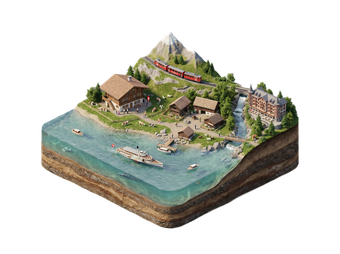
Interlaken sits on a narrow strip of land between Lake Thun and Lake Brienz. The town itself is small and quiet. Its main role is as a gateway to the Jungfrau region and the Bernese Oberland.
Most visitors stay two or three nights. They use it as a base for mountain trips, boat rides and adventure sports.

Interlaken – Stai pianificando un viaggio?
Costruisci il tuo itinerario giorno per giorno nell'app Tripomatic.


Quando andare
June to September is the best time for hiking, boat trips and clear views. July and August are busiest. Winter is good for skiing in nearby resorts, but the town itself is quiet. Spring and autumn are quieter, though some mountain lifts close for maintenance in April, May and November. Rain is frequent in late spring and summer, and clouds can hide the high peaks.
Attrazioni principali
- Harder Kulm is the viewpoint above town. A steep funicular climbs from the valley. The platform looks over both lakes and the Jungfrau peaks.
- Höhematte is a large meadow in the centre with a view of the Jungfrau. Paragliders land here.
- Schloss Interlaken is the former monastery, with a castle that now holds offices and a church.
- Schloss Unterseen is a small castle in the old part of town across the river.
- Zwei-Seen-Steg is a small viewing bridge at the top of the Harder.
- Brünig Dampfbahn BDB runs steam trains in summer.
Elenchi in evidenza

Cosa provare
- Take a lake cruise on Lake Thun or Lake Brienz.
- Ride the funicular to Harder Kulm at sunset.
- Try paragliding or canyoning. Interlaken is the main adventure-sports base in Switzerland.
- Walk or cycle along the Aare river between the lakes.
- Visit Alpenwildpark for local animals.
- Climb to the viewpoint of Heimwehfluh for another view over the town.
Tour e attività
Interlaken — Mappa

Gite in giornata
- Lauterbrunnen is a valley with many waterfalls. It is about 20 minutes away by train.
- Grindelwald is a mountain village at the foot of the Eiger. It is about 30 minutes away by train.
- Jungfraujoch is the high-altitude station on the Jungfrau massif. Trains leave from Interlaken Ost and change at Kleine Scheidegg.
- Brienz is a woodcarving village on Lake Brienz. Boats and trains both run there.
- Thun is a lake town with a castle. It is about 25 minutes away by train.
- Bern is the Swiss capital. It is about 50 minutes away by train.
Cosa esplorare
- Lauterbrunnen, Grindelwald and Brienz are villages in the same area.
Come arrivare
- By air: most visitors fly to Zurich, Geneva or Basel and take the train.
- By train: Interlaken has two stations, Interlaken West and Interlaken Ost. Trains run from Bern in about 50 minutes and from Zurich in about 2 hours. Check times on SBB.
- Interlaken Ost is the departure station for the mountain trains to Jungfraujoch.
Come muoversi
- The town is small and flat. The two stations are about 2 km apart.
- Local buses link the two stations and the main areas.
- Mountain trains and lifts are separate and priced separately. Check times and prices on the day, because the weather can change what runs.
- Boats on Lake Thun and Lake Brienz leave from two lake docks near the stations.
Guidare
- A car is not needed for Interlaken. Trains and buses reach most villages.
- Some villages in the Jungfrau region, such as Lauterbrunnen, have limited or costly parking.
- Parking in the centre is limited. Use a car park near a station.
Cibo e bevande
Try cheese fondue, raclette and rösti. Lake Brienz and Lake Thun fish such as whitefish appear on many menus. Bernese specialties such as Berner Platte are common. Restaurants are used to many international visitors, and prices are high.
Brienz is known for its woodcarvers. Local carved items are sold in shops nearby.
Sicurezza e salute
- Interlaken is very safe.
- Mountain weather changes quickly. Check the forecast and the last lift or train time.
- At high altitude, such as Jungfraujoch, some people feel dizzy or short of breath. Go slowly and drink water.
- Adventure sports operators are normally licensed. Check the operator and the conditions before you book.
- Tap water is safe to drink.
Storia
Interlaken began around an Augustinian monastery founded in the 12th century. The name means between the lakes. Tourism began in the 18th century when travelers came to see the Alps.
In the 19th century the railways opened the region to visitors. Today the town is a main centre for travelers to the Bernese Alps.
Informazioni sul paese
Quick practical facts for Switzerland at a glance:
- Valuta
- franco svizzero CHF CHF · Pagamenti con carta · Ampiamente accettata
- Numeri di emergenza
- 112
- Elettricità
- 230 V · 50 HzTipo C / Tipo J
- Lingue
- tedesco, francese, italiano, romancio
- Acqua del rubinetto
- Potabile
- Senso di marcia
- A destra
- Prefisso telefonico
- +41


Interlaken – Pianifica le tue giornate
Trasforma i luoghi di questa guida in un vero itinerario, con percorsi intelligenti, stime dei tempi e tutto il necessario per un viaggio perfetto.


Destinazioni correlate




Data: © OpenStreetMap contributors, Wikidata, Wikipedia, Tripomatic, Official websites, geoBoundaries (CC BY 4.0). Tours by GetYourGuide. We earn commission from bookings. Travel guide generated with AI.
Pianifica il tuo viaggio con Tripomatic
- Pianificazione con IAOttieni una giornata pronta in un tocco, lascia che l'IA distribuisca la tua lista dei desideri lungo il viaggio o pianifica tutto chattando.
- Avvisi di viaggioAvvisi ufficiali, maltempo, scioperi e calamità naturali per i luoghi di ogni giorno del tuo viaggio.
- Giorni festivi ed eventiScopri giorni festivi, festival e chiusure nei giorni del tuo viaggio e cosa comportano per i tuoi programmi.
- Stima dei costiDettaglio dei costi di viaggio calcolato dall'IA per sapere quanto mettere a budget prima di partire.
- Tour e bigliettiPrenota tour, biglietti prioritari e attività direttamente all'interno del tuo piano.