


Beppu
Beppu is Japan's best-known hot spring town. It sits on the east coast of Kyushu, at the west end of Beppu Bay, with hills right behind the town. Steam rises from its hot springs across the city. Beppu has more than 150 onsen facilities, grouped into eight hot spring areas called the Beppu Hatto.
The city suits a trip of two or three nights built around bathing. You can see the "hells", which are boiling ponds of blue, red and grey water. You can be buried in warm sand or soak in a historic public bath. Beppu is also a base for day trips to Yufuin and the Kunisaki Peninsula.

Beppu – A planear uma viagem?
Cria o teu itinerário dia a dia na app Tripomatic.


Quando visitar
Spring and autumn are the most pleasant seasons, and May and October are the best months. Winter is cool, which suits hot baths. Summer is hot and humid, and June and July bring heavy rain.
The main event is the Beppu Hatto Onsen Festival in early April. It runs for about 5 days, from 1 to 5 April. You can see parades and a mountain fire display. The hot water spray battle in front of Beppu Station is on the last day.
Melhor altura para visitar: maio, outubro
Principais atrações
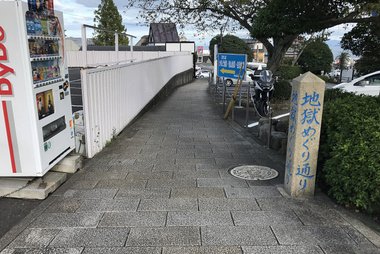
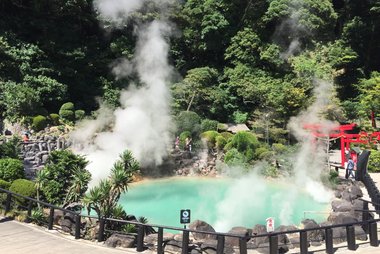
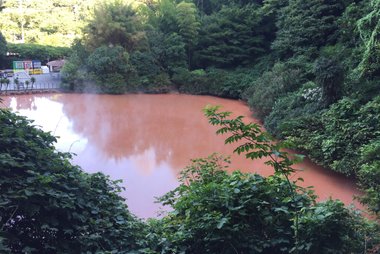
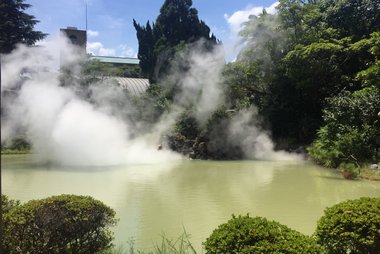
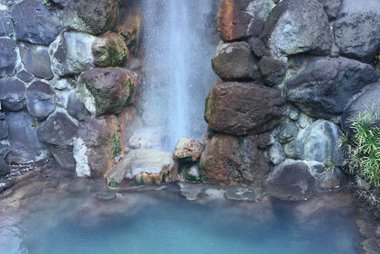

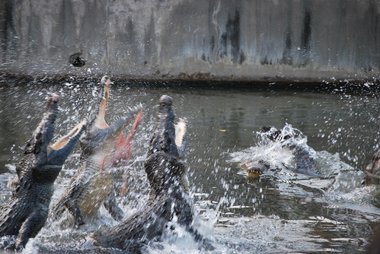
- Hells of Beppu is the main reason to come. Seven geothermal "hells" are open daily from 8:00 to 17:00. Five are in Kannawa and two are in Shibaseki. They are for viewing, not bathing.
- Umi Jigoku is the usual starting point, with cobalt-blue water at about 98 °C.
- Chinoike Jigoku has red hot mud and is called the oldest natural hell in Japan. It is in Shibaseki, about 10 minutes by bus or car from the Kannawa hells.
- Tatsumaki Jigoku is a geyser that erupts every 30 to 40 minutes. A roof over it keeps the eruption low, and you can watch from close.
- Oniyama Jigoku is known for its crocodiles, about 80 of them. It was Japan's first crocodile breeding facility, and the hot spring heat suits the animals.
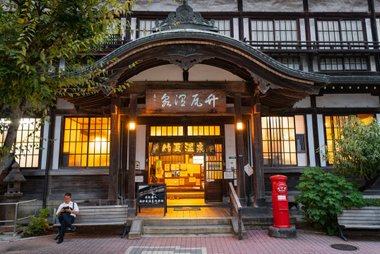
- Takegawara Onsen is a public bathhouse founded in 1879. The current wooden building dates from 1938. You can take a normal bath (about ¥300) or a sand bath (about ¥1,500). It is generally known as tattoo-friendly, but check the signs at the entrance. The bath opens at 6:30, the sand bath at 8:00, and both close at 22:30. It closes on the third Wednesday of each month.
- Shoningahama Sand Bath is a seafront sand bath beside the bay. Check opening days before you go, as it can close for bad weather.
Listas em destaque

Beppu's Geothermal Wonders & Essential Sights
Beppu is a geothermal hub centered around its eight distinct hot spring districts. The city features the 'Hells of Beppu,' a series of spectacular thermal ponds including the cobalt-blue Umi Jigoku and the iron-rich Chinoike Jigoku. Beyond the steam, the landscape is defined by historic wooden bathhouses like Takegawara Onsen and architectural landmarks such as the Naito-designed Beppu Tower. Elevated observatories across the city provide specific vantage points for viewing the rising steam plumes that characterize the skyline.
17 lugaresO que experienciar
Experiences in Beppu are mostly about bathing and steam.
- Sand bath: Staff bury you up to the neck in warm, wet sand for about 10 to 15 minutes. You wear a cotton yukata. Takegawara and the seafront sand bath both offer it.
- Ropeway to Mount Tsurumi: The Beppu Ropeway has run since 1962. The ride takes about 10 minutes to a station near 1,300 m, with views of the city and the bay.
- Onsen stamp rally: Beppu runs a stamp rally for its public baths. A visitor who collects 88 stamps earns the title "onsen meijin", or onsen expert.
Excursões e atividades
Beppu — Mapa

Passeios de um dia
Beppu has good day trips close by. They are listed from nearest to farthest.
- Takasakiyama monkey park: about 10 minutes by bus from Beppu Station or Kitahama. More than 1,000 wild Japanese macaques live on the mountain. The park is open 9:00 to 17:00, and the last entry is at 16:30.
- Kitsuki: about 25 minutes by local train. A small former castle town at the southern tip of the Kunisaki Peninsula.
- Usa Jingu: about 45 minutes by train to Usa Station, then a 7-minute bus. This is the head shrine of Japan's Hachiman shrines, about 40,000 in total.
- Yufuin: about 1 hour by direct bus. A hot spring town with Lake Kinrin, where steam rises from the water on cold mornings, and views of Mount Yufu.
- Kunisaki Peninsula: a rural area of old temples. A rental car is best, because many sights are hard to reach by public transport. A scheduled bus tour also leaves from Beppu Station.
Onde explorar
Nearby destinations in Kyushu:
- Oita Prefecture is the prefecture around Beppu. It has more hot spring towns and the Kunisaki Peninsula.
- Taketa is a castle town in the mountains of south-west Oita, with the ruins of Oka Castle.
- Fukuoka is the main gateway city, about 2 hours away by train.
- Aso is the volcano area in Kumamoto Prefecture, across the mountains to the south-west.
Como chegar
- By air: Oita Airport (OIT) has domestic flights from Tokyo Haneda, Osaka Itami and Nagoya, plus flights to Seoul and Taipei. An airport bus takes about 50 minutes to Beppu Kitahama. The airport has no train. Fukuoka Airport (FUK) is the main alternative, with onward rail from Hakata Station.
- By train: The Sonic limited express runs from Hakata Station in Fukuoka to Beppu in about 2 hours. From Tokyo or Osaka, take the Shinkansen to Kokura and change to the Sonic. Book with JR Kyushu.
- By bus: A highway bus from Fukuoka takes about 2 hours 20 minutes. Highway buses stop at Kitahama bus centre, a 5 to 10 minute walk from Beppu Station.
- By ferry: The overnight Sunflower ferry runs from Osaka to Beppu Port. It leaves in the evening and arrives the next morning. Beppu Port is about 10 minutes by bus from the station.
Como se deslocar
- Local buses: Kamenoi buses from the west exit of Beppu Station go to Kannawa, the main hells area, in about 20 minutes. Several buses leave each hour. Most buses accept IC cards such as Suica for single fares. The JR Pass is not valid on these buses.
- Bus passes: Kamenoi Bus sells a 1-day pass (about ¥1,100) and a 2-day pass (about ¥1,700) for central Beppu. The 2-day Wide Pass (¥2,800) also reaches the Yufuin area.
- Trains: JR Beppu Station is the main hub. The Nippo line also reaches Kitsuki and Usa.
- On foot: The centre around the station is flat and easy to walk. The hells and the hill onsen areas are far apart, so use the bus.
For routes and access, see the Enjoy Onsen Beppu official English site.
Conduzir
- Driving side: Japan drives on the left.
- Licence: Japan accepts only an International Driving Permit under the 1949 Geneva Convention. A permit under the 1968 Vienna Convention is not valid.
- Translation instead of a permit: Licences from Switzerland, Germany, France, Belgium, Monaco and Taiwan are valid with an official Japanese translation. JAF issues it at its branches. See JAF.
- Is a car worth it? Not for Beppu itself, where buses and trains are enough. A car helps for the Kunisaki Peninsula and for Yufuin.
Comida e bebida
Beppu has a few local dishes worth looking for:
- Jigoku-mushi: food steamed over hot spring vents, a method used in Kannawa for centuries. At Jigoku Mushi Kobo you buy food nearby, buy cooker tickets from a machine and steam it yourself. Alcohol is not allowed there.
- Toriten: bite-sized fried chicken in batter, eaten with vinegar soy sauce or mustard ponzu.
- Beppu reimen: cold noodles in broth, served with kimchi, grilled beef and egg. Look for them in the area around JR Beppu Station.
Segurança e saúde
Beppu is a safe destination for visitors. Take normal care with your belongings, as anywhere.
- Hot water: The hells are boiling and are for viewing only. Stay behind the barriers.
- Weather: June and July bring heavy rain. Typhoons can disrupt travel in late summer and autumn.
- Long hot baths: Leave the bath if you feel dizzy. Drink water afterwards.
Onsen etiquette
- Wash thoroughly at the shower stools before you enter the bath, and rinse off all soap.
- Never put your small towel in the bath water. Leave it beside the bath or fold it on your head.
- Dry off with your towel before you go back to the changing room.
- Many public baths do not admit guests with tattoos, and rules vary by bath. Ask at the entrance before you pay. Takegawara is generally known as tattoo-friendly, and sand baths give every guest a yukata.
História
Beppu's hot springs are very old. In the Kamakura period, wounded samurai used them to recover.
Hot spring tourism began in earnest in 1879 with the opening of Takegawara Onsen. Beppu became a city in 1924. The seven hells of Hells of Beppu are now nationally designated as a place of scenic beauty. Beppu Tower opened in 1957 and the ropeway to Mount Tsurumi in 1962, as tourism grew.
Factos sobre o país
Here are the essentials for traveling in Japan:
- Moeda
- Iene japonês JPY ¥ · Pagamentos com cartão · Geralmente aceite
- Eletricidade
- 100 VTipo A / Tipo B
- Idiomas
- japonês
- Água da torneira
- Própria para beber
- Sentido de condução
- Esquerda
- Indicativo telefónico
- +81


Beppu – Planeia os teus dias
Transforma os lugares deste guia num verdadeiro itinerário, com rotas inteligentes, estimativas de tempo e tudo o que precisas para uma viagem perfeita.


Destinos relacionados
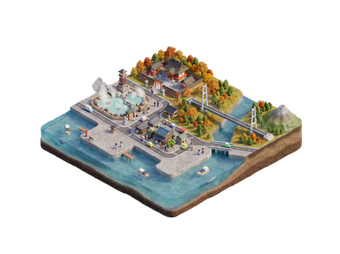

Data: © OpenStreetMap contributors, Wikidata, Wikipedia, Tripomatic, Official websites, geoBoundaries (CC BY 4.0). Tours by GetYourGuide. We earn commission from bookings. Travel guide generated with AI.
Planeia a tua viagem com o Tripomatic
- Planeamento com IAObtém um dia pronto com um toque, deixa a IA distribuir a tua lista de desejos pela tua viagem ou planeia tudo através do chat.
- Alertas de viagemAvisos oficiais, condições meteorológicas adversas, greves e perigos naturais para os lugares em cada dia da tua viagem.
- Feriados e eventosVê feriados, festivais e encerramentos nos dias da tua viagem e o impacto que têm nos teus planos.
- Estimativa de custosDiscriminação de custos de viagem com IA para saberes quanto orçamentar antes de ir.
- Excursões e bilhetesReserva excursões, bilhetes sem filas e atividades diretamente no teu plano.