



Lyon
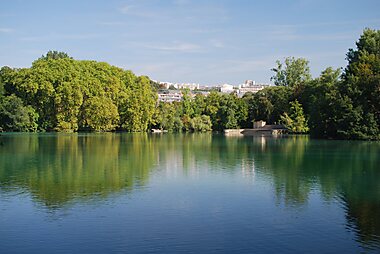
Lyon sits where the Rhône and Saône rivers meet, in the heart of eastern France. France's third-largest city grew wealthy from silk weaving in the Renaissance. It is now widely regarded as the country's food capital, with restaurants that draw visitors from across France.
The city suits a traveler who wants a full historic centre and serious food, without the scale of Paris. Two or three days cover it well. Antoine de Saint-Exupéry, author of The Little Prince, was born here. So were the Lumière brothers, inventors of cinema.

Lyon – A planear uma viagem?
Cria o teu itinerário dia a dia na app Tripomatic.


Quando visitar
Spring and autumn are mild and pleasant for walking. Summer turns warm and can get humid. Winter is cold and often grey.
Time a visit for the Fête des Lumières in early December. Buildings across the city are lit with large-scale light installations, one of France's biggest festivals and a tradition of its own.
Melhor altura para visitar: maio, junho, setembro
Expect the occasional afternoon thunderstorm in high summer, and frequent morning frost from December through February.
Principais atrações
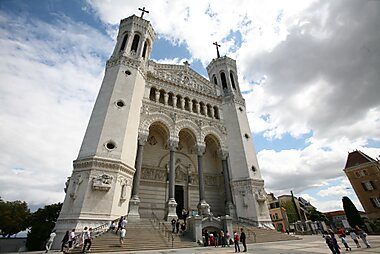

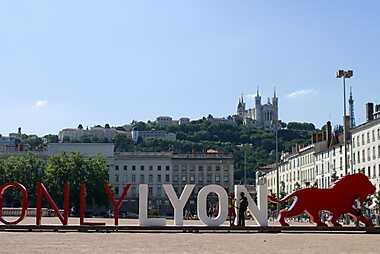
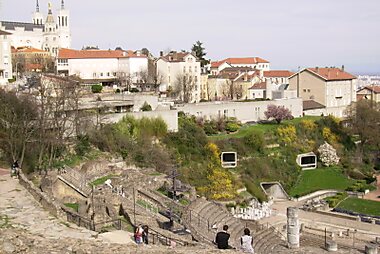
Basilique Notre-Dame de Fourvière crowns Fourvière hill above the old town. It is a 19th-century basilica with an ornate interior; the terrace outside gives views over the whole city.
Below the hill, Site historique de Lyon is one of Europe's largest Renaissance quarters still standing. Its narrow lanes are lined with pastel townhouses built by silk merchants.
Duck through Traboules du Vieux Lyon, hidden covered passageways in the old town. Silk weavers once used them to move goods between streets without exposure to the weather, and dozens still connect the courtyards today.
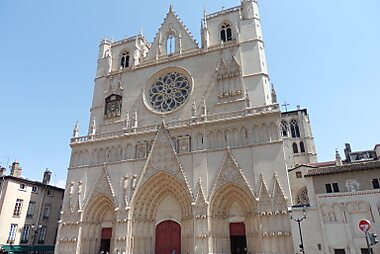
Cathédrale Saint-Jean took three centuries to build and mixes Romanesque and Gothic styles. Its 14th-century astronomical clock still chimes several times a day.
Place Bellecour is one of Europe's largest public squares. It sits on the Presqu'île peninsula, the wide-open meeting point between the two rivers.
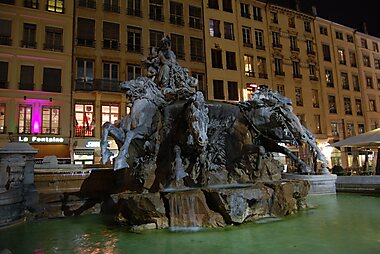
Place des Terreaux centres on a grand 19th-century fountain by Frédéric Bartholdi, the sculptor behind the Statue of Liberty. The city's ornate town hall frames the square.
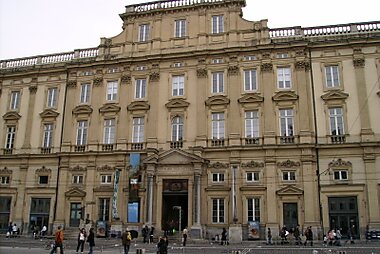
Musée des Beaux-Arts de Lyon is one of France's largest art museums, set inside a former abbey. Its collection spans ancient artefacts to Impressionist paintings.
Musée des Confluences is a striking modern science and anthropology museum shaped like a glass and steel cloud. It sits at the point where the Rhône and Saône rivers actually meet.
Institut Lumière preserves the family home and first film studio of the Lumière brothers, inventors of the cinématographe. Screening rooms and early film equipment are on display.
Listas em destaque


O que experienciar
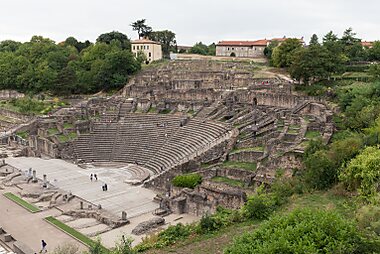
- Catch a summer concert or play at Théâtre Gallo-Romain de Fourvière, the open-air Roman theatre. It hosts the Nuits de Fourvière festival each summer.
- Watch a Guignol puppet show, Lyon's own 19th-century marionette tradition, still performed at small theatres around the city.
- Take a river cruise along the Rhône and Saône to see the Presqu'île and the Confluence district from the water.
Excursões e atividades
Lyon — Mapa

 Abrir o mapa interativo
 Passeios de um dia
Lyon makes a good base for day trips into the surrounding countryside and mountains.
- Vienne — a well-preserved Roman theatre and temple, about 20 minutes by train. Quieter than Lyon's own Roman sites.
- Pérouges — a walled medieval village about 35 minutes away by car. Cobbled lanes, stone houses, and the local galette pérougienne pastry.
- Beaujolais wine villages — rolling vineyard country about 45 minutes by car. Tastings in stone hilltop villages.
- Grenoble — gateway to the Alps, about 1h35 by train. A cable car climbs to a hilltop fort for panoramic views.
- Annecy — an alpine lake town with turquoise water, about 1h45 by train. It has a well-preserved old quarter.
Como chegar
- By air: Lyon–Saint-Exupéry Airport (LYS) is the main gateway, about 22 km southeast of the centre. The Rhônexpress tram runs directly to Part-Dieu station in around 30 minutes.
- By train: Lyon is a major TGV hub. The fastest trains reach Paris in under two hours. Direct services also run to Marseille, Geneva, and other regional cities. Trains arrive at Part-Dieu or Perrache station.
- By bus: Long-distance coaches connect Lyon to other French and European cities, arriving mainly at the Perrache bus station.
Como se deslocar
- Public transit: The TCL network covers metro, tram, bus, and two funiculars up to Fourvière hill. Tap a contactless bank card or phone directly on the validator at any stop. The network calculates the best fare and charges it automatically the next day; no ticket or app is needed. TCL journey planner
- Taxi / ride-hailing: Uber and local taxi apps operate throughout the city.
- On foot / cycling: The historic centre is compact and walkable. Vélo'v, the citywide bike-share system, has stations across the city and is a popular way to get around.
Conduzir
- Is a car worth it?: Skip it in the city. The centre is compact and walkable, with narrow one-way streets and limited parking. A car helps for reaching Beaujolais wine country or the Alps.
- Parking: Underground car parks serve the centre; on-street parking is metered and mostly paid through a phone app.
- Restrictions: Lyon has a low-emission zone covering most of the city, which excludes older, more polluting vehicles. Check your vehicle's Crit'Air sticker before driving in.
Comida e bebida
Lyon is widely regarded as France's food capital. The reputation was built by a wave of chefs, most famously Paul Bocuse, from the mid-20th century on.
Local specialties worth seeking out:
- Quenelle — a poached dumpling, often pike-based, served in crayfish sauce.
- Praline tart, with its bright pink pralines.
- Cervelle de canut, a herbed fresh-cheese spread named for the city's silk workers.
For an authentic meal, look for a bouchon, a small traditional Lyonnais tavern serving hearty, meat-heavy dishes at simple wooden tables. The streets of Site historique de Lyon hold some of the best-known ones.
For fresh produce and prepared food under one roof, browse Les Halles de Lyon Paul Bocuse. It is the city's covered food market near Part-Dieu.
Segurança e saúde
Lyon is generally safe for tourists. Pickpocketing can happen in crowded spots, such as Part-Dieu station and the Presqu'île shopping streets. It is more common during the Fête des Lumières in December. Keep bags zipped and valuables out of back pockets.
Tap water is safe to drink throughout the city.
História
Lyon began as Lugdunum, founded by the Romans in 43 BC on Fourvière hill. It grew into the capital of Roman Gaul. The Gallo-Roman museum and ruins at Lugdunum Musée et Théâtres Romains preserve remains from that era.
The city's fortunes turned again in the Renaissance, when Lyon became a centre of European silk weaving and banking. The merchant houses and hidden passageways of Site historique de Lyon date from that boom.
Silk weavers, known as canuts, revolted against falling wages in 1831. It was one of the first workers' uprisings of industrial Europe. The steep streets of La Croix-Rousse were their old district.
Basilique Notre-Dame de Fourvière was built in the late 19th century. Many residents credit it to a promise made to the Virgin Mary after the city was spared during the Franco-Prussian War.
Factos sobre o país
Quick practical facts for France at a glance:
- Moeda
- Euro EUR € · Pagamentos com cartão · Amplamente aceite
- Números de emergência
- 112
- Eletricidade
- 230 V · 50 HzTipo C / Tipo E
- Idiomas
- francês
- Água da torneira
- Própria para beber
- Sentido de condução
- Direita
- Indicativo telefónico
- +33


Lyon – Planeia os teus dias
Transforma os lugares deste guia num verdadeiro itinerário, com rotas inteligentes, estimativas de tempo e tudo o que precisas para uma viagem perfeita.

