


Pienza
Pienza is a small Renaissance town on a ridge above the Val d'Orcia in southern Tuscany. In the 1460s, Pope Pius II rebuilt his home village as a model town, and its harmonious main square is the result. The historic centre is a UNESCO World Heritage Site, and the valley below has its own UNESCO listing for its farmed landscape.
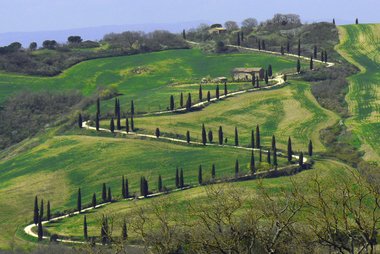
The town is tiny and easy to see in half a day, but many travellers stay longer for the countryside. From the walls you look out over rolling wheat fields, cypress-lined roads and farmhouses to the cone of Monte Amiata. Pienza is also famous for its pecorino sheep's cheese. It suits slow travellers, photographers and anyone exploring the Val d'Orcia by car.

Pienza – A planear uma viagem?
Cria o teu itinerário dia a dia na app Tripomatic.


Quando visitar
May, June, September and October are the best months, with mild days and green or golden hills. July and August are hot, and tour groups crowd the small centre in the middle of the day, so arrive early or stay overnight. Winter is cold and quiet.
The biggest annual event is the Fiera del Cacio, a cheese fair that runs for about a week at the start of September. Stalls sell local pecorino. On the first Sunday, teams from the town's districts compete in the Gioco del Cacio al Fuso on the main square, rolling whole cheeses towards a wooden spindle.
Melhor altura para visitar: maio, junho, setembro, outubro
Principais atrações
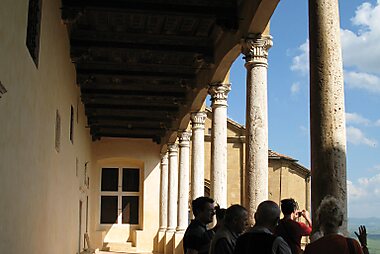
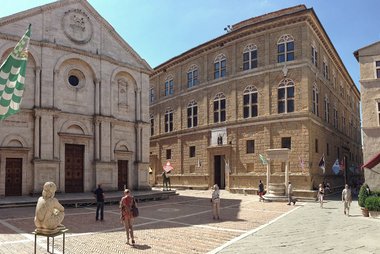
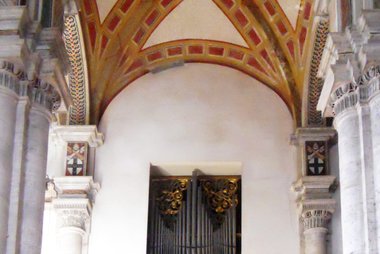
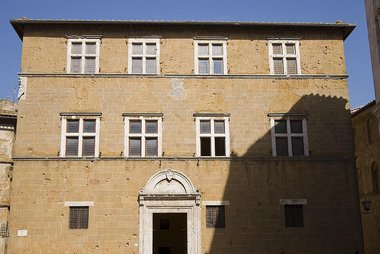
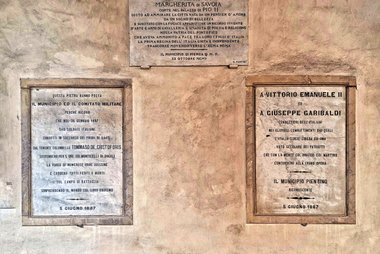
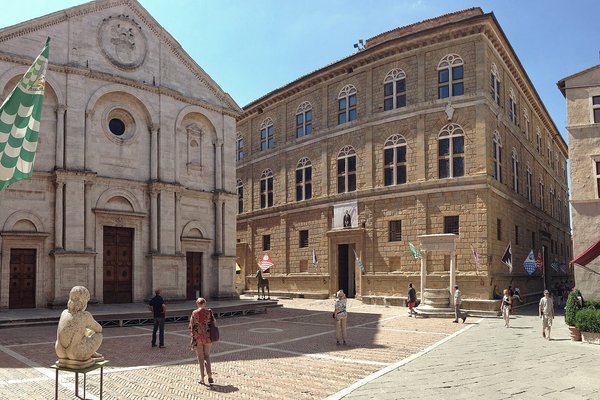
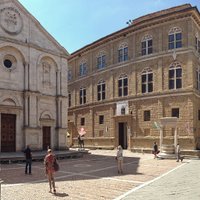
Piazza Pio Secondo is the heart of the Renaissance town. The architect Bernardo Rossellino designed it for Pius II, with the cathedral, the papal palace, the bishop's palace and the town hall arranged around one small space.
Palazzo Piccolomini was the pope's own residence. You can visit the furnished rooms, but the highlight is the loggia and hanging garden at the back, with wide views over the Val d'Orcia.
Cattedrale dell'Assunta has a pale travertine facade and an unusually bright interior, as the pope wanted large windows. Its side chapels hold altarpieces by Sienese painters of the 15th century.
Palazzo Borgia Museo Diocesano is the former bishop's palace on the square. The museum inside shows Sienese paintings, Flemish tapestries and a rare medieval English embroidered cope. A combined ticket with the papal palace is available.
Palazzo Comunale faces the cathedral across the square. The Renaissance town hall has an open loggia with three arches and a brick bell tower.
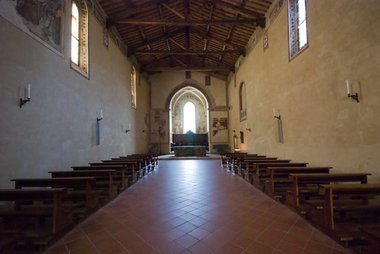
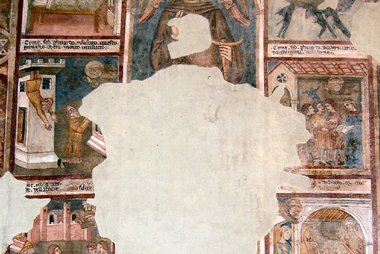
Chiesa di San Francesco is a plain Gothic church on the main street with 14th-century frescoes inside.
Pieve di Corsignano stands in the fields about a 10-minute walk below the town. This Romanesque church with a round bell tower is where Pius II was baptised.
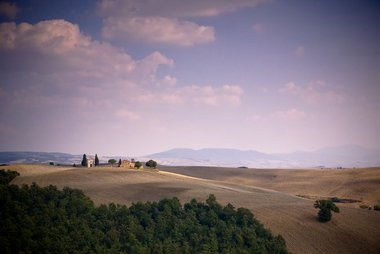
Cappella della Madonna di Vitaleta is a small stone chapel alone in the fields towards San Quirico d'Orcia, framed by cypress trees. View it from the path.
Listas em destaque

Historic Churches & Religious Sites
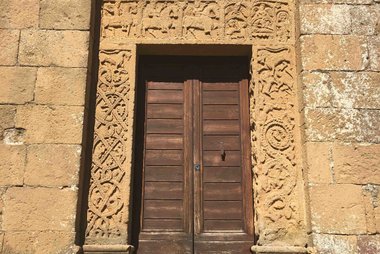
This collection highlights the architectural evolution of religious sites in the Val d'Orcia, ranging from the 7th-century Romanesque foundations of the Pieve di Corsignano to the 15th-century Renaissance design of Pienza Cathedral. The list includes the Gothic Church of San Francesco and the Pieve dei Santi Leonardo e Cristoforo in Monticchiello, notable for its Sienese school frescoes. Also featured is the Cappella della Madonna di Vitaleta, a 19th-century rural chapel that serves as a landmark of the Tuscan countryside.
5 lugares
O que experienciar
The best moments here come from the views, the countryside and the town's traditions.
- Walk the walls at sunset: follow the path along the southern walls behind the cathedral as the evening light turns the Val d'Orcia gold.
- Watch the cheese rolling: on the first Sunday of September, see the district teams roll pecorino wheels at the Gioco del Cacio al Fuso on Piazza Pio Secondo.
- See the Teatro Povero of Monticchiello: every summer, the villagers of Monticchiello write and perform their own play about their lives, staged in the village square.
- Walk or cycle to the Vitaleta chapel: take the gravel roads through the fields to Cappella della Madonna di Vitaleta, ideally early in the morning when the light is soft.
- Find the Gladiator field: scenes of the film Gladiator were shot in the fields around Pienza, and fans still come to see the wheat fields below the town.
Excursões e atividades
Pienza — Mapa

Passeios de um dia
Pienza sits in the middle of the Val d'Orcia, so several famous towns are less than half an hour away. Buses between them are infrequent, so a car gives the most freedom.
- San Quirico d'Orcia — ≈15 min by car. A quiet walled town with a Romanesque church and the formal Horti Leonini gardens.
- Monticchiello — ≈15–20 min by car. A tiny walled village of the Pienza municipality, with a Gothic church and its own summer theatre.
- Bagno Vignoni — ≈20 min by car. A small spa village whose main square is a large pool of steaming thermal water.
- Montepulciano — ≈20 min by car. A hilltop wine town with a long main street of palaces and the domed church of San Biagio below the walls.
- Montalcino — ≈30 min by car. The home of Brunello wine, with a fortress at the top of the town. The Romanesque Abbey of Sant'Antimo is a short drive further south.
- Siena — ≈1 hour by car. The great Gothic city of the Campo square and the striped Duomo.
Onde explorar
Pienza combines well with other classic stops in southern and central Tuscany.
- Nearby hill towns: Montepulciano, Montalcino and Cortona.
- Cities: Siena and Florence.
- Further afield: San Gimignano and Volterra.
Como chegar
Pienza has no railway station, and public transport is limited. Most visitors arrive by car.
- By air: Perugia Airport (PEG) is the closest, about 1 hour 15 minutes by car. Florence Airport (FLR) is about 1.5 hours by car, and Rome Fiumicino (FCO) about 2 hours 20 minutes. Rent a car at the airport.
- By train: the nearest main-line station is Chiusi-Chianciano Terme, on the line between Florence and Rome, about 40 minutes away by car. Continue by taxi or rental car, as bus links from the station are few. Trenitalia
- By bus: Autolinee Toscane buses link Pienza with Montepulciano and San Quirico d'Orcia. From Siena you need to change buses, and the trip takes about 2 hours. Services are infrequent, especially on Sundays, so check times before you travel. Autolinee Toscane
- By car: from the A1 motorway, leave at Chiusi-Chianciano Terme and drive through Montepulciano. From Siena, take the Via Cassia south to San Quirico d'Orcia, then turn east to Pienza.
Como se deslocar
- On foot: the old town is small and mostly flat, about 500 m from end to end. The main sights are all within a few minutes of the main square.
- Buses: Autolinee Toscane buses stop just outside the old town. Pay by contactless card or phone on board ("tip tap"), or buy a ticket in the Autolinee Toscane app or at a tobacconist. Autolinee Toscane
- Cycling: the gravel country roads around Pienza are popular with cyclists, but the hills are long and steep. E-bikes are a good choice for most visitors.
Conduzir
- Is a car worth it? Yes. A car is the easiest way to reach Pienza and to explore the Val d'Orcia. You will not need it in the old town.
- Restrictions: the historic centre is a limited traffic zone (ZTL), closed to cars around the clock. Do not drive through the gates. If you sleep in the old town, ask your hotel about a permit.
- Parking: use the paid car parks just outside the old town and pay at the machines. They fill quickly on summer weekends and during the cheese fair week, so arrive early.
Comida e bebida
Pienza is famous for pecorino, a cheese made from sheep's milk on the farms around the town. You can try it fresh and soft, aged and hard, or matured in ash, hay or walnut leaves. Local menus also feature thick hand-rolled pici pasta, ribollita bread soup in winter and Chianina beef. The local red is Orcia DOC, and Brunello and Vino Nobile come from the neighbouring towns.
The best place to taste is Corso Rossellino, the main street, which is lined with cheese shops and delis that offer samples. For a meal with a view, look for restaurants along the walls on the southern side of town. Many farms in the valley sell cheese directly and serve long lunches.
Segurança e saúde
Pienza is very safe, and serious crime is rare. The only common nuisance is crowding in the narrow streets at midday in summer, so keep an eye on bags and phones.
Summer days are hot, and there is little shade on country walks, so carry water and a hat. Country roads are narrow and winding, and gravel roads can be dusty or muddy. If you taste wine on a farm visit, do not drive afterwards, as Italian drink-driving limits are strict.
História
The town was once a village called Corsignano. Enea Silvio Piccolomini was born here in 1405 and became Pope Pius II in 1458. He decided to rebuild his birthplace as an ideal Renaissance town.
From 1459, the architect Bernardo Rossellino built a new centre in only a few years. Piazza Pio Secondo, Cattedrale dell'Assunta and Palazzo Piccolomini date from this time. The cathedral was consecrated in 1462, and the village was renamed Pienza in the pope's honour. Pius II died in 1464, and the building work stopped, so the town never grew beyond its small core.
That is why Pienza still looks much as it did in the 15th century. The historic centre became a UNESCO World Heritage Site in 1996. The 2000 film Gladiator shot its farm and wheat-field scenes in the Val d'Orcia around Pienza, in 1999.
Factos sobre o país
Quick practical facts for Italy at a glance:
- Moeda
- Euro EUR € · Pagamentos com cartão · Amplamente aceite
- Números de emergência
- 112
- Eletricidade
- 230 V · 50 HzTipo C / Tipo F / Tipo L
- Idiomas
- italiano
- Água da torneira
- Própria para beber
- Sentido de condução
- Direita
- Indicativo telefónico
- +39


Pienza – Planeia os teus dias
Transforma os lugares deste guia num verdadeiro itinerário, com rotas inteligentes, estimativas de tempo e tudo o que precisas para uma viagem perfeita.


Destinos relacionados




Data: © OpenStreetMap contributors, Wikidata, Wikipedia, Tripomatic, Official websites, geoBoundaries (CC BY 4.0). Tours by GetYourGuide. We earn commission from bookings. Travel guide generated with AI.
Planeia a tua viagem com o Tripomatic
- Planeamento com IAObtém um dia pronto com um toque, deixa a IA distribuir a tua lista de desejos pela tua viagem ou planeia tudo através do chat.
- Alertas de viagemAvisos oficiais, condições meteorológicas adversas, greves e perigos naturais para os lugares em cada dia da tua viagem.
- Feriados e eventosVê feriados, festivais e encerramentos nos dias da tua viagem e o impacto que têm nos teus planos.
- Estimativa de custosDiscriminação de custos de viagem com IA para saberes quanto orçamentar antes de ir.
- Excursões e bilhetesReserva excursões, bilhetes sem filas e atividades diretamente no teu plano.