


Visby
Visby is the walled medieval capital of Gotland, Sweden's largest island. Cobbled lanes, half-ruined church towers, and rose-covered stone houses give the town its nickname: the city of ruins and roses. Hanseatic Town of Visby preserves one of Europe's most complete Hanseatic-era townscapes, ringed by a strikingly intact medieval wall.
The town grew wealthy from Baltic trade in the 12th to 14th centuries, then spent centuries as a quiet backwater. That slow decline is exactly what saved its old core. Today Visby balances that history with a lively summer season, when outdoor cafés fill the old squares and Medieval Week turns the streets into a costumed festival. It also makes a natural base for exploring the rest of Gotland, from sea-stack coastlines to Fårö, once home to filmmaker Ingmar Bergman.

Visby – A planear uma viagem?
Cria o teu itinerário dia a dia na app Tripomatic.


Quando visitar
Summers (June to August) are mild and the liveliest time to visit, with long daylight hours and outdoor life in full swing. Winters are cold and quiet, and many small businesses close for the season. Spring and early autumn are milder and less crowded, a good trade-off if you don't mind cooler evenings.
Plan around Medeltidsveckan (Medieval Week) in early August, when the old town fills with jousting tournaments, a medieval market, and costumed crowds. It is Visby's biggest annual event, and accommodation books up well in advance.
Melhor altura para visitar: junho, julho, agosto
July and August bring the warmest, driest weather, while autumn and winter turn wet and grey.
Principais atrações

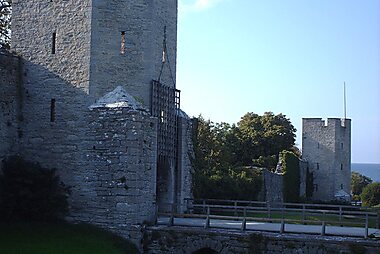


Hanseatic Town of Visby is Visby's UNESCO World Heritage core, a compact medieval town wrapped in stone walls and narrow lanes.
City Wall of Visby rings the old town for around 3.4 km, punctuated by dozens of towers. Walking a stretch of the rampart path gives the best overview of the town's layout.
Visby Cathedral is the only one of Visby's medieval churches still used for worship. Its stepped gables and tall spires dominate the skyline.
St. Katarina Ruins is one of several roofless church ruins scattered through the old town, a reminder of how many congregations Visby once supported.
Gotlands Museum traces Gotland's history from the Viking Age onward, including the Spillings Hoard, the largest Viking-era silver treasure ever found.
Visby Botanical Garden sits inside the old ramparts by the sea. Its sheltered position lets exotic plants and roses grow that would not otherwise survive this far north.
Lummelunda Cave, north of town, is one of Sweden's longest known caves, with guided tours through its dripstone chambers.
Kneippbyn is a family theme park built around Astrid Lindgren's Pippi Longstocking, whose fictional house still stands on the grounds.
Listas em destaque


O que experienciar
- Catch a concert inside the roofless walls of St. Nicolai Ruin — its ruined nave hosts an atmospheric summer concert series.
- Join the crowds for Medeltidsveckan (Medieval Week) in early August, when jousting tournaments, a medieval market, and costumed reenactors fill the old town for a week.
- Rent a bike and ride the coastal paths beyond the city wall — Gotland's flat terrain makes it one of Sweden's easiest places to explore by bicycle.
- Swim at one of the small gravel beaches tucked right against the ramparts, a rare way to cool off minutes from a medieval wall.
- If your visit falls in late June, look in on Almedalsveckan, Sweden's largest open-air political festival, when Almedalen park fills with debate tents and speeches.
Excursões e atividades
Visby — Mapa

 Abrir o mapa interativo
Passeios de um dia
Gotland rewards a day away from Visby, especially along the coast and on the island of Fårö. Rent a car or bike, since public transport beyond Visby is limited.
- Lickershamn, about 30–40 minutes north by car, has one of Gotland's best-known sea stacks (raukar), the Jungfrun rock formation, rising from the shore.
- Stora Karlsö, a nature reserve island off the west coast near Klintehamn (about 30–40 minutes by car, then a boat crossing), protects seabird colonies and rare orchids on its limestone cliffs.
- Fårö, roughly 1 to 1.5 hours away by car plus a free 6-minute ferry, is Gotland's northern island neighbor, known for dramatic rauk coastlines, sandy beaches, and its long association with film director Ingmar Bergman.
- Ljugarn, about an hour southeast, is a laid-back seaside village with its own raukar and a sandy beach, popular with Swedish summer visitors.
Como chegar
- By air: Visby Airport (VBY) is about 3.5 km from the town centre. Regular flights connect it to Stockholm's Arlanda and Bromma airports, a flight of around 45 minutes. Taxis and airport buses run into town. Visby Airport
- By ferry: Destination Gotland operates year-round car ferries to Visby from Nynäshamn (about 3 hours 15 minutes) and Oskarshamn (about 3 hours) on the Swedish mainland. This is the main way to bring a car, and summer sailings should be booked well ahead. Destination Gotland
- By train and bus: Gotland has no rail link of its own. Travelers combine a mainline train to Nynäshamn or Oskarshamn with the ferry crossing above.
Como se deslocar
- Public transit: Gotland's regional bus network connects Visby with towns across the island. Buy tickets through the operator's app or onboard. Kollektivtrafiken Gotland
- On foot: The old town is compact, largely car-free, and best explored on foot, though the cobbled lanes and rampart path have some steep, uneven stretches.
- Cycling: Gotland's flat terrain and marked routes make it one of Sweden's best cycling destinations. Bike rental shops are common in Visby, and many visitors explore the wider island by bike.
Conduzir
- Is a car worth it?: Not inside Visby itself — the old town is small, largely pedestrian, and easiest on foot. A car earns its keep once you leave town, since Gotland's beaches, rauk coastlines, and countryside churches are spread across the island with limited bus service.
- Parking: Paid parking zones sit just outside the city wall near the ferry terminal and the main gates; pay by app or meter. Free parking is easier to find a short walk from the wall.
- Restrictions: Much of the old town inside the walls is closed to general traffic, especially the narrow lanes near Stora Torget.
Comida e bebida
Gotland's kitchen leans on what the island and the Baltic Sea provide: lamb raised on the island's limestone pastures, fresh herring and other Baltic fish, and Gotland asparagus in early summer. Do not leave without trying saffranspannkaka, a golden saffron-and-rice dessert cake unique to the island, usually served with whipped cream and jam.
For a meal, head to the lanes and squares around Packhusplan and Stora Torget, where the old town's cafés and restaurants cluster. Outdoor seating fills up fast on summer evenings, so arrive early or book ahead in peak season.
Segurança e saúde
Visby and Gotland are very safe for travelers, with low rates of violent crime. The main practical risks are physical rather than criminal: the old town's cobbled lanes and steep sections near the city wall can be uneven underfoot, and summer crowds during festival weeks call for normal care with bags and wallets.
Beaches around the island are unsupervised, so swim within your ability, and pack sun protection — long Baltic summer days mean more sun exposure than the mild air temperature suggests.
História
Visby began as a Viking-age trading settlement and grew into one of the Baltic's wealthiest towns by the 13th century, a leading member of the Hanseatic League. That wealth built Visby Cathedral and more than a dozen other churches within the walls, along with the City Wall of Visby that still encircles the old town.
The town's fortunes turned in 1361, when the Danish king Valdemar Atterdag invaded Gotland and defeated a hastily assembled peasant militia just outside the walls. Visby itself surrendered rather than face destruction, but centuries of decline followed. Most of its medieval churches, including St. Katarina Ruins, were left to fall into ruin after the Reformation.
That long quiet period is why so much medieval fabric survives today. Gotlands Museum traces this history in detail, from Viking Age silver hoards to the Hanseatic boom and its abrupt end. Visby was named a UNESCO World Heritage Site in 1995, recognizing it as one of Europe's best-preserved fortified trading towns.
Factos sobre o país
Quick practical facts for Sweden at a glance:
- Moeda
- Coroa sueca SEK kr · Pagamentos com cartão · Amplamente aceite
- Números de emergência
- 112
- Eletricidade
- 230 V · 50 HzTipo C / Tipo F
- Idiomas
- sueco
- Água da torneira
- Própria para beber
- Sentido de condução
- Direita
- Indicativo telefónico
- +46


Visby – Planeia os teus dias
Transforma os lugares deste guia num verdadeiro itinerário, com rotas inteligentes, estimativas de tempo e tudo o que precisas para uma viagem perfeita.

