


Santo Domingo
Santo Domingo is the capital of the Dominican Republic and the oldest European city in the Americas that people still live in. Its small walled colonial core holds the oldest cathedral, fortress and paved street built by Europeans in the Americas. Around it spreads a large Caribbean capital: about one million people live in the city itself, and more than four million in the wider metro area.
The city suits travellers who want history and city life rather than a beach resort. Two or three days are enough for the colonial sights, a few museums and an evening of live music. Many visitors then continue to the beaches of the east coast. Expect heat, heavy traffic and loud music, and a very friendly welcome.

Santo Domingo – Planifici o călătorie?
Creează-ți itinerarul zi de zi în aplicația Tripomatic.


Când să vizitezi
The best months are December to April, when it is warm, sunnier and less humid. From May to November it is hot and humid, with frequent showers. This is also the hurricane season, from June to November.
The biggest annual event is Carnival in February. Groups in colourful costumes and masks parade on Sundays, including the devil figures called diablos cojuelos. A large national parade on the seafront follows a few weeks later.
Obiective turistice de top
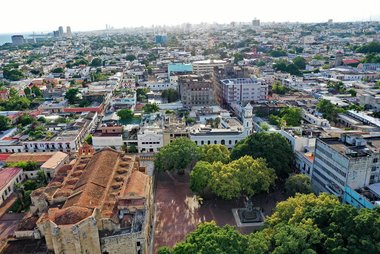





Most sights are inside Colonial City of Santo Domingo, the walled old town on the west bank of the Ozama River. It is compact, and you can walk between the main sights in 15 minutes.
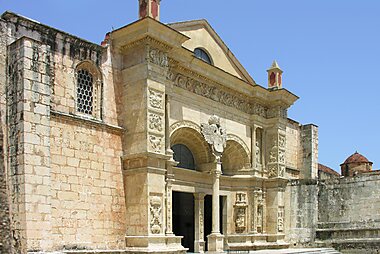
- Basilica Cathedral of Santa María la Menor is the oldest cathedral still standing in the Americas, consecrated in 1541.
- Alcázar de Colón was the palace of Diego Columbus, son of Christopher Columbus. It reopened in September 2026 after a full restoration, with new displays on colonial life and restored 16th-century tapestries.
- Fortaleza Ozama is the oldest European military building in the Americas, built from 1502. Climb its stone keep for views over the river and the old town.
- Calle de Las Damas is the first paved street of the New World. It leads past Panteón Nacional, a former Jesuit church where national heroes are buried.
- Calle El Conde is the main pedestrian street, lined with shops and cafés. At its west end, Puerta del Conde is where Dominican independence was declared in 1844.
- Ruinas de San Francisco are the roofless remains of the first monastery in the Americas, built from 1508.
- East of the river, Faro a Colón is a huge cross-shaped monument from 1992. It was built as a tomb for Christopher Columbus, although Seville Cathedral also claims his remains.
Liste recomandate


Ce merită experimentat
Some of the best things to do here are activities rather than sights:
- Sunday music in the ruins: every Sunday evening a band plays merengue, son and bachata at Ruinas de San Francisco. Local couples of all ages dance in front of the stage.
- Winter baseball: from mid-October to January, the rival teams Tigres del Licey and Leones del Escogido play at Estadio Quisqueya. The crowd sings, dances and shouts all game long.
- Changing of the guard: an honour guard stands at Panteón Nacional, and the guard changes several times a day.
- Sunset on the seafront: walk or sit along the Malecón in the evening, when families come out to enjoy the sea breeze.
- A cable car ride: the Teleférico passes over the Ozama River and the riverside neighbourhoods north of the centre. Board it at Gualey station, next to Eduardo Brito station on Metro Line 2.
Tururi și activități
Santo Domingo — Hartă

Excursii de o zi
The best day trips head east along the coast, to beaches and to the resort area around La Romana.
- Boca Chica (≈30–40 min by car) has the closest good beach to the city. A reef keeps the water calm and shallow. It gets very busy at weekends.
- Juan Dolio (≈1 h by car) is a quieter strip of beach hotels and condos, east of Boca Chica.
- La Romana (≈1.5–2 h by car or bus) is the base for Altos de Chavón, a copy of a Mediterranean stone village above the Chavón River.
- Bayahibe (≈2 h by car) is the fishing village where boats leave for Saona Island, with its white beaches and palm trees. Many tours go from Santo Domingo in one long day.
Ce poți explora
For other parts of the country:
- East coast and beaches: Boca Chica, La Romana, Bayahibe, Saona Island and Higüey, home of the country's main pilgrimage basilica.
- West of the capital: San Cristóbal and Baní.
- Inland and the north: Santiago de los Caballeros, the country's second city, La Vega and Puerto Plata on the Atlantic coast.
- Samaná Peninsula: Samaná.
Cum ajungi
- By air: Las Américas International Airport (SDQ) is east of the city, near the coast. Allow 35–50 minutes by taxi or ride-hailing car. Official airport taxis have a desk in the arrivals hall, so confirm the fare before you leave. Some visitors fly into Punta Cana (PUJ), about 2.5–3 hours away by road.
- By bus: Caribe Tours and Metro Tours run air-conditioned coaches to Santiago de los Caballeros, Puerto Plata and other cities. Expreso Bávaro runs to Bávaro and Punta Cana.
- By train: there are no passenger trains between cities.
Cum te deplasezi
- Metro and cable car: two metro lines and the Teleférico cable car serve the wider city, mainly for commuters. Buy a rechargeable card at a station ticket office and top it up there. Rides are very cheap. The metro runs from 5:30 am (Monday to Saturday) to 10:30 pm, and the cable car closes around 9 pm. Santo Domingo Metro and Teleférico
- Ride-hailing and taxis: Uber, DiDi and inDrive are widely used and are the easiest way to cross the city. Street taxis have no meters, so agree the price first. Avoid motorbike taxis (motoconchos).
- Buses: shared minibuses (guaguas) and old shared cars (carros públicos) are cheap, but crowded and hard to use for visitors.
- On foot: the old town is flat and best seen on foot. Other districts are spread out, and the traffic makes walking between them unpleasant. Cycling in traffic is not practical.
Condusul
- Is a car worth it?: not for the city itself. Traffic is heavy and driving is aggressive, and ride-hailing is cheap. A rental car makes sense only if you plan to explore the coast on your own.
- Parking: the narrow streets of the old town have very few spaces. Use a paid, guarded car park, and do not leave anything visible in the car.
- Tolls: the highways out of the city have toll booths. Cash lanes are being phased out for the Paso Rápido electronic tag, so ask your rental company whether the car has one.
Mâncare și băutură
Dominican food is filling home cooking. For breakfast, try mangú, mashed green plantain, often served with fried eggs, fried cheese and salami. At lunch, look for la bandera, the everyday plate of rice, red beans and stewed meat, often sold as a cheap set lunch. Sancocho, a rich meat and root-vegetable stew, is a weekend favourite.
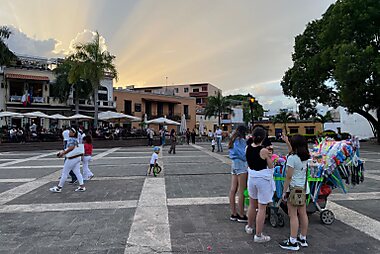
The old town has the most restaurants for visitors. The outdoor terraces on Plaza de España and the cafés along Calle El Conde are popular, especially in the evening. Local families eat at small cafeterias and street stands near the Malecón. Restaurant bills usually include a 10% service charge, and many people leave a little extra for good service.
Siguranță și sănătate
Santo Domingo is a big city with real street crime, but most visits pass without problems. The old town is busy by day and in the early evening, and tourist police patrol it.
- Bag and phone snatching: thieves on motorbikes grab phones and bags from people on the pavement. Keep your phone out of sight near the road, and carry bags on the side away from traffic.
- At night: use ride-hailing or a taxi called by your hotel instead of walking through quiet streets. Do not resist if someone robs you.
- Cards: card cloning happens. Keep your card in sight when you pay, and use ATMs inside banks or shopping centres.
- Health: dengue occurs in the country, so use mosquito repellent. The heat is strong all year, so drink plenty of water and avoid the midday sun.
Istorie
Bartholomew Columbus founded the city in the 1490s on the east bank of the Ozama River. After a hurricane in 1502, governor Nicolás de Ovando rebuilt it on the west bank, where the old town stands today. For the next decades it was the centre of Spanish power in the Americas. From here, the conquest of the other islands and the mainland began.
Many of the firsts from this time still stand. Fortaleza Ozama guarded the river mouth from 1502, and Alcázar de Colón was built for Diego Columbus, governor of the colony. Basilica Cathedral of Santa María la Menor was the first cathedral of the New World. The city soon lost its importance to Mexico and Peru, and the English privateer Francis Drake captured it and held it for ransom in 1586.
On 27 February 1844, Dominican independence was declared at Puerta del Conde. The founding fathers now rest in the nearby Altar de la Patria. From 1936 to 1961 the dictator Rafael Trujillo renamed the capital Ciudad Trujillo. The old name returned after his death. In 1990 UNESCO listed the Colonial City as a World Heritage Site.
Date despre țară
Quick practical facts for the Dominican Republic at a glance:
- Monedă
- peso dominican DOP · Plăți cu cardul · Acceptate în mod obișnuit
- Numere de urgență
- 911
- Electricitate
- 110 V · 60 HzTip A / Tip B
- Limbi vorbite
- spaniolă
- Apă de la robinet
- Nesigură de băut
- Sens de circulație
- Pe dreapta
- Prefix telefonic
- +1809


Santo Domingo – Planifică-ți zilele
Transformă locurile din acest ghid într-un itinerar real, cu trasee inteligente, estimări de timp și tot ce ai nevoie pentru o călătorie perfectă.


Destinații înrudite





Data: © OpenStreetMap contributors, Wikidata, Wikipedia, Tripomatic, Official websites. Tours by GetYourGuide. We earn commission from bookings. Travel guide generated with AI.
Planifică-ți călătoria cu Tripomatic
- Planificare susținută de AILasă inteligența artificială să-ți construiască itinerarul, să răspundă la întrebări de călătorie și să-ți organizeze documentele de rezervare în călătorie.
- Alerte de călătorieAvertizări oficiale, fenomene meteo severe, greve și pericole naturale pentru locurile din fiecare zi a călătoriei tale.
- Sărbători legale și evenimenteVezi sărbătorile, festivalurile și închiderile din zilele călătoriei tale și ce înseamnă acestea pentru planurile tale.
- Estimarea costurilorDefalcare a costurilor călătoriei susținută de AI, astfel încât să știi ce buget să aloci înainte de plecare.
- Tururi și bileteRezervă tururi, bilete cu acces prioritar și activități direct în planul tău.