


Фудзикавагутико
Fujikawaguchiko is a lakeside town on the north side of Mount Fuji, in southern Yamanashi Prefecture. The main station is about 850 m above sea level. Three of the Fuji Five Lakes are inside the town: Kawaguchi, Saiko and Shoji. Part of Lake Motosu also belongs to the town.
Most people come for the views of Mount Fuji across the water. The area also has lava caves, forest walks, small museums and hot springs. It suits a one- to three-night trip built around nature and photography. Many visitors come for one day only. Staying overnight gives you quiet mornings and a better chance of a clear mountain.

Фудзикавагутико — планируешь поездку?
Составь свой маршрут по дням в приложении Tripomatic.


Когда ехать
Spring and autumn are the best seasons. Cherry blossoms peak around mid-April, and autumn colours peak in the first half of November. Winter is cold with some snow, but the sky is often clear and Mount Fuji is easiest to see. June to August brings the most rain and cloud.
The biggest event is the Mount Fuji climbing season, from early July to about 10 September.
Главные достопримечательности
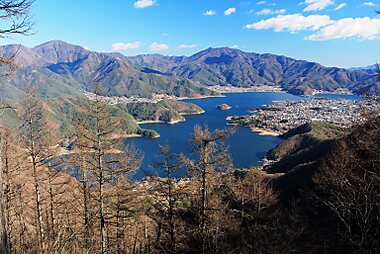
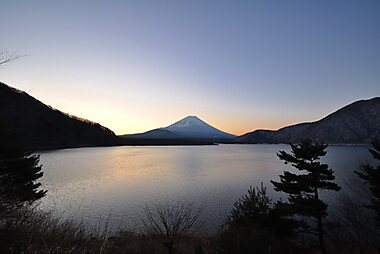
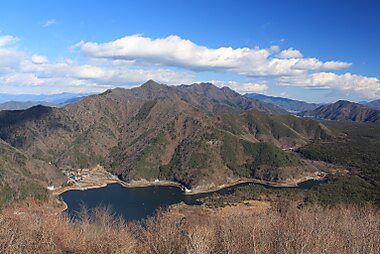
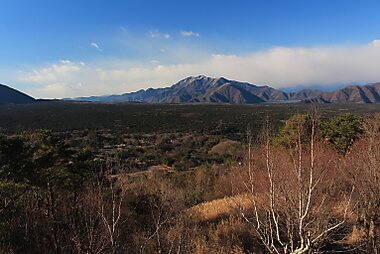
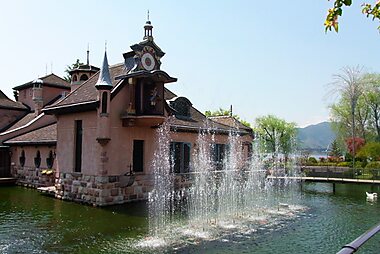

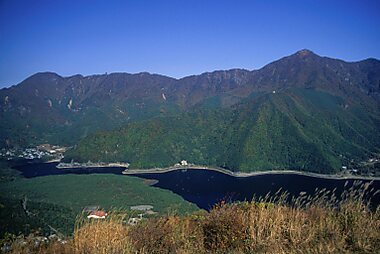
- Lake Kawaguchi is the centre of the area. Most hotels and the sightseeing boats are around it. Go early in the morning, when clouds are least likely to hide the mountain.
- Oishi Park is a free park on the north shore with seasonal flowers. It is open at all times and has views of Mount Fuji across the lake.
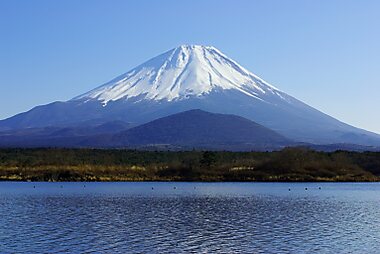
- Mount Fuji is Japan's highest mountain, at 3,776 m, and a World Heritage site since 2013. Most visitors only look at it from the lakes. Climbers start from the Yoshida Trail 5th Station.
- Mt. Kachi Kachi Ropeway climbs Mount Tenjo from the lake shore. The top station looks over the lake, the Aokigahara forest and Mount Fuji. The return fare is 1,000 yen, and it runs 8:30 to 17:00 (to 18:00 from 20 July to 31 August).
- Lake Saiko is quieter than Lake Kawaguchi. Mountains block the Fuji view from most of its shore, but the western end has a full view. A 30-minute hike leads to the Koyodai viewpoint.
- Lake Motosu is the deepest of the Five Lakes and the only one that does not freeze in winter. It is far from the station, and the bus runs only every one to two hours.
- Narusawa Ice Cave is a lava tube about 156 m long, inside the Aokigahara forest. It stays near 3 °C all year, so bring a warm layer.
- Aokigahara is a dense forest on hardened lava, with caves and marked trails near the western edge. The porous rock absorbs sound, so it is very quiet.
Что обязательно попробовать
- Climb Mount Fuji in summer. The Yoshida Trail season runs from early July to about 10 September. The hiking fee is 4,000 yen per person. Booking ahead is recommended, but you can also book on the day. The trail has a limit of 4,000 climbers a day, and hut guests are exempt. The gate is closed from 14:00 to 03:00 for everyone except hut guests. You must carry winter clothing, two-piece rain gear and suitable shoes to pass the gate. Check the official Mt. Fuji climbing site for current rules.
- Hike 30 minutes at Lake Saiko to the Koyodai viewpoint. It has an entry fee of 300 yen and is open 8:30 to 17:00.
- Take a sightseeing boat on Lake Kawaguchi.
- Soak in the Yurari hot spring at Lake Saiko. The upper-floor baths have a view of the mountain.
- Walk the maple corridor on the north shore of Lake Kawaguchi in early to mid November, when the leaves peak.
Экскурсии и активности
Фудзикавагутико — Карта

Поездки на один день
The nearest options are on the Fujikyuko Line or a short bus ride away.
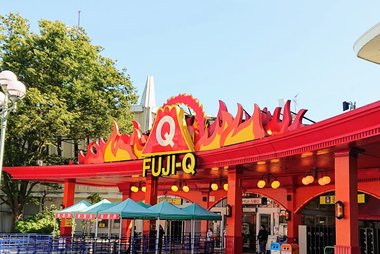
- Fuji-Q Highland is a large amusement park known for its thrill coasters. It is one stop from Kawaguchiko Station on the Fujikyuko Line.
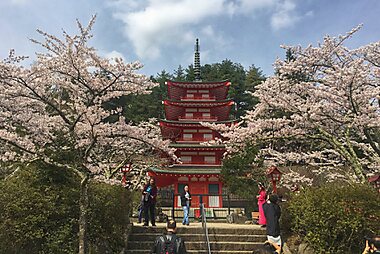
- Arakura Sengen (Chureito Pagoda) is a five-storey pagoda on a hillside with a classic Mount Fuji view. Take the Fujikyuko Line four stops to Shimoyoshida, then walk about 10 minutes. The climb is about 400 steps. Some viewpoints are fenced and photography is banned at certain spots. Go early and follow the signs.
- Lake Yamanakako is the largest and easternmost of the Five Lakes. Buses on the Kawaguchiko to Gotemba line take about 30 minutes and cost 890 yen one way. They run once or twice an hour.
- Oshino Hakkai is a group of eight clear spring ponds in Oshino village, and part of the Mount Fuji World Heritage listing. Bus lines F1 and F2 stop there.
Куда ещё съездить
- Lake Kawaguchi is the lake at the heart of the area. Hotels line its shore, and the ropeway starts beside it.
- Lake Yamanakako and Oshino village lie to the east. See the day trips above.
Как добраться
- By air: There is no airport in the area. Most visitors fly to Tokyo (Haneda or Narita) and continue to Shinjuku.
- By bus: Highway buses run from Shinjuku (Busta Shinjuku and the Keio terminal) to Kawaguchiko Station. Some services start in Shibuya, Tokyo Station or Ikebukuro. The trip takes about 2 hours, and up to 2.5 hours in heavy traffic. One-way fares are roughly 1,500 to 2,300 yen. Book online.
- By train: The Fuji Excursion limited express runs from Shinjuku in about 1 hour 50 minutes to 2 hours. It uses JR tracks to Otsuki and then the Fujikyuko Line. Local trains between Otsuki and Kawaguchiko run about every 30 minutes. The Otsuki to Kawaguchiko fare is 1,170 yen.
- From the south: Buses link Kawaguchiko with Gotemba and Mishima via Lake Yamanakako.
Транспорт
- Sightseeing buses: Three Omni bus lines leave from Kawaguchiko Station. The red line circles the east and north shores of Lake Kawaguchi every 15 minutes. The green line goes to Lake Saiko every 30 minutes. The blue line goes to Narusawa, Lake Shoji and Lake Motosu every one to two hours.
- Bus pass: The Kawaguchiko Saiko Motosuko Bus Pass costs about 1,500 yen for one day or 2,000 yen for two days. Buy it at Kawaguchiko Station or on the Omni buses. It also covers other regular buses in the area.
- Mount Fuji 5th Station: Buses take about 1 hour from Kawaguchiko Station. Check the seasonal timetable.
- Trains: The Fujikyuko Railway connects Kawaguchiko Station with Fuji-Q Highland and Shimoyoshida. Express trains need an extra 400 yen charge.
- On foot or by bike: Sights are far apart and the area is hilly. Use buses between sights and walk within each area.
Вождение автомобиля
- Driving side: Japan drives on the left.
- Licence: Japan accepts only an International Driving Permit under the 1949 Geneva Convention. A 1968 Vienna Convention permit is not valid. Drivers with licences from Switzerland, Germany, France, Belgium, Monaco and Taiwan need an official Japanese translation from JAF instead. Check JAF's current list before you travel.
- Is a car worth it? Buses cover the main Lake Kawaguchi sights. A car helps for Lake Saiko, Lake Shoji and Lake Motosu, where buses run only every one to two hours.
- Winter: Snow and ice are possible from November to April. Check that your rental car has winter tyres or chains.
Еда и напитки
Try hōtō, the local dish of Yamanashi. It is flat wheat noodles stewed with seasonal vegetables in miso soup. Many restaurants around the lakes serve it.
Restaurants cluster around Kawaguchiko Station and along the lake roads. Choose a place with hōtō on the menu rather than a tour-bus stop.
Безопасность и здоровье
- Cold and weather: The town is at about 850 m. Nights are cold from November to April, so bring warm layers even in spring.
- Mount Fuji: Climb only in the official season. The trail above the 5th Station is closed in winter, so do not plan a climb outside the season.
- Aokigahara: Stay on the marked trails. The forest is dense and the ground is rough lava.
- Photo spots: Do not block roads or enter private land for a photo. In May 2024 the town put up a large barrier behind a convenience store near the station after littering, trespassing and blocked roads.
История
Mount Fuji shaped this landscape. Lava from an eruption in 864 to 868 split one large lake into Lake Saiko, Lake Shoji and Lake Motosu. Aokigahara now grows on the hardened lava.
Fuji became a World Heritage site in 2013, listed as a cultural site. The ropeway above Lake Kawaguchi opened in 1959, and the amusement park near the station opened in 1968.
Факты о стране
Here are the essentials for traveling in Japan:
- Валюта
- японская иена JPY ¥ · Оплата картой · Широко распространены
- Электричество
- 100 ВТип A / Тип B
- Языки
- японский
- Водопроводная вода
- Безопасно пить
- Сторона движения
- Левосторонее
- Телефонный код
- +81


Фудзикавагутико — добавь в свою поездку
Создай подробный маршрут с умным расчётом пути, оценкой времени и всем необходимым для идеальной поездки.


Похожие направления
Другие направления
Data: © OpenStreetMap contributors, Wikidata, Wikipedia, Tripomatic, Official websites, geoBoundaries (CC BY 4.0). Tours by GetYourGuide. We earn commission from bookings. Travel guide generated with AI.
Спланируй поездку с Tripomatic
- Планирование с помощью ИИПолучай готовый план на день в одно касание, распределяй список желаний по всей поездке с помощью ИИ или планируй всё в формате чата.
- Оповещения для поездкиОфициальные рекомендации, штормовые предупреждения, забастовки и стихийные бедствия для мест в каждый день твоей поездки.
- Праздники и событияУзнавай о праздниках, фестивалях и нерабочих днях во время поездки и о том, как они влияют на твои планы.
- Оценка расходовРасчёт стоимости поездки на базе ИИ поможет заранее спланировать бюджет.
- Экскурсии и билетыБронируй экскурсии, билеты без очереди и активности прямо в своём плане.