


Orvieto
Orvieto sits on top of a flat cliff of volcanic rock that rises steeply above the valley. The town looks like a fortress from below, and its streets of grey-brown tuff stone have changed little since the Middle Ages. It lies in southwestern Umbria, close to the borders of Tuscany and Lazio.
The main reason to come is the cathedral, one of the great Gothic churches of Italy. But the town also has a second world below its streets: Etruscan wells, tunnels and caves cut into the soft rock. Orvieto is an easy day trip from Rome by train, yet it rewards a night or two, when the day visitors leave and the town grows quiet. It suits travellers who like art, history, wine and slow walks.

Orvieto – Planerar du en resa?
Bygg din resplan dag för dag i Tripomatic-appen.


När du ska besöka
Late spring and early autumn are the best times, with warm days and green or golden hills. July and August are hot, with days often above 30 °C. Winter is cool and damp, with occasional light snow, but the town is quiet and hotel prices drop.
The biggest annual event is Corpus Domini, in late May or June. A historic procession of more than 400 people in medieval costume walks through the streets with the town's most sacred relic. It is worth planning a trip around it, but book a room early.
Bästa tiden att besöka: maj, juni, september, oktober
Främsta sevärdheter
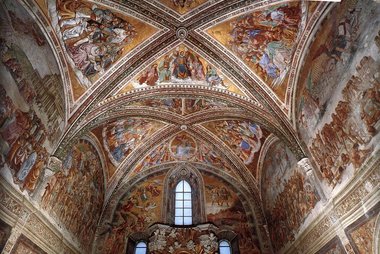



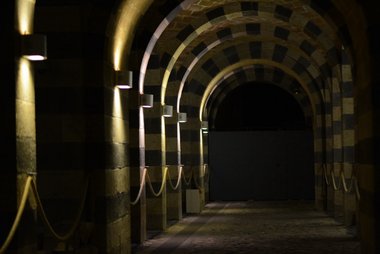


Orvieto Cathedral is the town's great landmark, built from 1290 onward. Its facade shines with gold mosaics and carved marble reliefs, and the inside is striped in black and white stone.
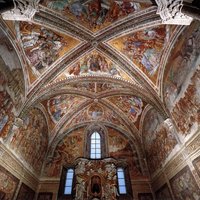
Inside the cathedral, Cappella di San Brizio holds Luca Signorelli's frescoes of the end of the world and the Last Judgment, painted around 1500. Many visitors come to Orvieto for these frescoes alone.
Pozzo di San Patrizio is a deep well built for Pope Clement VII after the sack of Rome in 1527. Two separate spiral staircases wind around the shaft, so people going down never meet people coming up.
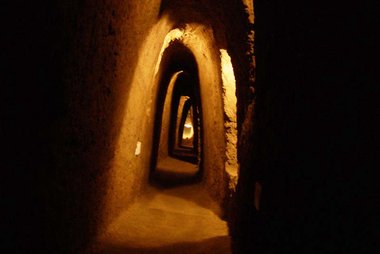
Grotte della Rupe are visited on a guided tour of the man-made caves below the town. You see Etruscan tunnels and cisterns, old wine cellars and medieval pigeon houses cut into the rock.
Pozzo della Cava is a smaller, privately run cave complex in the western part of town, with a deep well of Etruscan origin and a series of connected caves.
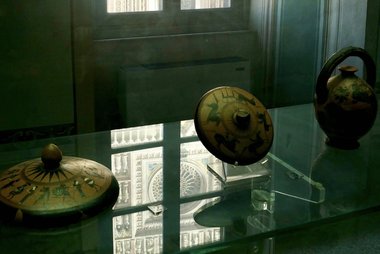
Museo Claudio Faina, opposite the cathedral, has a rich collection of Etruscan vases, bronzes and coins. Museo Opera del Duomo - Palazzi Papali shows the cathedral's own treasures in the medieval papal palaces next door.
Torre del Moro stands at the main crossroads of the old town. Climb it for a wide view over the rooftops and the surrounding valley.
Necropoli del Crocifisso del Tufo lies at the foot of the cliff. Its Etruscan stone tombs are laid out in neat streets, like a small town of the dead.
Utvalda listor


Upplevelser att prova
Some of the best moments in Orvieto are tied to a time of day or a time of year.
- Watch the cathedral facade at sunset: late in the day the gold mosaics catch the low sun and glow. Find a seat on the steps of the square and wait for it.
- Walk the Anello della Rupe: a footpath that circles the base of the cliff. It passes Etruscan tombs, old gates and caves, and gives the best views of the town from below.
- See the Palombella at Pentecost: a small model dove slides down a wire across the cathedral square and sets off fireworks at the end. It is an old local tradition with a crowd to match.
- Hear Umbria Jazz Winter: every year around New Year, the town hosts a jazz festival. Concerts fill the theatre, churches and palaces, and there is often a jazz mass in the cathedral.
- Visit the living nativity scene underground: over the Christmas holidays, a cave at Pozzo della Cava hosts a nativity scene with mechanically animated figures.
Turer och aktiviteter
Orvieto – Karta

Dagsutflykter
Orvieto sits where Umbria, Tuscany and Lazio meet, so there is a lot within easy reach. A car is the easiest way to do most of these trips.
- Lake Bolsena (about 30 min by car): a large volcanic lake with beaches and the lakeside town of Bolsena. Good for a swim or a long lunch in summer.
- Civita di Bagnoregio (about 40 min by car, or by Cotral bus from the station square, Monday to Saturday only): a tiny medieval village on a crumbling clay hill, reached on foot by a long footbridge. A ticket is charged to enter the village.
- Todi (about 45 min by car): a quiet hill town built around a large medieval main square.
- Viterbo (about 50 min by car): a city with a well-kept medieval quarter and a former papal palace.
- Montepulciano (about 1 hour by car): a Tuscan hill town known for its red wine and Renaissance palaces.
- Rome (about 1 hour 15 minutes by train): a full day in the capital is easy, with direct trains through the day.
Områden att utforska
Orvieto combines well with other towns in Umbria on a longer trip.
Resa dit
- By air: the main gateway is Rome Fiumicino airport. Take a train to Roma Termini or Roma Tiburtina and change there for Orvieto; allow about 2.5 hours in total. Florence airport is another option, with a change of train in Florence.
- By train: Orvieto station is on the main Rome–Florence line, in the lower town of Orvieto Scalo. Direct trains from Rome take about 1 hour 15 minutes to 1.5 hours, and from Florence about 2 hours. Trenitalia
- From the station to the old town: the funicular from the station square (Piazza Matteotti) to Piazza Cahen has been closed for works since June 2026. A frequent replacement shuttle bus runs on the same route, and city bus line 1 also links the station with Piazza Cahen. Check whether the funicular has reopened before you travel.
- By car: Orvieto has its own exit on the A1 motorway between Rome and Florence. Rome is about 1.5 hours away and Florence about 2 hours.
Ta sig runt
- On foot: the old town on top of the cliff is compact. Piazza Cahen to the cathedral is about a 15-minute walk along Corso Cavour, and everything else is close by.
- City buses: line A runs from Piazza Cahen to Piazza Duomo, and line 1 links the station with Piazza Cahen. While the funicular is closed, a replacement shuttle also runs between the station and Piazza Cahen. Buy tickets in the Trenitalia app or at Busitalia sales points. Busitalia
- Lifts and escalators: free lifts and escalators connect the large car park at the former Campo della Fiera with the western end of the old town.
- Cycling: not practical on top of the cliff, which has narrow and crowded streets. The roads in the valley below suit fit road cyclists.
Bilkörning
- Is a car worth it?: not for the town itself, which is best on foot. A car is very useful for the countryside, the wineries and the nearby lakes and villages.
- Restrictions: most of the old town is a limited traffic zone (ZTL), and cameras fine cars without a permit. Do not drive into the centre unless your hotel has registered your car.
- Parking: the easiest option is the large car park at the former Campo della Fiera, below the western end of the cliff, with free lifts and escalators up to the town. You can also park in the lower town near the station and take the shuttle bus or bus line 1 up, or the funicular once it reopens.
Mat och dryck
Orvieto is best known for its white wine, Orvieto Classico, made from grapes grown on the volcanic soil around the town. Local food is simple Umbrian cooking: thick hand-rolled pasta called umbrichelli, wild boar, pigeon, roast pork and dishes with black truffles. Look in bakeries for lumachelle, small savoury rolls with cheese and cured pork.
For eating, the streets around the cathedral are the busiest and most expensive. You often eat better a few streets away, along Corso Cavour and around Piazza della Repubblica and Piazza del Popolo. Many wine bars and shops have cellars cut into the tuff rock, and some offer tastings inside them.
Säkerhet och hälsa
Orvieto is a very safe town. Serious crime against visitors is rare, and even pickpocketing is uncommon outside the busiest days. Keep the usual watch on your bag in crowds on the cathedral square.
The main risks are physical. The streets are steep and paved with stone, which is slippery when wet, so wear good shoes. Take care at the edges of the cliff and on the stairs of the deep wells, which are long and tiring. In July and August carry water, as the stone town holds the heat.
Historia
The Etruscans built a powerful city here, called Velzna, from around the 9th century BC. The cliff made it easy to defend, and the soft rock was easy to dig. Their tombs at Necropoli del Crocifisso del Tufo and the wells and tunnels under the town still survive. Rome destroyed the city in 264 BC and moved its people to the shore of Lake Bolsena.
In the Middle Ages Orvieto grew rich and became a favourite home of the popes. In 1263 a priest saw blood appear on the bread at Mass in nearby Bolsena. This miracle led Pope Urban IV, who lived in Orvieto, to create the feast of Corpus Domini. The cloth from the miracle is still kept in a chapel of Orvieto Cathedral, which was begun a few decades later.
In 1527 Pope Clement VII fled here after the sack of Rome. Fearing a siege, he ordered Pozzo di San Patrizio to make sure the town would never run out of water. After that, Orvieto slowly lost its importance, which is why its medieval centre survives so well today.
Landsfakta
Quick practical facts for Italy at a glance:
- Valuta
- euro EUR € · Kortbetalning · Allmänt accepterat
- Nödnummer
- 112
- Elektricitet
- 230 V · 50 HzTyp C / Typ F / Typ L
- Språk
- italienska
- Kranvatten
- Drickbart
- Körsida
- Höger
- Landskod
- +39


Orvieto – Planera dina dagar
Förvandla platserna från den här guiden till en riktig resplan, med smart ruttplanering, tidsberäkningar och allt du behöver för en perfekt resa.


Relaterade destinationer



Data: © OpenStreetMap contributors, Wikidata, Wikipedia, Tripomatic, Official websites, geoBoundaries (CC BY 4.0). Tours by GetYourGuide. We earn commission from bookings. Travel guide generated with AI.
Planera din resa med Tripomatic
- AI-driven planeringLåt AI bygga din resplan, svara på resefrågor och ordna dina bokningsdokument i resan.
- ResevarningarOfficiella reserekommendationer, extremväder, strejker och naturkatastrofer för platserna under varje dag av din resa.
- Helgdagar och evenemangSe helgdagar, festivaler och stängningar under resans dagar, och hur de påverkar dina planer.
- KostnadsberäkningAI-drivna kostnadssammanställningar för resan så att du vet vad du ska budgetera för innan du åker.
- Turer och biljetterBoka turer, gå-före-i-kön-biljetter och aktiviteter direkt i din resplan.