



Assisi
Assisi is a small hill town in Umbria, built in pale pink and white stone on the slopes of Monte Subasio. It is the home town of Saint Francis and Saint Clare, and one of the most important pilgrimage places in the Catholic world. The town, its great basilica and other Franciscan sites are a UNESCO World Heritage Site.
Pilgrims and art lovers come for the churches and their medieval frescoes. Others come for the quiet lanes, the views over the Umbrian plain and the walks on the mountain. Day-trip crowds fill the main streets from late morning to late afternoon, so staying one or two nights lets you see the town early and late, when it is calm. Assisi also works well as a base for the other hill towns of central Umbria.

Assisi – Gezi mi Planlıyorsun?
Tripomatic uygulamasında gün gün güzergahını oluştur.


Ne zaman gidilmeli
Spring (April–June) and autumn (September–October) are the best times, with mild days and green or golden countryside. July and August are hot and crowded, especially around the big religious feasts. Winter is cold and quiet, with occasional snow on Monte Subasio and the lowest crowds of the year.
The biggest local event is Calendimaggio, a medieval festival in early May. Early October is the other big moment: the feast of Saint Francis brings large crowds of pilgrims and official guests. Book early for either.
Ziyaret etmek için en iyi zaman: Mayıs, Haziran, Eylül, Ekim
En popüler turistik yerler
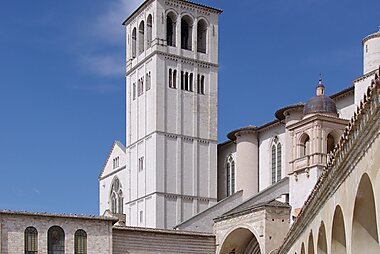
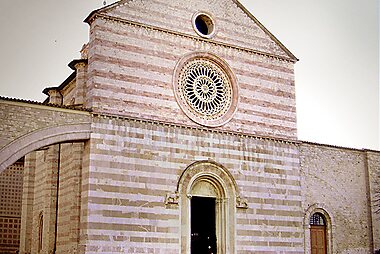
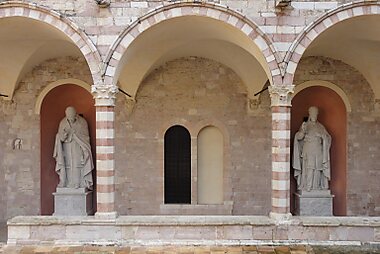
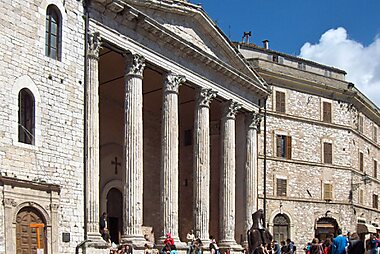
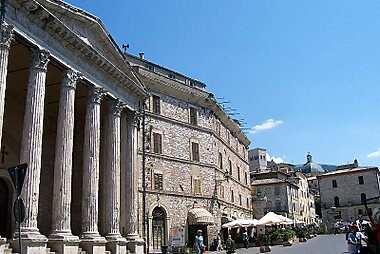
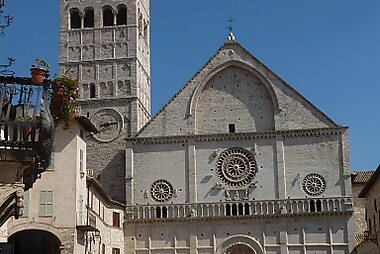
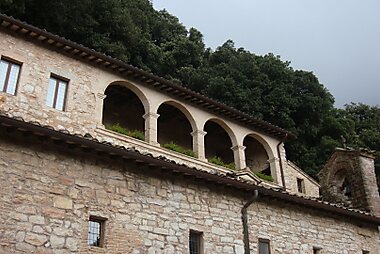
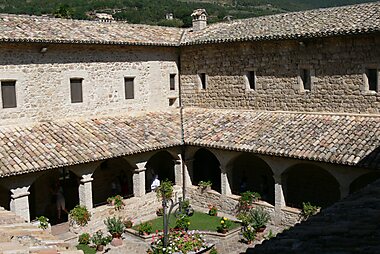
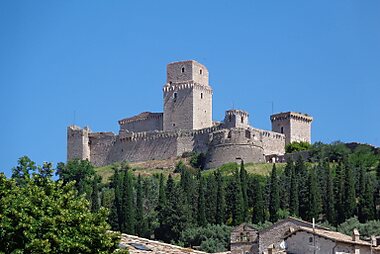
The main sights sit along one long ridge, from the Basilica of Saint Francis at the west end to the Basilica of Saint Clare and the cathedral at the east end. It is about a 15-minute walk from end to end, mostly on sloping streets. Piazza del Comune, the main square, is in the middle.
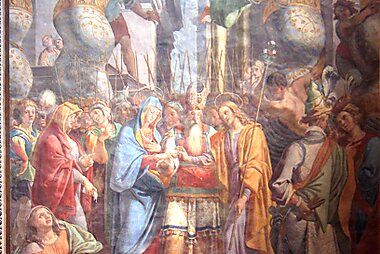
- Basilica of Saint Francis of Assisi is the reason most people come. It has two churches built one above the other. The Upper Church is bright and Gothic, with a famous cycle of 28 frescoes of the saint's life, traditionally given to Giotto. The darker Lower Church has frescoes by Cimabue, Simone Martini and Pietro Lorenzetti. Below it, the crypt holds the tomb of Saint Francis. Entry is free.
- Basilica di Santa Chiara has a striped facade of pink and white stone. Inside hangs the original painted crucifix that, according to tradition, spoke to Francis at San Damiano. The tomb of Saint Clare is in the crypt.
- The Temple of Minerva, now the church of Santa Maria sopra Minerva, stands on the main square. It is a Roman temple from the 1st century BC with six columns still in place.
- Museo Civico e Foro Romano lets you walk under the main square through the excavated remains of the Roman town centre.
- Cathedral of San Rufino has a carved Romanesque facade. Francis and Clare were baptised here.
- Rocca Maggiore is the medieval castle above the town. Climb up for the widest views over the town and the Umbrian plain.
- On the plain below the hill, near the railway station, stands the large Basilica of Santa Maria degli Angeli. Under its dome is the tiny Porziuncola chapel, where Francis founded his order. Nearby is the small room where he died.
- Chiesa di San Damiano is a simple church and convent among olive trees, a 20-minute walk downhill from the town. Clare and her sisters lived here, and it keeps the quiet feel of early Franciscan life.
Öne Çıkan Listeler

Assisi's Sacred Heart: The Absolute Essentials
Assisi’s historic center is defined by its deep Franciscan roots and well-preserved medieval architecture. This selection includes the Basilica of Saint Francis, famous for its Giotto frescoes, and the Basilica of Saint Clare, which houses the saint's remains. Highlights range from the Romanesque San Rufino Cathedral to the Eremo delle Carceri, a remote hermitage on Monte Subasio. The list also features the 12th-century Rocca Maggiore fortress and the Piazza del Comune, a central square built over the city's original Roman forum.
9 yer

Sacred Sites of Assisi
Assisi’s spiritual landscape is defined by the legacy of Saint Francis and Saint Clare. This collection spans from the UNESCO-listed Basilica of Saint Francis, featuring frescoes by Giotto and Cimabue, to the humble Porziuncola housed within the massive Santa Maria degli Angeli. The list includes the Romanesque San Rufino Cathedral, the ancient Temple of Minerva repurposed as a church, and secluded sites like the Carceri Hermitage on Monte Subasio. These landmarks illustrate architectural and religious evolution from the 1st century BC through the high Middle Ages.
20 yer
Assisi Art & Culture
Assisi’s artistic legacy spans from Roman foundations to contemporary expressions. This collection features the UNESCO-listed Basilica of Saint Francis, home to frescoes by Giotto and Cimabue, and the Gothic Basilica of Saint Clare. Beyond the major churches, explore the Roman Forum beneath Piazza del Comune, the medieval frescoes within Palazzo Vallemani, and specialized collections like the Missionary Museum. Modern bronze sculptures and monuments throughout the town bridge the gap between historical religious tradition and modern spiritual art.
16 yerNeler deneyimlenmeli
These local traditions and moments are what make a stay in Assisi different from a day trip.
- Calendimaggio (early May): for four days, the two halves of town, Parte de Sopra and Parte de Sotto, compete in medieval costume with parades, songs, games and contests. A jury awards the prize on the last evening.
- The feast of Saint Francis (3–4 October): on the evening of 3 October, the Transito ceremony at the basilica of Santa Maria degli Angeli remembers the saint's death. On 4 October, an Italian region offers oil for the lamp at his tomb, and the town fills with pilgrims and official guests.
- The Perdono (1–2 August): thousands of pilgrims come to the Porziuncola chapel for the Pardon of Assisi, a special indulgence that goes back to Saint Francis.
- The walk to the hermitage: leave town through Porta Cappuccini and walk the road or path up Monte Subasio to Eremo delle Carceri, a hermitage in the woods where Francis and his companions prayed in small caves. It is about 4 km and steadily uphill. Walkers can continue on marked trails to the open meadows near the summit.
- The woodland below the basilica: Bosco di San Francesco is a restored woodland with a path down to the Benedictine complex of Santa Croce, with its small church and an old mill that is now a restaurant. On the valley floor is a land-art work by Michelangelo Pistoletto, made of olive trees. The entrance is beside the square of the Upper Church. It is run by the FAI, the Italian heritage trust, and there is an entry fee.
- Evening in town: after the tour buses leave, sit on the steps of the Temple of Minerva on the main square, or walk to the lawn in front of the Upper Church of Saint Francis to watch the light fade over the plain.
Turlar ve Aktiviteler
Assisi — Harita

 Etkileşimli haritayı aç
Günübirlik geziler
Central Umbria is full of small hill towns, and many are close to Assisi. Trains cover the towns along the valley line, but a car is easier for the smaller places.
Close by
- Spello (about 10 minutes by train): a hill town of pink stone, known for the flowers in its lanes and for frescoes by Pinturicchio.
- Perugia (about 20 minutes by train): the regional capital and a university city, with a medieval main square, a large Gothic town hall and the National Gallery of Umbria.
- Bevagna and Montefalco (about 25–35 minutes by car): Bevagna is a small, flat medieval town with a Roman mosaic. Montefalco, on a hilltop above it, is the home of Sagrantino red wine. Combine them in one day with a winery visit.
- Spoleto (about 40 minutes by train): a hill town with a cathedral, a Roman theatre and a tall medieval bridge and aqueduct.
Further afield
- Gubbio (about 50 minutes by car): a medieval town of grey stone on a steep hillside, with a large town hall palace and a cable car up Monte Ingino.
- Todi (about 1 hour by car): a hill town above the Tiber valley with a large medieval main square.
- Cortona (about 1–1.5 hours by car): a Tuscan hill town with Etruscan roots and wide views over the Val di Chiana.
- Orvieto (about 1.5 hours by car): a town on a high rock with a large Gothic cathedral and a mosaic facade.
Nereyi keşfetmeli
Assisi is one of the best-known towns of Umbria, and several other Umbrian destinations are easy to combine with it.
Nasıl gidilir
- By air: the nearest airport is Perugia San Francesco d'Assisi – Umbria International Airport, about 12 km away, with a limited number of European flights. The Umbria Airlink bus links it with Assisi station in about 20 minutes, timed with flights; a taxi is the alternative. Most international visitors fly into Rome Fiumicino or Florence and continue by train.
- By train: Assisi station is not in the old town. It is in Santa Maria degli Angeli, on the plain about 4 km below. Direct trains reach it from Rome in about 2 hours and from Perugia in about 20 minutes. From Florence, direct regional trains take about 2–2.5 hours; other services need a change, usually at Terontola. Trenitalia
- From the station to the town: town bus line C runs from the station up to the old town, with stops near the Basilica of Saint Francis and at Piazza Matteotti, roughly every 30 minutes. A taxi takes about 10 minutes.
- By bus: long-distance coaches link Assisi with Rome and other Italian cities, and regional buses run to Perugia.
Ulaşım
- On foot: the old town is small and best explored on foot, but almost every street slopes and some are steep, with steps. Wear comfortable shoes.
- Town buses: Busitalia runs three small town lines. Line C links the railway station and Santa Maria degli Angeli with the old town; lines A and B loop from the main square to the upper and lower parts of town. Buy tickets before boarding at newsstands or tobacconists, or in the Trenitalia app. Busitalia Umbria
- Taxi: there are taxi ranks in the old town and at the station, or call Radio Taxi Assisi.
- Cycling: the steep hills make cycling hard in town. The flat roads on the plain below suit cyclists better.
Araç kullanımı
- Is a car worth it?: not for the town itself, which is small and best on foot. A car is useful for the hill towns, wineries and the roads up Monte Subasio.
- Restrictions: the old town is a ZTL (limited traffic zone) with camera enforcement. Hotel guests may drive in only to unload luggage, for up to 60 minutes, and the hotel must register your plate in advance.
- Parking: use the paid car parks just outside the walls. Giovanni Paolo II is the closest to the Basilica of Saint Francis and the busiest. Porta Nuova is at the east end, near the Basilica of Saint Clare. Mojano and Matteotti serve the centre and the upper town. Expect around €1.50 per hour.
Yeme ve içme
Umbrian food is simple and based on local produce. Look for strangozzi (long hand-made pasta), often served with black truffle, torta al testo (a flat bread cooked on a griddle and filled with cured meats or greens), and lentils from Castelluccio. The local red wines are Sagrantino and Rosso from nearby Montefalco. The town's traditional sweet is rocciata, a rolled pastry filled with apples, nuts and raisins.
The restaurants on the busiest streets between the Basilica of Saint Francis and the main square aim at day visitors. For better value, eat in the evening, and look in the side lanes above the main square and towards the cathedral and Piazza Matteotti.
Güvenlik ve sağlık
Assisi is a very safe town. Petty crime is rare, but keep an eye on bags and phones in the crowds at the basilicas and during the big feasts.
- Dress code: the basilicas and churches are active places of worship. Cover your shoulders and knees — no shorts, sleeveless tops or short skirts. Carry a light scarf in summer.
- Behaviour in churches: keep quiet, switch your phone to silent and follow the signs on photography, which is not allowed in some parts of the Basilica of Saint Francis. Do not walk around during Mass.
- Steep streets: the stone paving is slippery when wet. Take care on the steeper lanes and steps.
- Summer heat: there is little shade on the walk up to the castle and the hermitage. Carry water.
Tarihçe
Assisi began as a town of the ancient Umbrian people and became the Roman town of Asisium. The Temple of Minerva on the main square and Museo Civico e Foro Romano below it survive from this time. The Roman poet Propertius is thought to have been born here.
In the Middle Ages, Assisi was a free commune and often at war with nearby Perugia. Francis, the son of a rich cloth merchant, was born here around 1181. As a young man, he gave up his wealth to live in poverty and preach. Clare, a young noblewoman from the town, followed him and founded the order of the Poor Clares. Francis died at the Porziuncola, below the town, in 1226. He was declared a saint only two years later, and work on Basilica of Saint Francis of Assisi began the same year. The best painters of the time then decorated its walls.
In 1997, an earthquake brought down part of the vault of the Upper Church, killing four people and destroying sections of its frescoes. The church reopened after two years of restoration. In 2000, Assisi and its Franciscan sites became a UNESCO World Heritage Site.
Ülke bilgileri
Quick practical facts for Italy at a glance:
- Para birimi
- Euro EUR € · Kartla ödeme · Yaygın olarak kabul ediliyor
- Acil durum numaraları
- 112
- Elektrik
- 230 V · 50 HzTip C / Tip F / Tip L
- Diller
- İtalyanca
- Musluk suyu
- İçilebilir
- Trafik akış yönü
- Sağ
- Ülke kodu
- +39


Assisi – Günlerini Planla
Bu rehberdeki yerleri; akıllı rota oluşturma, tahmini süreler ve kusursuz bir gezi için gereken her şeyle gerçek bir güzergaha dönüştür.


İlgili varış noktaları
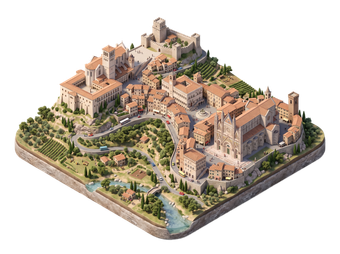
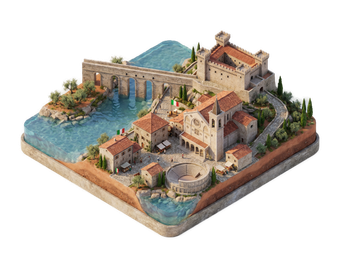



Data: © OpenStreetMap contributors, Wikidata, Wikipedia, Tripomatic, Official websites, geoBoundaries (CC BY 4.0). Tours by GetYourGuide. We earn commission from bookings. Travel guide generated with AI.