



Prostějov
Prostějov sits at the heart of the flat, fertile Haná plain in central Moravia — a working town rather than a postcard destination. In the late 19th and early 20th centuries it grew into the leading center of the Czech clothing and textile industry, and that wealth still shows in its confident Art Nouveau architecture; locals once nicknamed it the Athens of Haná for its cultural and intellectual life.
A walk through the compact old town takes in a lively main square, a former Jewish quarter that was once among the largest in Moravia, and buildings by leading Czech architects. It suits travelers who want a real, lived-in Moravian town rather than a polished tourist stop, and pairs well with a day trip or two to nearby Olomouc or Kroměříž. The poet Jiří Wolker, one of the most significant Czech poets of the early 20th century, was born here in 1900.

Prostějov – Gezi mi Planlıyorsun?
Tripomatic uygulamasında gün gün güzergahını oluştur.


Ne zaman gidilmeli
Spring and autumn are mild, the best seasons for walking the old town without summer heat or winter cold. Summer is warm with occasional afternoon storms, while winter brings frost and short days.
Plan around Prostějovské léto (Prostějov Summer), the town's season of free open-air concerts and cultural events on the main square through July and August.
Ziyaret etmek için en iyi zaman: Haziran, Ağustos, Eylül
En popüler turistik yerler


New Town Hall anchors the main square, an Art Nouveau administrative building with an asymmetric tower that has been a national cultural monument since 2024; the viewing tower is open by prior reservation.
A few steps away, National House is the town's grandest building, an Art Nouveau theatre and cultural center designed by Jan Kotěra and completed in 1907. It still hosts concerts, exhibitions, and performances today.
Prostějov Museum and Gallery covers local history, folk traditions, art, and science, and includes a small planetarium — a good stop on a rainy afternoon.
Southwest of the square, the former Jewish quarter is anchored by the Old Synagogue on Demelova street, a reminder that Prostějov once had one of Moravia's largest Jewish communities. Nearby, Hussite Church began life in 1904 as the town's New Synagogue before its Art Nouveau shell was converted into a Hussite church after the Second World War.
Saints Peter and Paul Church traces its roots to the 12th or 13th century, though the current building dates from an 18th-century Baroque rebuild; look for the historic tombstones and the town's oldest bell, cast in 1506.
Prostějov Castle mixes Renaissance, neo-Renaissance, and Art Nouveau elements, and today works as a cultural center with a courtyard used for events and exhibitions.
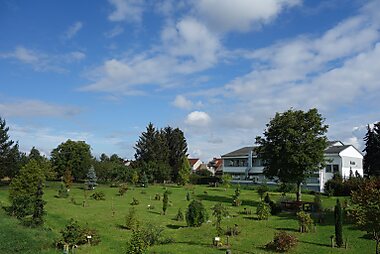
For a green break from the old town, Arboretum Vrahovice in the Vrahovice district gathers trees and shrubs from three continents along shaded paths, and it is free to enter.
Neler deneyimlenmeli
- Rent a bike and ride out into the flat Haná countryside — quiet farm roads link Prostějov to nearby villages, an easy region to explore at a relaxed pace.
- In December, browse the small Christmas market that fills the main square around New Town Hall, with mulled wine and festive stalls.
- Over summer weekends, catch an open-air concert on the square as part of the town's Prostějovské léto season.
Turlar ve Aktiviteler
Prostějov — Harita

Günübirlik geziler
Prostějov makes a convenient base for exploring central Moravia, with historic towns and a fairy-tale castle all within a couple of hours.
- Plumlov — about 15 minutes by car or bus. A small town below a Renaissance castle overlooking a reservoir lake; good for a short walk and, in summer, a swim.
- Olomouc — about 25 minutes by train. Moravia's former capital, with a Baroque old town and the Holy Trinity Column, a UNESCO World Heritage Site.
- Kroměříž — about 45 minutes by car or train, usually with a change. The Gardens and Castle at Kroměříž, another UNESCO World Heritage Site, pair a Baroque palace with an elaborate formal garden.
- Bouzov Castle — about an hour by car. A neo-Gothic fairy-tale castle rebuilt around 1900, popular with families and used as a filming location.
Nasıl gidilir
- By air: Prostějov has no commercial airport. The nearest gateway most travelers use is Brno–Tuřany (BRQ), around 70 km southeast, with limited seasonal and charter flights. Prague's Václav Havel Airport (PRG) has far more international connections; from there, reach Prostějov by train with a change in Olomouc or Brno.
- By train: Prostějov's main station sits on the line to Olomouc, a major rail hub with fast connections on to Prague, Brno, and Ostrava. Book tickets through Czech Railways (České dráhy).
- By bus: Long-distance coaches connect Prostějov's bus terminal with Brno, Olomouc, and other regional towns, a useful backup to the train.
Ulaşım
- Public transit: MHD Prostějov town buses cover the outer districts; the compact old town itself is easy to explore on foot. Tap a contactless bank card or phone directly on board to pay — no ticket machine or app needed.
- Taxi: local taxi companies operate around the town center and the train station.
- On foot: the old town and its main sights sit close together, all comfortably reachable on foot.
Araç kullanımı
- Is a car worth it?: Not for the old town itself — everything is walkable. A car helps for day trips to Plumlov, Bouzov Castle, or smaller Haná villages that trains and buses reach less often.
- Parking: Paid parking zones cover the streets around the main square; a free car park sits a short walk from the center. Pay by app, meter, or parking-disc depending on the zone.
Yeme ve içme
The restaurants and cafés around the main square, near New Town Hall, cover the usual range of Czech and international food for a stay of a day or two.
Local specialties reflect the Haná region's farming heritage — look for dishes built on potatoes, pork, and fresh vegetables from the surrounding plain. Tipping follows the national norm: round up the bill or leave around 10%.
Güvenlik ve sağlık
Prostějov is a safe, low-key town, with little crime beyond occasional pickpocketing in crowds during the summer festival season.
The town has its own hospital for everyday needs; Olomouc's larger hospitals are the nearest option for anything more serious.
Tarihçe
Prostějov grew from a Haná market town first recorded in the 13th century into a regional center; the Pernštejn lords later held the town, and their Renaissance rebuilding shaped Prostějov Castle. A Jewish community that settled here from the 16th century built up trading and textile workshops, laying the groundwork for the town's rise as the leading center of the Czech clothing industry by the early 20th century — wealth confident enough to commission Jan Kotěra's National House and the Art Nouveau New Town Hall, and to earn Prostějov its old nickname, the Athens of Haná.
That Jewish community, once one of the largest in Moravia, was almost entirely destroyed in the Holocaust. The Old Synagogue on Demelova street survives as a reminder of that history, while the former New Synagogue was rebuilt into Hussite Church after the war. Prostějov's clothing factories kept running through the socialist era and remain part of the local economy today.
Ülke bilgileri
Quick practical facts for the Czech Republic at a glance:
- Para birimi
- Çek korunası CZK Kč · Kartla ödeme · Genellikle kabul ediliyor
- Acil durum numaraları
- 112
- Elektrik
- 230 V · 50 HzTip C / Tip E
- Diller
- Çekçe
- Musluk suyu
- İçilebilir
- Trafik akış yönü
- Sağ
- Ülke kodu
- +420


Prostějov – Gezine Ekle
Akıllı rota oluşturma, tahmini süreler ve kusursuz bir gezi için ihtiyacın olan her şeyle ayrıntılı bir seyahat güzergahı oluştur.




