


圣彼得堡
Saint Petersburg was built from scratch on the Neva River delta in 1703, on the order of Tsar Peter the Great, who wanted a modern capital facing Europe. For two centuries it was the seat of the Russian tsars, and its center still looks the part: wide avenues, gilded domes, and grand palaces lined up along the river and its canals. UNESCO lists the whole historic core as a World Heritage Site.
The city suits a traveler who wants art, architecture, and imperial history in a walkable setting. Days here mean major art museums, palace interiors dripping in gold leaf, and a river-and-canal network sometimes compared to Amsterdam or Venice. In summer, the near-endless daylight of the White Nights adds a festival mood that pulls in visitors from across Russia and beyond. The novelist Fyodor Dostoevsky set much of his work in the city's back streets, and composer Pyotr Tchaikovsky spent his career here.

圣彼得堡 – 正在规划旅行?
在 Tripomatic 应用中按天构建您的行程。


最佳旅行时节
Late spring through early autumn is the most pleasant stretch, with mild days and long evenings. Winters are cold, dark, and often snowy, though the city dresses up for the New Year and Orthodox Christmas holidays.
The single best reason to time a trip here is the White Nights, from roughly late May to mid-July, when the sun barely sets and the sky stays light through the night. Museums, boat tours, and outdoor events run late, bridges over the Neva draw crowds at night to watch them lift for river traffic, and hotel prices climb accordingly. Book well ahead if visiting during this window.
最佳旅行时间: 七月, 八月
热门景点
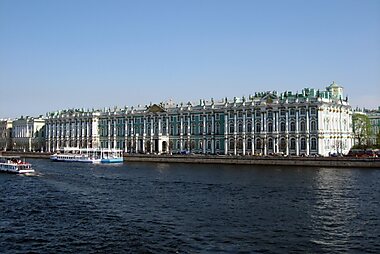


Hermitage Museum is one of the largest art museums in the world, housed in the former Winter Palace of the tsars. Give it at least half a day — the collection runs from Egyptian antiquities to Impressionist masterpieces, and the gilded state rooms are an attraction in themselves.
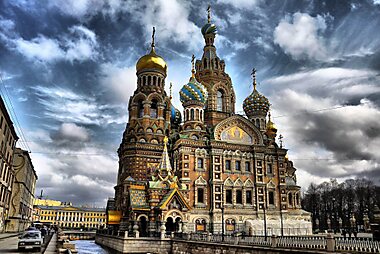
The Church of Our Savior on the Spilled Blood was built on the spot where Tsar Alexander II was assassinated in 1881. Its onion domes and mosaic-covered interior make it the most photographed church in the city.
St Isaac's Cathedral took 40 years to build and dominates the skyline with its gilded dome. Climb the colonnade for one of the best panoramic views over the rooftops and canals.
Peter and Paul Fortress is the city's founding site, a star-shaped fortress on an island in the Neva. Inside, the cathedral holds the tombs of nearly every Russian tsar since Peter the Great.
Kazan Cathedral was modeled on St Peter's Basilica in Rome and stands at the heart of Nevsky Prospekt, the city's main avenue.
Nevsky Prospekt is the main street for shopping, cafés, and people-watching, running in a straight line from the Admiralty to the Alexander Nevsky Monastery.
Peter the Great (Bronze Horseman), often called the Bronze Horseman, is the equestrian statue of Peter the Great that inspired Pushkin's famous poem of the same name.
Grand Palace, Peterhof is the centerpiece of Peterhof, the tsars' summer estate on the Gulf of Finland. Its terraced gold fountains, fed by gravity alone, run without a single pump. Reach it by a 30–40 minute hydrofoil from the Hermitage embankment, or by suburban train.
精选榜单


特色体验
- Watch the bridges lift. From late April to November, crowds gather along the embankments after midnight to watch the drawbridges rise one by one to let ships pass — a genuine spectacle, especially under the pale light of the White Nights.
- Take a canal boat ride. A short cruise through the canals and along the Neva shows the palace façades from the water, a different angle than walking the streets.
- Catch a performance at Mariinsky Theatre. Top-tier ballet and opera at working-class ticket prices, in one of the most famous stages in Russia.
- Try a Russian banya. A steam bathhouse session, often finished with a plunge into cold water, is a genuine local ritual rather than a spa gimmick.
观光与活动
圣彼得堡 — 地图

 打开互动地图
一日游
Several worthwhile destinations sit within easy reach of the city, from nearby palace towns to historic centers further afield.
- Pushkin (Tsarskoye Selo) — ≈40 min by train from Vitebsky station. This former imperial village is home to The Catherine Palace, famous for its reconstructed Amber Room and sweeping Rococo façade.
- Pavlovsk — ≈45 min by train, one stop past Pushkin. A quieter palace estate with the largest landscaped park in the region, good for a slow walk among lakes and pavilions.
- Vyborg — ≈2–2.5 hours by train or bus. A small town near the Finnish border with a medieval stone castle and a Hanseatic-era old town, a rare mix of Swedish, Finnish, and Russian architecture.
- Veliky Novgorod — ≈2.5–3 hours by high-speed train. One of Russia's oldest cities, with a well-preserved kremlin and a cluster of UNESCO-listed medieval churches. It is often called the birthplace of the Russian state.
周边探索
Within the city's own limits: Historical Part of the Town of Kronstadt is a former naval fortress town on an island in the Gulf of Finland, reachable by bus or car across a causeway. Its dome-topped naval cathedral and old forts are worth a half-day trip.
Further afield, by train: Moscow, the national capital, is roughly 4 hours away on a high-speed train — a realistic add-on for a longer trip. Pskov is a smaller historic city near the western border, with its own kremlin and medieval churches, a few hours away by train or bus.
如何到达
- By air: Pulkovo Airport (LED) is about 17 km south of the center; a taxi or ride-hailing app takes 30–40 min, and bus routes connect to the metro. There are currently no direct flights from Western Europe or North America — most international travelers connect through hub cities such as Istanbul, Dubai, or Belgrade.
- By train: Moskovsky Station is the arrival point for Moscow and most long-distance domestic routes; high-speed Sapsan trains cover Moscow in about 4 hours. Direct passenger rail links to Finland and other EU countries are currently suspended.
- Visa: most nationalities need a visa to enter Russia; a 30-day e-visa is available online for many countries, applied for no earlier than 86 days and no later than 4 days before arrival. Citizens of several countries, including the US, UK, Canada, and Australia, need a standard visa instead of the e-visa. Always verify current requirements before travel.
- Money: foreign-issued Visa and Mastercard cards do not work anywhere in Russia, including at ATMs. Bring enough cash in euros or US dollars to exchange on arrival, or arrange a Russian MIR card in advance.
当地交通
- Metro: five lines cover the main sights and run deep underground — some stations double as sightseeing stops for their Soviet-era mosaics and chandeliers. Buy a token or a rechargeable Podorozhnik card at station booths or machines with cash, since foreign bank cards do not work here.
- Buses and trams: a dense network fills the gaps the metro misses; pay the same way as on the metro, in cash.
- On foot: the historic center is compact and walkable, with most major sights within a couple of kilometers of Nevsky Prospekt.
- Bridges: from late April to November, the drawbridges over the Neva lift nightly for a few hours (typically after 1 a.m.) to let ships pass. Check the schedule before planning a late crossing between the two riverbanks, or you may be stuck until morning.
自驾指南
- Is a car worth it? Skip it in the city itself — traffic, scarce parking, and the metro make a car more hassle than help. Renting one only makes sense for a trip out to Vyborg, Novgorod, or other towns beyond easy train range.
- Parking: metered street parking covers most of the center, paid by SMS or a parking app in rubles; multi-story car parks near the main sights are the easier option for a short visit.
- Documents: an International Driving Permit alongside your home license is required to drive as a foreign visitor.
美食与饮品
Saint Petersburg's food scene leans European compared to the rest of Russia, with a strong café culture along the canals and a wave of modern Russian restaurants reinterpreting classic dishes.
For a concentration of good, affordable places to eat, head to the courtyards and side streets off Rubinshteyna Street, a few blocks south of Nevsky Prospekt — it is dense with cafés, bars, and small restaurants aimed at locals rather than tour groups. Tipping in restaurants follows the country default: it is appreciated but not required.
安全与健康
Violent crime against tourists is rare in the center. The most common risks are pickpocketing in crowded spots like Nevsky Prospekt and the metro, and taxi drivers or unofficial guides overcharging visitors who look unfamiliar with local prices — use a ride-hailing app or agree on a fare before getting in.
Tap water is not safe to drink; stick to bottled or filtered water, including for brushing teeth.
Always carry a copy of your passport and visa, since document checks do happen, and keep the originals somewhere secure.
历史
Peter the Great founded the city in 1703 on marshy land captured from Sweden, laying the first stone at Peter and Paul Fortress. He moved the capital here from Moscow in 1712, determined to build a "window to Europe" built by European architects in a European style — a sharp break from old Russian tradition.
For over two centuries the Winter Palace was the residence of the Romanov tsars, and Palace Square in front of it was the stage for the city's darkest turning points: the massacre of Bloody Sunday in 1905, and the storming of the palace during the October Revolution of 1917.
The city's hardest chapter came during the Second World War, when Nazi forces besieged it for 872 days between 1941 and 1944. Hundreds of thousands of residents died, mostly from starvation, and the siege is still central to how the city remembers itself today. The name changed three times over the century — Saint Petersburg, then Petrograd, then Leningrad under Soviet rule — before residents voted to restore the original name in 1991.
国家概况
Quick practical facts for Russia at a glance:
- 货币
- 俄罗斯卢布 RUB · 刷卡支付 · 建议备足现金
- 紧急求助电话
- 112
- 用电规格
- 220 V · 50 HzC 型插头 / F 型插头
- 语言
- 俄语
- 自来水
- 建议谨慎饮用
- 行车方向
- 靠右行驶
- 国际区号
- +7






