



Korsika
Corsica is a mountainous French island in the western Mediterranean, just north of Sardinia. Granite peaks rise close to the sea. Beaches, pine forests and hill villages are often only an hour apart. The island suits active trips: hiking, swimming, boat trips and long road journeys.
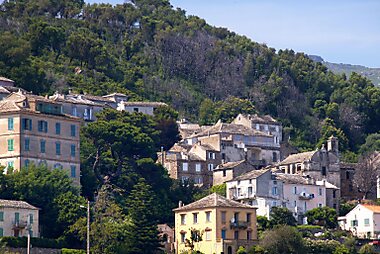
The coast has old Genoese citadels and towers. Inland, shepherd villages and chestnut forests keep a strong local identity. Corsican is spoken alongside French, and many road signs show both.

Korsika – Planst du eine Reise?
Erstelle deine Reiseroute Tag für Tag in der Tripomatic-App.


Beste Reisezeit
Late May, June and September are the best months. The sea is warm enough to swim, trails are open and the island is less crowded. July and August are hot and busy, and beach towns are full. Winter is quiet. The mountains get snow, and many coastal hotels and restaurants close.
Visit in Holy Week for a special event. On Good Friday evening, Sartène holds the Catenacciu, an old night procession in which a penitent carries a heavy cross through the town.
Top-Sehenswürdigkeiten

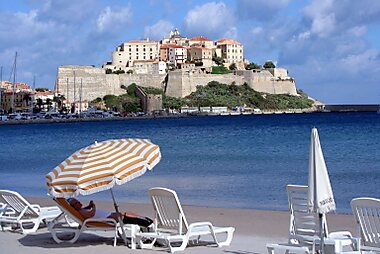


- Citadelle de Calvi stands on a rocky headland above the bay of Calvi. The Genoese walls enclose a small old town with sea views.
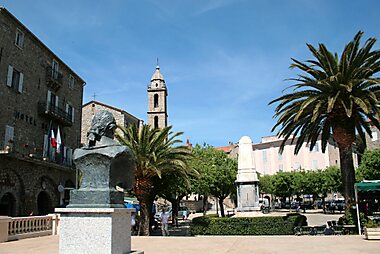
- Cathédrale Santa-Maria-Assunta in Ajaccio is where Napoleon was baptised in 1771. It is a late 16th-century church in the old town.
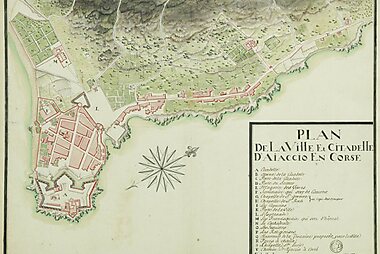
- Citadelle d'Ajaccio guards the harbour of Ajaccio. It is a good start for a walk along the waterfront.
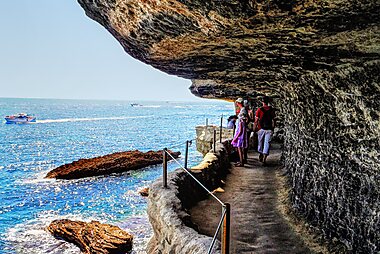
- Escalier du Roi d'Aragon is a steep stair of 187 steps cut into the white cliff at Bonifacio. It leads down to a spring at sea level. Local tradition links it to the Aragonese siege of 1420.
- Sainte-Marie Majeure is the main church of Bonifacio's old town. The town sits on limestone cliffs above the sea.
- Sartène is a granite town in the south. Its tall stone houses and narrow lanes are the setting for the Good Friday procession.
- Monte Cinto is the highest peak on the island (2,706 m). The summit is a long hike for experienced walkers.
- Tour d'Erbalunga is a Genoese tower in the fishing village of Erbalunga, on the east coast of Cap Corse.
Nature and coast
- The Calanques de Piana, the Gulf of Girolata and the Scandola reserve form one UNESCO World Heritage site. Red granite cliffs drop into the sea along the west coast.
- The Restonica valley near Corte has a river with rock pools and trails into the high mountains.
- The Aiguilles de Bavella are jagged granite spires above the Col de Bavella, with many walking trails.
- Palombaggia and Santa Giulia are the best-known sandy beaches near Porto-Vecchio.
- Filitosa, near Propriano, is a prehistoric site with carved standing stones.
Empfohlene Listen


Best Beaches
Corsica's coastline features a diverse range of beaches, from the shallow turquoise lagoon of Santa Giulia to the red granite rocks of Palombaggia. In the north, the Désert des Agriates offers wild stretches like Plage du Lotu, accessible primarily by boat or coastal trails. Further south, Rondinara forms a natural shell-shaped bay, while Grand Sperone provides views across to the Lavezzi Islands. These locations are characterized by fine white sand, clear Mediterranean waters, and surrounding Mediterranean maquis or pine forests.
7 Orte
Historic Heritage Sites
Corsica’s strategic Mediterranean position is etched into its landscape through formidable military architecture. This collection spans the 15th-century Citadelle d'Ajaccio and the 'eagle's nest' of Corte to the iconic Genoese towers like Campomoro and Mortella, built to defend against Barbary pirates. From the Neoclassical Palais Lantivy to the rock-carved lookouts of Bonifacio, these sites reveal the island's complex history of Genoese and French rule.
14 Orte

Viewpoints & Towers
Corsica’s diverse geography is showcased through its historic coastal defenses and high-altitude passes. This collection features 16th-century Genoese towers, including the rare square tower at Porto and the vertically split ruins of Santa-Maria-della-Chiappella. High-point vistas are accessible via the Col de Vergio—the island’s highest road pass—and the jagged granite needles of Col de Bavella. Coastal landmarks include the red porphyry heights of Phare de la Pietra and the limestone sea stacks of Bonifacio.
14 OrteErlebnisse & Aktivitäten
- Walk part of the GR20. The long-distance trail crosses the island's mountains. The whole route takes about two weeks. Day sections from Vizzavona or near Bavella give a taste of it.
- Take a boat into Scandola. See sea caves, red cliffs and the Gulf of Girolata from the water.
- Swim in a mountain river. Rock pools in the Restonica valley are a cool break on a hot day.
- Hear Corsican polyphony. Traditional songs for three male voices are on UNESCO's list of intangible heritage in need of urgent safeguarding. Look for concerts in churches and village halls in summer.
- Watch the sunset at the Calanques de Piana. The red rocks turn deep orange in the evening light.
Touren & Aktivitäten
Korsika — Karte

 Interaktive Karte öffnen
 Tagesausflüge
Corsica is large, and most trips are by car or boat. These are the easiest day trips from the main bases.
- Cap Corse loop from Bastia: the full loop takes about 4 to 5 hours with stops. Narrow coastal roads pass Genoese towers and small harbours. Saint-Florent is a good lunch stop.
- Corte from Bastia or Ajaccio: about 1.5 to 2 hours by road or train. It is the old capital of the Corsican republic, with a hilltop citadel and access to the Restonica valley.
- Scandola and Girolata by boat: boat tours run in the season from Porto, Calvi and other west-coast harbours. This is the easiest way to see the UNESCO coast from the water.
- Sardinia from Bonifacio: ferries run several times a day on a short crossing to Santa Teresa Gallura. The strait is only about 11 km wide.
- Lavezzi Islands from Bonifacio: boat trips go to a nature reserve of low granite islands with clear water.
Orte zum Entdecken
Anreise
- By air: Corsica has four airports with scheduled flights: Ajaccio Napoléon Bonaparte, Bastia Poretta, Calvi Sainte-Catherine and Figari Sud Corse. Flights come from mainland France and many European cities, with more routes in summer. Choose the airport closest to where you will stay, because travel across the island is slow.
- By ferry from France: ferries run from Marseille, Nice and Toulon to Bastia, Ajaccio and other Corsican ports. Night crossings with cabins are common. Book early for July and August, especially with a car.
- By ferry from Italy: ferries link Corsica with Genoa, Livorno and other Italian ports. Bonifacio has short crossings to Sardinia.
- Main ports: Bastia, Ajaccio, L'Île-Rousse, Calvi, Porto-Vecchio, Propriano and Bonifacio.
- Corsica tourist board
Unterwegs vor Ort
- By car: a car is the most practical way to see the island. See the driving section.
- By train: a narrow-gauge railway runs from Bastia to Ajaccio through Corte. A branch line links Calvi and L'Île-Rousse with the main line at Ponte-Leccia. The train is slow but scenic, and winter service is reduced. Corsican railways
- By bus: buses link the main towns, with fewer trips in winter and on Sundays. Small villages and trailheads often have no service.
- Taxis and boats: taxis are expensive over long distances. In summer, small boats connect some coastal spots that have no road.
- On foot: towns like Calvi, Bonifacio and Sartène are good to walk. Distances between towns are too long for walking or cycling for most visitors.
Autofahren
- Is a car worth it? Yes, for most trips. Public transport does not reach many villages, beaches and trailheads.
- Roads: mountain roads are narrow and winding. A trip of 80 km can take over two hours. Watch for cows, pigs and goats on the road.
- Rental: reserve early for summer. Choose a small car for narrow village streets.
- Parking: car parks fill early at Bonifacio, Calvi and popular beaches in July and August.
Essen & Trinken
Corsican food is based on mountain and island produce. Look for cured meats such as figatellu, lonzu and coppa, and for brocciu, a fresh sheep or goat cheese used in both savoury and sweet dishes. Chestnut flour appears in bread, cakes and pasta. Wild boar stew is a common main dish.
Local drinks include wines from Patrimonio and Ajaccio, the aperitif Cap Corse, myrtle liqueur and chestnut beer. For good value, eat at village inns in the mountains and at harbour restaurants on the coast. Local markets in the larger towns sell cheese, ham and honey.
Sicherheit & Gesundheit
Corsica is safe for visitors. The main risks are in nature, not in towns.
- Mountains: weather changes fast. Storms and heat are common in summer. Carry water, start early and check forecasts before any long hike.
- Wildfires: summer is the dry season, and fires can close roads and trails. Follow local rules on fires and barbecues.
- Sea: swim at beaches with calm water and keep away from strong currents and rocky coasts in wind.
- Theft: cars left at trailheads and beach car parks are sometimes broken into. Do not leave valuables inside.
- Health: pharmacies are in the larger towns, and the main hospitals are in Ajaccio and Bastia. Villages in the interior are far from care.
Geschichte
Genoa ruled most of Corsica for centuries and built the coastal towers and citadels. The walls of Citadelle de Calvi in Calvi and the old town of Bonifacio come from this time. Genoese towers still stand on many headlands, such as Tour d'Erbalunga.
In 1755 Pasquale Paoli led a short-lived Corsican republic with its capital at Corte. Genoa ceded the island to France in 1768, and France took full control in 1769. That year Napoleon was born in Ajaccio. Around 1500 BC, people raised carved standing stones at Filitosa in the south.
Länderfakten
Quick practical facts for France at a glance:
- Währung
- Euro EUR € · Kartenzahlung · Weitgehend akzeptiert
- Notrufnummern
- 112
- Stromnetz
- 230 V · 50 HzSteckertyp C / Steckertyp E
- Sprachen
- Französisch
- Leitungswasser
- Trinkbar
- Fahrseite
- Rechtsverkehr
- Telefonvorwahl
- +33


Korsika – Zu deiner Reise hinzufügen
Erstelle eine detaillierte Reiseroute mit intelligenter Routenführung, Zeitschätzungen und allem, was du für eine perfekte Reise brauchst.

