


Niagara-on-the-Lake
Niagara-on-the-Lake is a small historic town where the Niagara River meets Lake Ontario. Its main street is lined with 19th-century shops, inns and gardens. Fields of vines and orchards surround the town, and it is one of Canada's best-known wine areas.
It suits a quiet trip of one to three nights. Visitors come for the Shaw Festival theatre season, wine tasting, War of 1812 forts and cycling along the river. The Falls are about 20 minutes away by car.

Niagara-on-the-Lake – Planst du eine Reise?
Erstelle deine Reiseroute Tag für Tag in der Tripomatic-App.


Beste Reisezeit
Late spring to early autumn is the best time. Summer is warm and humid, and Queen Street is busy on weekends. Early autumn is calm, with the grape harvest and fruit stands. Winters are cold and quiet, but cozy for wine and theatre.
Plan around the Shaw Festival. Its plays run from spring into December, with the most shows from May to October. In January, the town hosts an Icewine festival with winery events.
Top-Sehenswürdigkeiten
- Queen Street is the heart of the Old Town. Shops, cafés and inns line the street, and the old clock tower stands in the middle. It is best seen on foot.
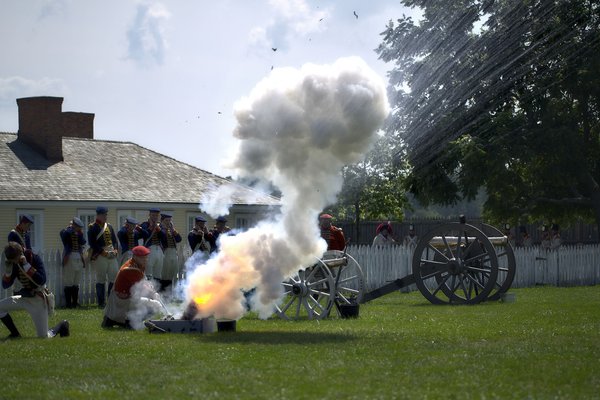
- Fort George is a restored fort from the War of 1812. Costumed guides, historic buildings and seasonal demonstrations show how soldiers lived. It is open daily in summer and on fewer days in spring and autumn, so check the hours. It stands at the edge of town, a short walk from Queen Street.
- Fort Mississauga is a star-shaped fort with a brick tower on the lakeshore. It sits on a golf course, and you can walk to it along the shore.
- Shaw Festival Theatre is the main stage of the Shaw Festival, near Queen Street. Even if you do not see a show, the building and its gardens are worth a look. Other stages are on nearby streets.
- Queen's Royal Park is a grassy park at the river mouth. It has views across the water to Fort Niagara in the United States.
- Queenston Heights is a hilltop park about 10 minutes by car south. It is the site of a battle in 1812 and has Brock's Monument, a tall tower with views over the river and the vineyards.
- Floral Clock is a large flower display along the Niagara Parkway. It is a common photo stop on the scenic drive to the Falls.
Empfohlene Listen
Erlebnisse & Aktivitäten
- See a Shaw Festival play. The festival stages works by George Bernard Shaw and other writers at several theatres in town. Book early for summer evenings.
- Taste wine at the source. Visit two or three wineries in one afternoon, and stop for lunch at a winery restaurant. Arrange a driver or a tour first.
- Go in January for Icewine. Grapes are picked frozen at night in deep cold. The festival has tastings and winery events.
- Cycle the river trail. Ride from the town toward the Falls along the water and the parkway. Stop at fruit stands for cherries and peaches in summer.
- Join a fort event. Fort George holds demonstrations and seasonal programs with costumed staff.
- Take a horse-drawn carriage ride. Rides leave from Queen Street in warm months.
Touren & Aktivitäten
Niagara-on-the-Lake — Karte

Tagesausflüge
All trips are one way from the town, in order from closest to farthest.
- Niagara Parkway and Queenston: 10 to 20 minutes by car or bike. A scenic road along the river, with Queenston Heights, the Laura Secord Homestead and views of the gorge.
- Niagara wine route: 10 to 30 minutes by car. Wineries and fruit farms spread along the roads east and west of the town. Book a driver or a tour if you plan to taste.
- Niagara Falls: about 20 to 25 minutes by car. See the waterfalls, and take the river path or the Niagara Parkway on the way.
- St. Catharines and Welland Canal: about 25 to 30 minutes by car. A larger city with canal locks where ships pass.
- Buffalo, United States: about 1 hour by car, plus the border crossing. Bring a passport.
- Toronto: about 1.5 hours by car. A large city with big museums, a lake waterfront and many restaurants.
Anreise
- By air: Toronto Pearson (YYZ) is the main gateway, about 1.5 hours away by car. Buffalo Niagara (BUF) is about 1 hour away, but you must cross the border.
- By train: GO trains run from Toronto to Niagara Falls GO station. The town has no rail station. From the Falls, take a taxi or the WEGO shuttle to Fort George. The shuttle is seasonal, so check the schedule. See GO Transit and WEGO.
- By bus: Coaches from Toronto reach Niagara Falls. Change there for a taxi or the shuttle.
- By car: Toronto is about 130 km away on the QEW highway. Allow 1.5 hours or more in heavy traffic.
Unterwegs vor Ort
- On foot: The Old Town is small and flat. Queen Street, the theatres and Fort George are all within a short walk.
- By bike: Quiet roads and the river trail make cycling easy. A paved trail follows the Niagara River toward the Falls, about 15 km one way. Many shops rent bikes in summer.
- By shuttle: The WEGO shuttle links Fort George with Niagara Falls in the warm season. See WEGO.
- By taxi: Taxis are the practical way to reach wineries and the train in Niagara Falls if you do not drive. Book ahead on busy summer evenings.
Autofahren
- Is a car worth it? Not for the Old Town, which is compact and walkable. A car helps for wineries, fruit farms and the Niagara Parkway. If you plan to taste wine, choose a driver or a tour.
- Parking: Spaces near Queen Street fill up on summer weekends and theatre days. Park a little way out and walk in.
Essen & Trinken
Niagara-on-the-Lake is known for wine, fresh fruit and farm-to-table cooking. Look for local VQA wines, Icewine as a dessert wine, and peaches and cherries in summer. Fudge and ice cream shops are common on Queen Street.
Eat along Queen Street, where cafés, inns and restaurants cluster close to the theatres. Many wineries have their own restaurants among the vines, mostly on the roads outside the Old Town. Book tables in summer and before evening shows. Tipping of 15 to 20 percent is normal in sit-down restaurants.
Sicherheit & Gesundheit
Niagara-on-the-Lake is very safe for visitors. Normal care is enough. Keep valuables out of sight in parked cars.
Drink-driving laws are strict. Do not drive after wine tasting. In summer, bring sun protection and insect repellent for bike rides and farms. In winter, wear warm layers, as paths and roads can be icy. Cross-border trips to the United States need a passport.
Geschichte
Indigenous peoples lived along the Niagara River long before settlers arrived. After the American Revolution, Loyalists settled here, and the town, then called Newark, became the first capital of Upper Canada in 1792. The capital moved to York, now Toronto, a few years later.
War of 1812 sites remain in town. American forces took Fort George in 1813. The same year they burned Newark as they left, and the town was rebuilt. Fort George and Fort Mississauga show that period today. The Shaw Festival began here in 1962 and now draws theatre audiences from across North America.
Länderfakten
Quick practical facts for Canada at a glance:
- Währung
- Kanadischer Dollar CAD $ · Kartenzahlung · Weitgehend akzeptiert
- Notrufnummern
- 911
- Stromnetz
- 120 V · 60 HzSteckertyp A / Steckertyp B
- Sprachen
- Englisch, Französisch
- Leitungswasser
- Trinkbar
- Fahrseite
- Rechtsverkehr
- Telefonvorwahl
- +1
Niagara-on-the-Lake – Plane deine Tage
Verwandle die Orte aus diesem Reiseführer in eine echte Reiseroute mit intelligenter Routenführung, Zeitschätzungen und allem für eine perfekte Reise.


Ähnliche Reiseziele
Weitere Reiseziele
Data: © OpenStreetMap contributors, Wikipedia, Tripomatic, Official websites, geoBoundaries (CC BY 4.0). Tours by GetYourGuide. We earn commission from bookings. Travel guide generated with AI.
Plane deine Reise mit Tripomatic
- KI-gestützte PlanungErhalte mit einem Fingertipp einen fertigen Tag, lass die KI deine Merkliste über deine Reise verteilen oder plane alles im Chat.
- ReisewarnungenOffizielle Hinweise, Unwetter, Streiks und Naturgefahren für die Orte an jedem Tag deiner Reise.
- Feiertage & EventsSieh Feiertage, Festivals und Schließungen an den Tagen deiner Reise und erfahre, was sie für deine Pläne bedeuten.
- KostenschätzungKI-gestützte Reisekostenübersichten, damit du dein Budget schon vor der Abreise genau kennst.
- Touren & TicketsBuche geführte Touren, Tickets ohne Anstehen und Aktivitäten direkt in deinem Reiseplan.