



Sellagruppe
The Sella Group is a massif of pale dolomite rock rising between four valleys in the heart of the Dolomites: Val Gardena, Alta Badia, Val di Fassa, and Livinallongo. Steep cliffs rise from a high central plateau, and the massif is ringed by some of the most famous mountain passes in the Alps. It forms part of the Dolomites UNESCO World Heritage Site.
The group takes its name from Quintino Sella, the Italian statesman and mountaineer who founded the Club Alpino Italiano. There is no town inside the massif itself. Visitors stay in one of the surrounding valley villages and come here to hike, climb, ski, or drive the passes. This destination suits travelers who want outdoor activity — it is a place to walk trails and ride cable cars, not a town to sightsee in.

Sellagruppe – Planst du eine Reise?
Erstelle deine Reiseroute Tag für Tag in der Tripomatic-App.


Beste Reisezeit
Summer, from June to September, is best for hiking, climbing, and driving or cycling the passes; afternoons often bring short thunderstorms, so plan hikes for the morning. Winter, from December to early April, brings heavy snow and the ski season. Spring and late autumn are quiet, with many cable cars, rifugios, and hotels closed.
Time a summer visit around the Maratona dles Dolomites, a mass cycling event held in early July that closes the passes around the Sella Group to normal traffic for one day — tens of thousands of riders climb Passo Pordoi, Passo Sella, Passo Gardena, and Passo Campolongo in a single loop.
At this altitude, conditions stay alpine even in summer: expect cool days and cold nights near the passes, with snow possible at any time of year on the highest points.
Top-Sehenswürdigkeiten



Piz Boè is the highest point in the Sella Group at 3,152 meters, reached by cable car and a short hike, or by a full via ferrata route for a bigger challenge. It's one of the few 3,000-meter Dolomite summits a fit hiker can reach without technical climbing gear, with a wide view across the Dolomites.
Passo Pordoi, at 2,239 meters, is one of the highest paved passes in the Dolomites, its hairpin bends familiar to every Giro d'Italia fan. It marks the boundary between the Sella Group and the Marmolada.
Sass Pordoi is a flat rock plateau just above Passo Pordoi, reached in a few minutes by cable car. Its viewing terrace looks out over the Marmolada glacier and the Val di Fassa.
Passo Sella is a high pass between rock towers and scree slopes, linking Val Gardena to Val di Fassa. It's one of the classic viewpoints for photographing the massif's cliffs.
Passo Gardena connects Val Gardena to Alta Badia and is a popular starting point for hikes and climbing routes on the massif's northern side.
Cascate del Pisciadù is a waterfall reached by an easy walk from Corvara, tucked below the cliffs on the massif's southeastern side.
Piz Ciavazes is one of the best-known rock walls in the Dolomites for climbers, rising directly above Passo Sella.
Empfohlene Listen


Erlebnisse & Aktivitäten
The Sella Group is built for outdoor activity, not sightseeing from a café table.
- Ski or ride the Sella Ronda, a roughly 40-kilometer lift-and-piste circuit that loops around the entire massif through all four surrounding valleys — most skiers complete it in a single day.
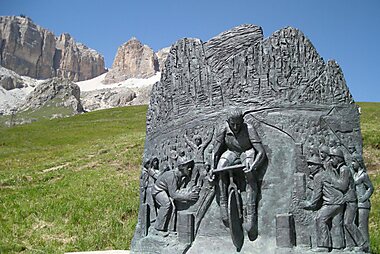
- Cycle the same loop by road in summer, climbing Passo Pordoi, Passo Sella, Passo Gardena, and Passo Campolongo — the route made famous by the Maratona dles Dolomites race. A monument near the top of Passo Pordoi, Fausto Coppi Memorial, honors Fausto Coppi, one of the greatest riders to race over the Dolomite passes.
- Clip into the fixed cables and ladders of the Via Ferrata Brigata Tridentina, a classic via ferrata built over old World War I mountain infrastructure — wear a helmet and harness, or book a mountain guide if it's your first time.
- Spend a night at a mountain hut such as Rifugio Boé or Rifugio Pisciadù, sleeping high on the massif between days of hiking or climbing.
Touren & Aktivitäten
Sellagruppe — Karte

Tagesausflüge
The valleys around the Sella Group make good bases for day trips further into the Dolomites and beyond.
- Marmolada: about 30–40 minutes by car over Passo Fedaia. The only glacier in the Dolomites and their highest peak, reached by cable car; a somber World War I front line runs beneath the ice.
- Cortina d'Ampezzo: roughly 45 minutes to an hour by car over Passo Falzarego. A well-known ski town surrounded by its own dramatic peaks, worth combining with the drive over the pass.
- Lago di Braies: about an hour by car. A turquoise mountain lake with a lakeside chapel, one of the most photographed spots in the Dolomites — arrive early, since parking fills up fast in summer.
- Bolzano: around 1 to 1.5 hours by car or bus. South Tyrol's capital, with the Ötzi ice mummy at the South Tyrol Museum of Archaeology and a historic center that mixes Italian and Austrian influence.
Orte zum Entdecken
There is no town within the Sella Group itself. Most visitors base themselves in one of the villages in the four valleys that surround it.
- Corvara in Badia, in Alta Badia to the southeast, is close to the Cascate del Pisciadù waterfall and sits directly on the Sella Ronda ski and bike circuit.
- Selva di Val Gardena, in Val Gardena to the northwest, sits below Passo Sella and is known for woodcarving workshops alongside its outdoor activities.
- Canazei, in Val di Fassa to the southwest, is the main base for reaching Passo Pordoi and Sass Pordoi.
- Arabba, on the northeastern side in the municipality of Livinallongo del Col di Lana, is a small ski village directly on the Sella Ronda circuit.
Anreise
- By air: The nearest airport is Bolzano Airport (BZO), about an hour's drive, but it has only limited seasonal flights. Most travelers fly into Innsbruck (INN, Austria), Verona (VRN), or Venice Marco Polo (VCE), each roughly 2 to 3 hours away by car or transfer bus. Munich (MUC) is a longer but common option too, around 3.5 to 4 hours.
- By train: No railway reaches the valleys around the Sella Group. The nearest useful station is in Bolzano, on the main Munich–Verona line; regional buses run from there up to the valleys.
- By bus: Regional SAD/Südtirol Mobil buses connect Bolzano to Corvara in Badia and Selva di Val Gardena; Canazei is reached by bus from Bolzano or Trento via Val di Fassa. Journeys typically take 1.5 to 2.5 hours and often require a change.
Unterwegs vor Ort
- Cable cars and chairlifts: A network of lifts crosses the massif and its passes, including the cable car up to Sass Pordoi from Passo Pordoi. In winter, the Dolomiti Superski pass covers the Sella Ronda circuit and the wider ski area; buy it at any valley ticket office or lift station.
- Buses: Local SAD buses and, in ski season, a dedicated Sella Ronda bus link the valley villages and the passes; a Mobilcard covers unlimited rides on South Tyrol's public transport, including these routes.
- Driving: A car is the easiest way to move between the four valleys and reach trailheads at the passes. Roads are well paved but wind through many hairpin bends, and mountain passes can close temporarily for snow or ice outside summer.
- On foot: There is no walkable town center here — getting around means hiking trails, via ferratas, and lift-served terrain rather than sidewalks.
Autofahren
- Is a car worth it?: Yes. A car makes it far easier to reach different trailheads and passes around the massif in a single day, especially outside ski season when buses run less often.
- Parking: Paid parking areas sit at Passo Pordoi, Passo Sella, and Passo Gardena; they fill early on summer mornings and during the Maratona dles Dolomites weekend. Village parking in Corvara, Selva, and Canazei is usually a mix of free street spaces and paid lots near the centers.
- Restrictions: Passes can close temporarily for snow, ice, or maintenance, especially in shoulder season; check road conditions before driving over Passo Sella, Passo Gardena, Passo Pordoi, or Passo Campolongo outside summer.
Essen & Trinken
Food up here is Ladin and South Tyrolean alpine fare: canederli (bread dumplings) in broth, speck, polenta with mushrooms, and Kaiserschmarrn for dessert. Expect hearty, simple dishes built for a day of hiking or skiing.
The best places to eat are the mountain rifugios scattered across the massif and its passes — many double as restaurants with terraces facing the cliffs, and some are reachable only on foot or by cable car. Eating at a rifugio, rather than a restaurant down in the valley, is part of visiting the Sella Group.
Sicherheit & Gesundheit
Hiking and via ferrata routes here go well above 2,000 meters, and weather can change fast — afternoon thunderstorms are common in summer, and snow is possible even in July on the highest ground. Check the forecast before setting out, carry warm layers, and turn back if clouds build over the peaks.
Via ferratas require a harness, a via ferrata lanyard, and a helmet. Do not attempt one without this gear or without experience, and consider hiring a mountain guide for a first attempt. Mountain rescue is well organized, but a helicopter rescue can be expensive without travel or Alpine Club insurance that covers it.
Petty crime is rare here. Tap water is safe to drink, including at most staffed rifugios.
Geschichte
The Sella Group sat inside the front line of the Guerra Bianca, the "White War" fought between Italy and Austria-Hungary from 1915 until the front shifted after Austria-Hungary's advance in late 1917. Soldiers on both sides cut tunnels, trenches, and gun positions into the rock and ice above 2,500 meters, some of which are still visible along hiking routes today. A cemetery near Passo Pordoi, Cimitero Militare Tedesco, holds the graves of Austro-Hungarian and German soldiers who fought on this front.
The massif takes its name from Quintino Sella, the Italian statesman and mountaineer who founded the Club Alpino Italiano in 1863 and helped bring early mountaineering to the Dolomites. Climbers began mapping and naming its peaks and rock towers in the late 1800s and early 1900s, and the group remains one of the most climbed in the range today.
In 2009, the Sella Group and the rest of the Dolomites were named a UNESCO World Heritage Site for their geology and landscape.
Länderfakten
Quick practical facts for Italy at a glance:
- Währung
- Euro EUR € · Kartenzahlung · Weitgehend akzeptiert
- Notrufnummern
- 112
- Stromnetz
- 230 V · 50 HzSteckertyp C / Steckertyp F / Steckertyp L
- Sprachen
- Italienisch
- Leitungswasser
- Trinkbar
- Fahrseite
- Rechtsverkehr
- Telefonvorwahl
- +39


Sellagruppe – Plane deine Tage
Verwandle die Orte aus diesem Reiseführer in eine echte Reiseroute mit intelligenter Routenführung, Zeitschätzungen und allem für eine perfekte Reise.




