


Πορτοφίνο
Portofino is a tiny fishing village on the Italian Riviera, about 30 km east of Genoa. Tall houses painted in ochre, pink and yellow stand around a small harbour, with a steep green headland behind them. Fewer than 400 people live here, but the village has drawn writers, film stars and yacht owners since the late 19th century.
Most visitors come for a day. You can walk the whole village in an hour, so the real reward is what surrounds it: cliff paths through the Portofino Regional Park, a protected sea that is popular with divers, and boat trips to the hidden abbey of San Fruttuoso. Expect high prices and crowds around midday in summer. Early mornings and evenings, after the day boats leave, are much quieter.

Πορτοφίνο – Σχεδιάζεις ταξίδι;
Φτιάξε το δρομολόγιό σου ημέρα με την ημέρα στην εφαρμογή Tripomatic.


Πότε να πας
Late spring (May–June) and September are the best months: warm, green, and good for both walking and swimming. July and August are hot and humid, and the village is packed with day visitors and yachts. Winter is mild but wet, and many shops and restaurants close.
The biggest local event is the Feast of San Giorgio on 23 April. In the evening a large bonfire is lit in the Piazzetta, with music and food, and processions with the saint's relics follow over the next days. It is the one time of year when the village celebrates for itself rather than for visitors.
Ιδανική εποχή για επίσκεψη: Ιουνίου, Σεπτεμβρίου
Κορυφαία αξιοθέατα




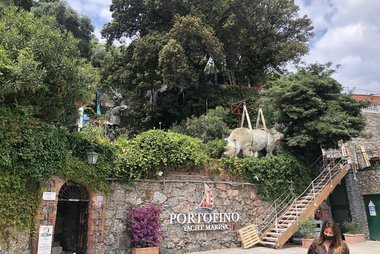
The harbour of Portofino and its Piazzetta, the small square at the water's edge, are the heart of the village. Sit at a café, watch the boats come in, and look up at the painted façades.
Chiesa di San Giorgio stands on the headland above the harbour, a 10-minute climb up stone steps. It keeps relics attributed to Saint George, and the terrace in front has one of the best views of the village.
Castello Brown is a former Genoese fort a little higher up. An English consul turned it into a villa in the 19th century; today it is a small museum with gardens and wide views over the bay.
Museo del Parco di Portofino is an open-air sculpture park on the terraced slope below the castle, on the same path up from the harbour.
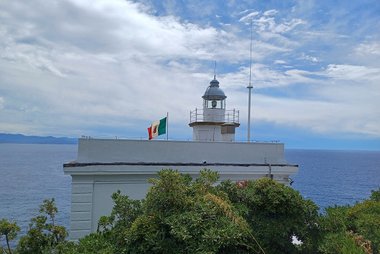
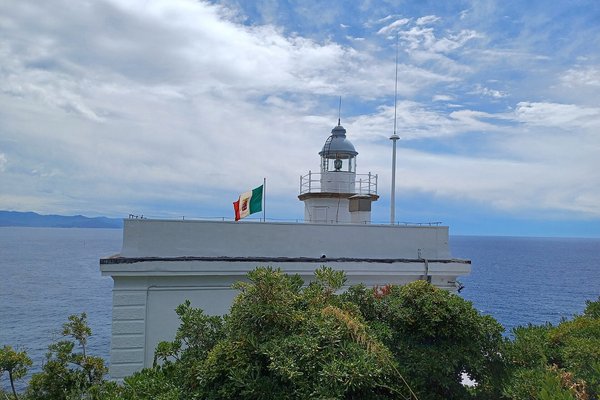
Faro di Portofino marks the tip of the promontory at Punta del Capo. A partly shaded path reaches it in about 20 minutes from the harbour, with views along the Gulf of Tigullio.
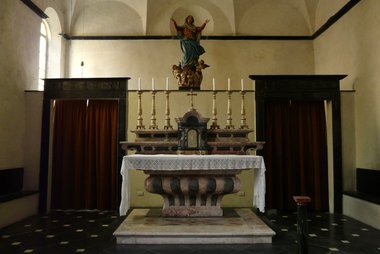
Chiesa del Divo Martino is the parish church, a short walk above the Piazzetta. It has Romanesque origins and a carved wooden Deposition inside. The small Oratorio di Nostra Signora Assunta next to it is the seat of the village confraternity.
San Fruttuoso Abbey sits in a small bay on the far side of the promontory, with no road access. Arrive by boat from the harbour or on foot through the park. The medieval abbey, its cloister and the Doria watchtower make it the most memorable trip from Portofino.
Christ of the Abyss is a bronze statue of Christ on the seabed of San Fruttuoso bay, placed there in 1954. It lies about 17 m down and is visited on guided dives from the bay.
Προτεινόμενες λίστες


Τι να ζήσεις
The best moments in Portofino happen on the water and on the trails around it.
- Boat to San Fruttuoso: Take the ferry around the promontory to the abbey in its tiny bay, then swim or have lunch on the pebble beach before the boat back.
- Hike over the promontory: Walk through holm-oak and pine woods from Portofino to San Fruttuoso, then continue to Camogli or return by boat.
- Snorkel or dive in the marine reserve: The waters around the promontory are a protected marine area. Dive centres run trips to the underwater Christ of the Abyss and to Wreck Mohawk Deer, a cargo ship that sank in 1967; guided kayak and snorkel tours explore the cliffs and coves.
- Aperitivo in the Piazzetta at sunset: Once the day visitors leave, the harbour turns quiet. An evening drink by the water is the classic Portofino ritual.
Περιηγήσεις και δραστηριότητες
Πορτοφίνο — Χάρτης

Ημερήσιες εκδρομές
Portofino is small, so it combines easily with the towns along the coast. Boats and the train make a car unnecessary.
- Santa Margherita Ligure – about 20 minutes by bus or 15 minutes by boat. A larger resort town with a long seafront, a fish market and the nearest train station. On the way you pass Paraggi, a small bay with the nearest sandy beach.
- Camogli – by boat via San Fruttuoso in summer, or on a full-day hike over the promontory. A fishing town with tall colourful houses right on a pebble beach.
- Rapallo – about 35–45 minutes by boat, with a stop in Santa Margherita Ligure. A larger town with a seafront promenade, and a small 16th-century castle standing in the sea.
- Recco – about 15 minutes by train from Santa Margherita Ligure. Known for its cheese focaccia.
- Genoa – about 40–60 minutes by train from Santa Margherita Ligure. A large port city with one of Europe's biggest medieval old towns, palaces on the Strade Nuove and a famous aquarium.
- Cinque Terre – about 1–1.5 hours by train from Santa Margherita Ligure, or by seasonal boat. Five villages on steep terraced cliffs, linked by trains, boats and hiking paths.
Μέρη για εξερεύνηση
Portofino sits on a promontory between two other Riviera towns, both easy to combine with a visit:
- Santa Margherita Ligure and Camogli are the closest bases, with more hotels and lower prices.
- Genoa is the regional capital and the main gateway by air and rail.
Farther east along the Ligurian coast:
- Cinque Terre with the villages of Monterosso al Mare, Vernazza and Riomaggiore.
- La Spezia, the port city at the eastern end of the Ligurian coast.
Πώς να πας
Portofino has no train station. Almost everyone arrives through Santa Margherita Ligure, 5 km away, and continues by bus or boat.
- By air: Genoa Cristoforo Colombo Airport is the closest, about 40 km away. The Volabus takes about 30 minutes to Genova Piazza Principe and Genova Brignole stations; continue by train to Santa Margherita Ligure, then by bus or boat. Milan and Pisa airports are farther away and take several hours by train. Genoa Airport
- By train: Santa Margherita Ligure–Portofino station is on the coastal line between Genoa and La Spezia. Trains from Genoa take about 40–60 minutes, and there are direct trains from Milan. Trenitalia
- By bus: Line 782 runs from Santa Margherita Ligure to Portofino in about 20 minutes, along a narrow coastal road. AMT Genova
- By boat: Scheduled ferries link Rapallo, Santa Margherita Ligure, Portofino and San Fruttuoso all year, with more trips in summer. Arriving by sea is the most scenic way in and avoids the road traffic. Servizio Marittimo del Tigullio
Μετακινήσεις
- On foot: The village is tiny and car-free around the harbour. Paths to the church of San Giorgio, the castle and the lighthouse are steep and stepped, so wear good shoes.
- Bus: On line 782 to Santa Margherita Ligure you can tap a contactless bank card or phone on the validator on board; the system charges the best fare automatically. Paper tickets are also sold in shops. AMT contactless payment
- Boat: Ferries and water taxis leave from the harbour for Santa Margherita Ligure, Rapallo and San Fruttuoso.
- Hiking: Marked trails of the Portofino Regional Park start just above the village. The path to San Fruttuoso takes about 2–2.5 hours each way, with steep, rocky sections.
- Cycling: Not practical. The only road is narrow and busy, and the trails are too steep for most riders.
Οδήγηση
- Is a car worth it?: No. The single road from Santa Margherita Ligure is narrow, winding and often jammed in summer, and the bus and boats are easier.
- Parking: The only car park is a multi-storey garage at the entrance of the village. It is small and expensive, and it fills early on summer days and weekends. A better option is to park in Santa Margherita Ligure and take the bus or boat.
- Restrictions: In the busy season, traffic police can stop cars at a checkpoint before Paraggi when the car parks are full. The harbour area is closed to cars.
Φαγητό & ποτό
Portofino follows the Ligurian kitchen: pesto with trofie or trenette pasta, focaccia, fresh fish and seafood, pansoti with walnut sauce, and fried anchovies. Look also for focaccia di Recco, a thin flatbread filled with soft cheese from the next bay.
Restaurants around the harbour and the Piazzetta are among the most expensive on the Riviera, and you pay for the view. For simpler food, buy focaccia from a bakery in the lanes behind the harbour, or eat in Santa Margherita Ligure or Camogli. The beach restaurants at San Fruttuoso are a popular lunch stop on the boat or hiking trip.
Ασφάλεια & υγεία
Portofino is very safe, and serious crime is rare. The main risks are practical:
- Prices: Check menu prices before you sit down at a harbour café; a coffee or a drink with a view can cost several times more than in nearby towns.
- Crowds: On summer days the narrow lanes and the harbour are crowded when boats arrive; keep an eye on bags and phones.
- Trails: Park paths are steep, rocky and slippery after rain, with little shade. Carry water, wear proper shoes and check the last boat time if you plan to return by sea.
- The sea: Swimming and boating are restricted in parts of the marine reserve. Follow the buoys and local signs.
Ιστορία
The Romans knew the harbour as Portus Delphini, the "port of the dolphin". In 986 the village was given to the abbey of San Fruttuoso Abbey, on the other side of the promontory. From the 13th century it belonged to the Republic of Genoa, which used the natural harbour as a shelter for ships.
Genoa fortified the headland above the village; that fort is today Castello Brown. In the 19th century an English consul, Montague Yeats-Brown, bought the ruin and turned it into a villa. Visitors from Britain and northern Europe followed, and Elizabeth von Arnim's 1922 novel The Enchanted April, inspired by a stay at the castle, made Portofino fashionable.
By the 1950s tourism had replaced fishing. Film stars arrived by yacht, and the song "Love in Portofino" spread the name around the world. The forest above the village and the sea around it are now protected as a regional park and a marine reserve, which is why the promontory still looks almost wild.
Στοιχεία για τη χώρα
Quick practical facts for Italy at a glance:
- Νόμισμα
- Ευρώ EUR € · Πληρωμές με κάρτα · Ευρέως αποδεκτές
- Τηλέφωνα έκτακτης ανάγκης
- 112
- Ηλεκτρικό ρεύμα
- 230 V · 50 HzΤύπος C / Τύπος F / Τύπος L
- Γλώσσες
- Ιταλικά
- Νερό βρύσης
- Πόσιμο
- Πλευρά οδήγησης
- Δεξιά
- Κωδικός κλήσης
- +39


Πορτοφίνο – Σχεδίασε τις ημέρες σου
Μετάτρεψε τα μέρη από αυτόν τον οδηγό σε ένα πραγματικό δρομολόγιο, με έξυπνη δρομολόγηση, εκτιμήσεις χρόνου και όλα όσα χρειάζεσαι για ένα τέλειο ταξίδι.


Σχετικοί προορισμοί
Data: © OpenStreetMap contributors, Wikidata, Wikipedia, Tripomatic, Official websites, geoBoundaries (CC BY 4.0). Tours by GetYourGuide. We earn commission from bookings. Travel guide generated with AI.
Σχεδίασε το ταξίδι σου με το Tripomatic
- Σχεδιασμός με AIΆφησε το AI να δημιουργήσει το δρομολόγιό σου, να απαντήσει σε ταξιδιωτικές ερωτήσεις και να αρχειοθετήσει τα έγγραφα των κρατήσεών σου στο ταξίδι σου.
- Ταξιδιωτικές ειδοποιήσειςΕπίσημες ταξιδιωτικές οδηγίες, έντονα καιρικά φαινόμενα, απεργίες και φυσικοί κίνδυνοι για τα μέρη σε κάθε ημέρα του ταξιδιού σου.
- Επίσημες αργίες & ΕκδηλώσειςΔες αργίες, φεστιβάλ και ημέρες μη λειτουργίας κατά τις ημέρες του ταξιδιού σου και πώς επηρεάζουν τα σχέδιά σου.
- Εκτίμηση κόστουςΑνάλυση του κόστους του ταξιδιού με AI, ώστε να γνωρίζεις τον προϋπολογισμό σου πριν ξεκινήσεις.
- Περιηγήσεις & ΕισιτήριαΚλείσε περιηγήσεις, εισιτήρια χωρίς αναμονή στην ουρά και δραστηριότητες απευθείας στο πλάνο σου.