


Bergamo
Bergamo is a two-layer city in the foothills of the Alps, an hour from Milan by train. Its walled hilltop old town, Città Alta, sits above a busier lower city, and two historic funiculars connect them. The upper town keeps its Venetian-era fortifications and medieval streets almost intact, while the lower town has grand 19th-century boulevards and everyday Italian city life.
It suits a traveler who wants an easy day or two: a compact, walkable old town with strong Renaissance and Venetian architecture, good food, and none of the crowds of Venice or Florence. Many visitors pass through only because of budget flights into the city's airport, but Bergamo rewards an overnight stay far more than a quick layover. The composer Gaetano Donizetti, one of opera's great names, was born here in 1797 and is still closely tied to the city's identity.

Bergamo – Planning a Trip?
Build your day-by-day itinerary in the Tripomatic app.
When to visit
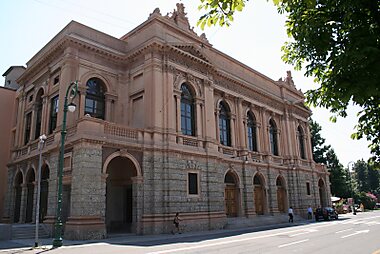
Spring and early autumn bring mild days and the clearest views from the old town's walls; summer is warm and can be humid, and winter is cold with occasional snow. Plan around the Donizetti Opera festival each November, when the composer's operas fill Teatro Donizetti and other venues around the city for about three weeks.
Best time to visit: June, September
September combines warm days with less of summer's humidity, making it a particularly good pick for a visit.
Top sights
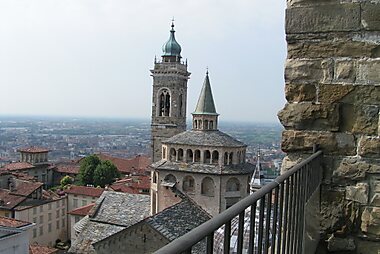
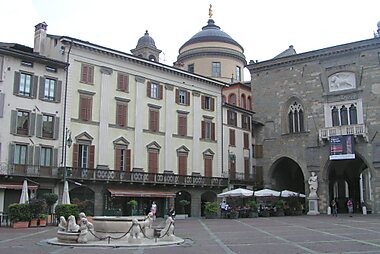
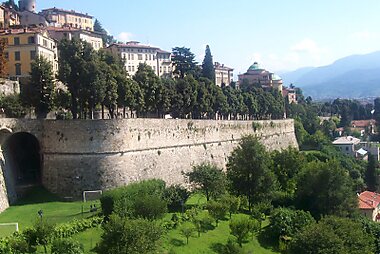
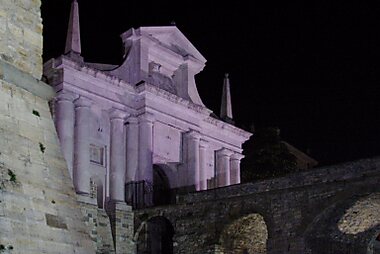
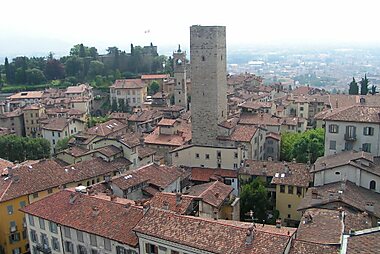


Start in Città Alta, the walled upper town, where nearly everything worth seeing sits within a 15-minute walk.
- Basilica di Santa Maria Maggiore is Bergamo's grandest church, a Romanesque exterior wrapped around a lavish Baroque interior with tapestries and inlaid wood panels.
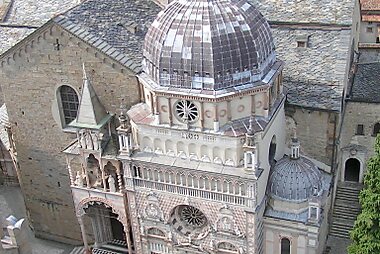
- Next door, Cappella Colleoni is a Renaissance mausoleum built for the condottiero Bartolomeo Colleoni, its striped marble facade among the finest in Lombardy.
- Piazza Vecchia is the old town's monumental heart, ringed by council buildings and cafes that have hosted city life for eight centuries.
- Climb Torre del Gombito for a rooftop view over the tiled roofs of the upper town.
- Mura Venete still encircles Città Alta almost completely and is part of a UNESCO World Heritage Site recognizing Venetian defensive architecture.
- Porta San Giacomo is the best preserved of the wall's four gates, and a good place to start or end a walk along the ramparts.
- Above the old town, Castello di San Vigilio crowns the hill of San Vigilio, reachable by a short second funicular and rewarding the climb with views over the plain toward Milan.
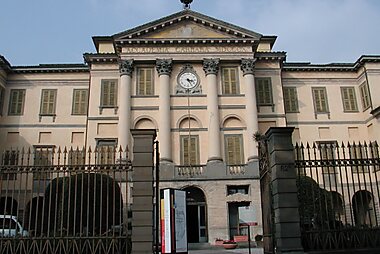
- Down in the lower town, Accademia Carrara holds one of Lombardy's best collections of Italian Renaissance painting.
Featured Lists


Churches and Shrines
Bergamo’s spiritual landscape is defined by architectural landmarks spanning centuries. The Upper Town features the Romanesque Basilica of Santa Maria Maggiore with its Renaissance Colleoni Chapel and the octagonal Tempietto di Santa Croce. In the Lower Town, Baroque churches like Sant'Alessandro in Colonna and Sant'Alessandro della Croce house significant religious artworks. Notable sites include San Michele al Pozzo Bianco with its Lorenzo Lotto frescoes and the tranquil Astino Abbey, reflecting the city's evolution from medieval strongholds to ornate Renaissance and Baroque centers.
14 places

Audio Guides – Bergamo
Explore on foot with a self-guided audio tour that narrates each stop as you reach it.


Hear Bergamo's audio tours
1 walk in Audio Guides by Tripomatic


What to experience
Bergamo's best rituals are tied to its two levels and its native composer.
- Ride the Funicolare funicular up to Città Alta, then take the second, smaller funicular further up to San Vigilio for the view over the plain — riding both is part of the Bergamo experience, not just a way to get somewhere.
- Catch a performance during the Donizetti Opera festival each November, when Teatro Donizetti and other venues around the city stage the composer's own operas.
- Walk a stretch of the city walls at sunset, when the light over the Alpine foothills and the plain below is at its best.
Tours & Activities
Bergamo — Map

 Open the interactive map
 Day trips
Bergamo makes a good base for day trips into the wine country, lakes, and mountains of Lombardy.
- Franciacorta wine region — about 30–40 minutes by car. Italy's leading sparkling-wine region, with dozens of small producers open for tastings and cellar tours.
- Lake Iseo — about 40 minutes by car or direct bus. A quieter, less crowded lake than Como or Garda, with boat trips out to Monte Isola, the largest lake island in southern Europe.
- Val Seriana and Val Brembana — about 30–45 minutes by car or bus (Val Seriana also has a light-rail line to Albino). The mountain valleys just north of the city offer hiking trails and small alpine villages, an easy escape from summer heat in the lowlands.
- Lake Como — about an hour by car, longer by train with a change. One of Italy's most famous lakes, with dramatic mountain scenery and grand lakeside villas.
- Milan — about 50 minutes by direct train. Italy's fashion and design capital makes an easy day trip from Bergamo, which is often cheaper to fly into than Milan itself.
Getting there
- By air: Milan Bergamo Airport (BGY, also known as Orio al Serio), about 5 km from the centre, is a major hub for low-cost flights across Europe. Airport buses reach the centre of Bergamo in around 15 minutes; other buses connect directly to Milan's centre in under an hour and to Linate in about the same time, while reaching Malpensa by bus takes closer to 90 minutes.
- By train: Bergamo's railway station has direct trains to Milan (about an hour) and to Brescia, Lecco, and other towns in Lombardy.
- By bus: Long-distance coaches connect Bergamo to Milan and other Italian and international cities, mainly from the bus station next to the railway station.
Getting around
- Public transit: ATB runs the local bus network, plus the two funiculars linking the lower town to Città Alta and on to San Vigilio. Tap a contactless bank card or phone directly on board to pay as you go — this now works across the ATB network. Tickets can also be bought in advance from tobacconists, ATB machines, or the ATB app.
- On foot: The lower town is flat and easy to walk. Città Alta is compact but steep and cobbled in places — the Funicolare funicular is the easiest way up if you would rather not climb.
- Cycling: Practical in the flat lower town, less so on Città Alta's hills and stairs.
Driving
- Is a car worth it?: Not for the historic centre — it's compact and walkable, and Città Alta has a restricted traffic zone (ZTL) enforced by camera. A car is useful for reaching Franciacorta, the lakes, or the mountain valleys at your own pace.
- Parking: Park in one of the multi-storey car parks in the lower town near the base of the walls, or at a park-and-ride further out; the historic centre itself has very limited street parking.
- Restrictions: Città Alta's ZTL is closed to non-resident traffic; check signage before driving up, since fines are issued automatically by camera.
Food & drink
Bergamo's kitchen is built around hearty mountain food: casoncelli, pasta parcels stuffed with meat, breadcrumbs, and pancetta, and polenta served alongside braised meats or small game birds. Look out too for local cured meats and cheeses from the valleys just north of the city.
For something special, Caffè del Tasso is a historic cafe on Piazza Vecchia that has served coffee and drinks since the 15th century. Otherwise, the streets around Via Colleoni in Città Alta and the Sentierone promenade in the lower town both cluster good, casual places to eat.
Safety & health
Bergamo is a safe city for travelers, with petty crime largely limited to pickpocketing in crowds around Piazza Vecchia, the funicular stations, and the railway station. Keep bags zipped and be aware of your belongings in these spots, as anywhere else in Italy.
Tap water is safe to drink throughout the city.
History
Bergamo's split identity comes from its history. The lower town's Roman and medieval origins as Bergomum gave way to a self-governing medieval commune, visible today around Piazza Vecchia, where the arcaded Palazzo della Ragione once housed the city's law courts and public assemblies.
From 1428 to 1797, Bergamo was a border outpost of the Republic of Venice, and this period left the deepest mark: the Mura Venete were built in the late 1500s to defend the city and are now recognized, together with similar Venetian defenses elsewhere in Europe, as a UNESCO World Heritage Site. Each evening, the bell of the Campanone still rings 100 times, a tradition recalling the old curfew that once closed the city gates.
The composer Gaetano Donizetti, born in Bergamo in 1797, is the city's most famous native son; Teatro Donizetti carries his name and stages his operas every November.
Country facts
Quick practical facts for Italy at a glance:
- Currency
- Euro EUR € · Card payments · Widely accepted
- Emergency numbers
- 112
- Electricity
- 230 V · 50 HzType C / Type F / Type L
- Languages
- Italian
- Tap water
- Safe to drink
- Driving side
- Right
- Calling code
- +39


Bergamo – Plan Your Days
Turn the places from this guide into a real itinerary, with smart routing, time estimates, and everything you need for a perfect trip.




