



Bosnia and Herzegovina
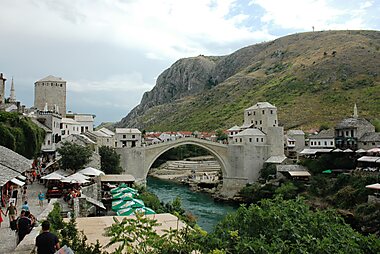
Bosnia and Herzegovina sits where Central Europe meets the Balkans: a compact, mostly mountainous country that is not landlocked — a short strip of Adriatic coastline reaches the sea at Neum. Centuries of Ottoman and Austro-Hungarian rule left mosques, churches, and a synagogue standing within a few streets of each other in Sarajevo, and Ottoman-era mosques and bridges define Mostar. The assassination of Archduke Franz Ferdinand at Sarajevo's Latin Bridge in 1914 set off the chain of events that led to the First World War, and the 1992-1995 war is still part of the story many visitors come to understand today.
The country suits travelers who enjoy history with texture and prices that stretch further than in Western Europe. Sarajevo rewards a few unhurried days of walking. Herzegovina's limestone rivers and Ottoman-era bridges make classic day trips from Mostar. The mountains around Jajce, Bihać, and the eastern border see fewer visitors but offer good hiking, rafting, and skiing.




Bosnia and Herzegovina – Planning a Trip?
Build your day-by-day itinerary in the Tripomatic app.


Money & payments
Bosnia and Herzegovina uses the convertible mark, pegged to the euro at a fixed rate, so prices are easy to estimate if you already know rough euro costs.
Cards work in most hotels, restaurants, and supermarkets in Sarajevo, Mostar, and other cities, but smaller shops, local buses, and rural guesthouses often expect cash. ATMs are common in town centers but can be scarce in mountain villages, so withdraw money before heading into national parks.
Featured Lists


Tours & Activities
Bosnia and Herzegovina — Map

 Open the interactive map
 Tipping
Tipping is informal and appreciated rather than obligatory. In restaurants, rounding up the bill or adding around 10% is common when service was good; a written service charge is rare. Bar and café tabs usually get rounded up too. Taxi drivers expect the fare rounded up rather than a separate tip. Hotel porters and private tour guides are the main exceptions, where a small tip is genuinely expected.
round up or ~10%
round up
round up
1-2 KM for porters
10-20 KM per day
Electricity
Bosnia and Herzegovina uses Type C and F plugs at 230 V / 50 Hz, the standard continental European socket. Most phone and laptop chargers work without an adapter.
Language
Bosnian, Croatian, and Serbian are all official languages. For a visitor they are effectively one spoken language, though two alphabets are in use: Latin script is standard in tourist areas, and Cyrillic is more common on road signs and shopfronts in Republika Srpska. English is widely understood in Sarajevo, Mostar, and other tourist hubs, especially among younger people, but less so in small towns and rural areas.
Staying connected
Prepaid SIM cards are cheap and easy to buy at any of the main operators' shops with your passport — plan for a quick ID check at the counter. Coverage is strong along the main road corridors and in cities, but can drop out in mountain valleys and some national parks, so download offline maps before heading into remote areas.
Safety & emergencies
Bosnia and Herzegovina is a safe country for visitors, and violent crime targeting tourists is rare. The most common issues are pickpocketing in busy tourist areas of Sarajevo and Mostar, and overcharging by unlicensed taxis — use a metered or app-booked taxi instead.
One serious hazard is practical, not criminal: large areas of countryside away from marked paths and roads still contain landmines left from the 1992-1995 war. Stick to marked trails and paved roads, especially in former conflict zones, and never enter abandoned buildings or overgrown fields in the countryside.
Health
Tap water is generally treated as safe in Sarajevo and other major cities, but bottled or filtered water is the safer default in smaller towns and rural guesthouses, where the source is less certain. Pharmacies (apoteka) are common in towns and cities, well stocked, and usually staffed by someone who speaks enough English to help with common ailments; a rotating pharmacy stays open outside normal hours in larger cities. No special vaccinations are required beyond routine immunizations, though a tick-borne encephalitis vaccine is worth considering before extensive hiking in forested areas.
Visas & entry
Citizens of the EU, UK, US, Canada, Australia, and many other countries can enter Bosnia and Herzegovina visa-free for stays of up to 90 days. Travelers who would otherwise need a visa can often enter using a valid Schengen or US visa or residence permit instead of applying separately; check current rules before booking. Those who do need a visa can apply at a Bosnian embassy or consulate in advance.
Visa and entry requirements change frequently. Verify current requirements with the official immigration authority or your country's embassy before travel.
Etiquette
- Religious sites: cover shoulders and knees when visiting a mosque, and women should bring a scarf for their hair; wraps are often available to borrow at the entrance. Remove shoes before entering a mosque's prayer hall.
- War history: sites tied to the 1992-1995 war, including Sarajevo's siege-era landmarks and the Memorial Center Srebrenica, are places of memory, not photo backdrops. Keep a quiet, respectful tone.
- Coffee culture: being invited for Bosnian coffee is a genuine social ritual. Take your time rather than rushing through it, and expect to be offered a refill.
- Greetings: a handshake is standard; among people who know each other well, a cheek kiss on both sides is common.
Holidays & opening hours
Bosnia and Herzegovina's two entities, the Federation of Bosnia and Herzegovina and Republika Srpska, observe some different public and religious holidays alongside the shared national ones, so exact closures can vary by region.
Most shops and bakeries open early and close by early evening, and many close on Sundays outside big-city centers. Restaurants and cafés keep long hours and rarely close for a midday break.
Getting around
- By bus: the main way to move between cities. Frequent coaches connect Sarajevo, Mostar, Banja Luka, and Tuzla; buy tickets at the station shortly before departure.
- By train: a limited, slow network. The scenic Sarajevo–Mostar–Ploče line is worth the ride for the views, but rail does not reach most smaller towns.
- By air: domestic flights are not practical given the country's small size. Sarajevo, Banja Luka, Tuzla, and Mostar each have an international airport for arriving from abroad.
A rental car is the easiest way to reach smaller towns like Jajce, Travnik, and the Herzegovina countryside that buses serve less often.
Driving
- Key rules: headlights on at all times, even in daylight. The blood-alcohol limit is effectively zero for driving. Winter tires or chains are required on mountain roads from November through April.
- Tolls: no nationwide vignette. The short A1 motorway section charges a toll at staffed barriers as you pass through.
- Parking: paid parking zones operate in city centers, usually pay-by-meter or by parking-zone SMS or app; free parking is easy to find outside the centers.
- Fuel: stations are staffed, not self-service, and take cards. Ask for Eurosuper 95 or Super 98 for petrol and Dizel for diesel.
- Mountain driving: many rural and mountain roads are narrow and winding, with limited lighting after dark. Allow more time than the distance suggests, especially around Jajce and toward the eastern border.
Food & drink
Bosnian food blends Ottoman traditions with Central European habits from the Austro-Hungarian era. Breakfast is often simple — bread, cheese, and a strong coffee — while lunch is the main meal of the day, built around grilled meat, stews, or filled pastries. Restaurants and family-run aščinica canteens serve slow-cooked, home-style dishes at lunchtime, and dinner tends to be lighter or eaten later in the evening in cities.
Grilled ćevapi and flaky burek are the dishes visitors remember most, alongside stuffed vegetables, thick bean stews, and pastries filled with spinach or potato. Bosnian coffee is simmered in a small copper pot and served with a sugar cube; it is meant to be shared slowly, not rushed like a coffee-to-go. Rakija, a strong fruit brandy, is the traditional welcome shot. Markets and bakery counters sell burek and other pastries by weight, cut into wedges, as an everyday snack rather than a sit-down meal.
Where to explore
Bosnia and Herzegovina's short list of larger cities each has a distinct character. Sarajevo, the capital, mixes Ottoman-era Sarajevo Old Town with Austro-Hungarian boulevards and living memory of the 1990s siege. Mostar is built around its rebuilt Ottoman bridge and the karst rivers of Herzegovina nearby. In the north, Banja Luka and Tuzla see far fewer foreign visitors but offer an easier-paced, more local look at the country. Bihać is the gateway to whitewater rafting on the Una river.
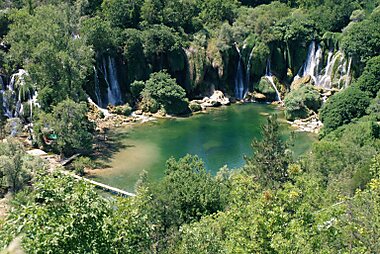
History-focused travelers should add Trebinje's Ottoman old town in the far south, the fortress town of Jajce with a waterfall at its center, and hillside Travnik, once the seat of Ottoman governors. For nature, Sutjeska National Park protects the country's highest peak and one of Europe's last primeval forests, Una National Park centers on turquoise waterfalls and rafting, and the small coastal town of Neum is Bosnia and Herzegovina's only stretch of coastline.
Bosnia and Herzegovina – Plan Your Trip
Pick the places you want to see and Tripomatic turns them into a day-by-day route, with smart routing, time estimates, and everything you need for a perfect trip.




