



Cape Town
Cape Town sits where Table Mountain drops straight into the Atlantic Ocean, giving it one of the most dramatic settings of any city in the world. Its character is shaped by layers of history: Cape Dutch buildings from the 17th century, the scars of forced removals under apartheid, and Nelson Mandela's imprisonment on nearby Robben Island.
The city works well as a base for three to five nights, combining a walkable centre with day trips into the mountains, vineyards, and beaches of the wider peninsula. Hikers, surfers, and wine lovers all find something here, which is part of why Cape Town draws more visitors than any other South African city.

Cape Town – Planning a Trip?
Build your day-by-day itinerary in the Tripomatic app.


When to visit
Cape Town's seasons are reversed from the Northern Hemisphere. Summer (December-February) is warm, dry, and often windy from the "Cape Doctor" southeaster. Winter (June-August) is cooler and brings most of the year's rain.
Plan around the Cape Town Minstrel Carnival on January 2nd. Thousands of costumed minstrel troupes parade through the city centre singing and dancing, a tradition unique to Cape Town.
Best time to visit: January, February, March, April, May, October, November, December
Pack a windbreaker for the coast in any season, even when the city itself feels mild.
Top sights

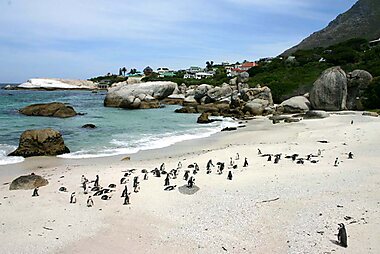
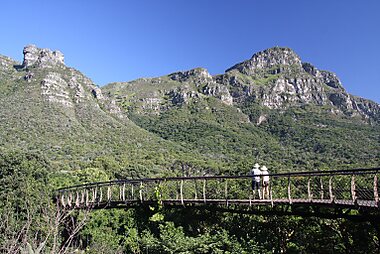
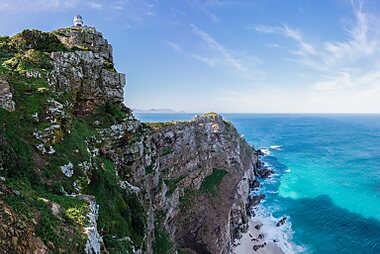
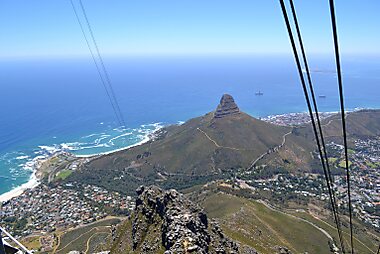
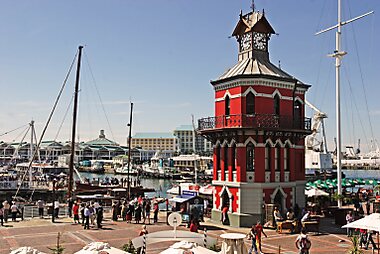
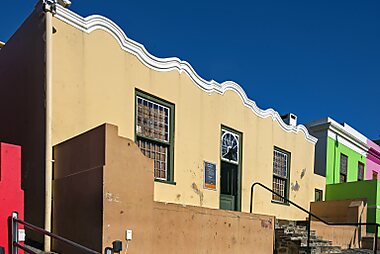
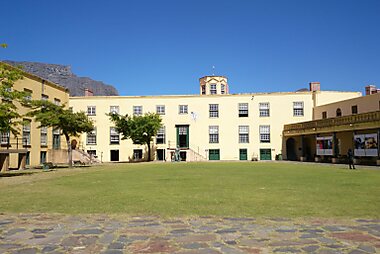
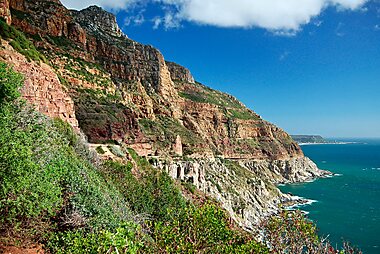
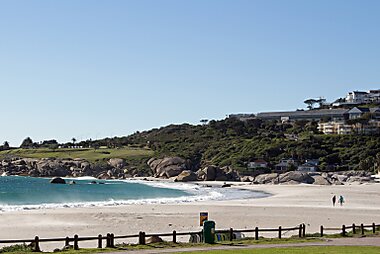
Table Mountain rises straight above the city and is the view every visitor comes for. Ride the rotating cable car to the flat summit for panoramas over the Atlantic, or hike up on one of several marked trails.
A ferry from the V&A Waterfront reaches Robben Island Museum, the former prison island where Nelson Mandela and other anti-apartheid leaders were held; tours are often led by former political prisoners.
V&A Waterfront combines Cape Town's working harbour with shops, restaurants, and boat departures, and makes a good base for an evening out.
At the tip of the peninsula, Cape Point offers dramatic cliffs, hiking trails, and a historic lighthouse close to where the Atlantic and Indian Ocean currents meet.
The African penguin colony at Boulders Beach nests right on the sand, letting visitors watch the birds from boardwalks just metres away.
Kirstenbosch Botanical Gardens, on the eastern slopes of Table Mountain, showcases South Africa's unique fynbos plant life along a canopy walkway with mountain views.
The brightly painted houses and cobbled streets of Bo-Kaap preserve one of Cape Town's oldest residential neighbourhoods and its Cape Malay heritage.
District Six Museum tells the story of the forced removal of 60,000 residents from the neighbourhood during apartheid, through personal testimonies and a floor map annotated by former residents.
Featured Lists


Editor's Choice: Cape Town Highlights
Cape Town’s landscape is defined by Table Mountain’s iconic flat-topped silhouette and the diverse flora of Kirstenbosch Botanical Gardens, situated on its eastern slopes. Along the Victoria & Alfred Waterfront, the Two Oceans Aquarium showcases marine life from where the Atlantic and Indian Oceans meet. The city's historical and scientific contributions are highlighted at the South African Jewish Museum, which details immigrant heritage, and the Heart of Cape Town Museum in Observatory, the site of the world’s first successful human heart transplant.
5 places


What to experience
- Hike Lion's Head at sunset or under the full moon — a local ritual, with a line of headlamp-lit hikers on the busiest full-moon nights.
- Buy fish straight off the boats and watch the daily catch come in at the harbour in Kalk Bay.
- Take a surf lesson at Muizenberg Beach, the city's main beginner-friendly surf beach.
- Join a tasting at Groot Constantia Manor House or another Constantia estate, in South Africa's oldest wine-growing valley.
Tours & Activities
Cape Town — Map

 Open the interactive map
 Day trips
Cape Town sits close to South Africa's wine country, and a scenic coastal drive reaches one of the best places to watch whales from shore.
- Stellenbosch — about 45 minutes by car, or around 1 hour by train with a change at Bellville. South Africa's second-oldest town, with oak-lined streets, Cape Dutch architecture, and dozens of wine estates offering tastings.
- Franschhoek — about 1 hour by car. Founded by French Huguenot refugees, now known for its gourmet restaurants and wine estates along a dramatic mountain pass.
- Hermanus — about 1.5-2 hours by car. One of the best land-based whale-watching spots in the world; southern right whales come close to the cliffs from June to November.
All three are best reached by car or an organized tour; rail service is limited outside the Stellenbosch line.
Getting there
- By air — Cape Town International Airport (CPT) is about 20 km from the centre. Take the MyCiTi airport shuttle (around 30 minutes) or a metered taxi or ride-hailing car (20-30 minutes depending on traffic).
- By train — Cape Town's main railway station on Adderley Street is the terminus for long-distance rail. The Shosholoza Meyl service reaches Johannesburg in about 26 hours.
- By bus — Intercape, Greyhound, and Translux coaches link the main bus terminal at the railway station to Johannesburg, Durban, and towns along the Garden Route.
Getting around
- Public transit — The MyCiTi bus rapid transit network covers the city centre, the Atlantic seaboard, and the airport. Buy and load a reusable myconnect card at a station or kiosk before boarding. MyCiTi journey planner
- Taxi and ride-hailing — Uber and Bolt operate widely and are the easiest way to reach areas outside the MyCiTi network, including most Cape Peninsula sights.
- On foot — The City Bowl and V&A Waterfront are walkable by day; avoid walking alone after dark.
Driving
- Left-hand traffic — South Africa drives on the left, unlike most of mainland Europe and the Americas.
- Is a car worth it? — Not needed for the city centre and Waterfront, but genuinely useful for the wider Cape Peninsula (Cape Point, Boulders Beach, Constantia) and the Winelands, where public transport is limited.
- Parking — Metered street parking is common; informal car guards in reflective vests help you park and expect a small tip of R5-10.
- Chapman's Peak Drive charges a toll and hugs a cliff between Hout Bay and Noordhoek. It can close after heavy rain or rockfall, so check conditions first.
Food & drink
Cape Town's food reflects its Cape Malay, Dutch, and coastal roots. Bo-Kaap is the best place to try Cape Malay dishes like bobotie and koeksisters, cooked in family-run kitchens. The Atlantic and False Bay coastlines supply excellent fresh seafood, especially West Coast rock lobster and snoek.
For dining and nightlife, head to Bree Street and Kloof Street in the City Bowl, both lined with restaurants and bars, or the food market at V&A Waterfront for casual harbourside eating. The harbour at Kalk Bay is the spot for fish and chips straight off the boats.
Safety & health
Cape Town is generally safe for tourists in well-populated areas, but petty crime is more common here than in many other major destinations. Bag snatching and opportunistic theft happen in busy tourist areas and on quiet streets after dark. Keep valuables out of sight, avoid displaying phones or jewellery, and use registered taxis or ride-hailing apps rather than unmarked minibus taxis.
Avoid walking alone after dark, particularly around the city centre and Company's Garden. Smash-and-grab theft from parked or stationary cars occurs, so keep bags out of view. At the beaches, swim only where lifeguards are present — currents at some Atlantic-facing beaches can be strong.
History
Cape Town began in 1652 as a Dutch East India Company supply station, laid out around what is now Company's Garden, planted to grow fresh produce for ships rounding the Cape. The Dutch built Castle of Good Hope between 1666 and 1679 to defend the young settlement; it remains the oldest colonial building in South Africa.
Under apartheid, the government declared District Six a "whites-only" area in 1966 and forcibly removed some 60,000 residents; District Six Museum preserves their stories today. St. George's Cathedral became known as the "People's Cathedral" during the same period, when Archbishop Desmond Tutu led anti-apartheid marches from its steps. A short ferry ride away, Robben Island Museum held Nelson Mandela and other political prisoners for decades before his release in 1990 helped end apartheid rule.
Country facts
Quick practical facts for South Africa at a glance:
- Currency
- South African Rand ZAR R · Card payments · Widely accepted
- Electricity
- 230 V · 50 HzType C / Type D / Type M / Type N
- Languages
- Afrikaans, English, South Ndebele, Swati, Southern Sotho, Tswana, Tsonga, Venda, Xhosa, Zulu
- Tap water
- Safe to drink
- Driving side
- Left
- Calling code
- +27


Cape Town – Plan Your Days
Turn the places from this guide into a real itinerary, with smart routing, time estimates, and everything you need for a perfect trip.


Related destinations
Other Destinations
Data: © OpenStreetMap contributors, Wikidata, Wikipedia, Tripomatic, Official websites, geoBoundaries (CC BY 4.0). Tours by GetYourGuide. We earn commission from bookings. Travel guide generated with AI.