



Chamonix
Chamonix sits in a narrow valley beneath Mont Blanc, Western Europe's highest peak, in the French Alps near the Swiss and Italian borders. It is the birthplace of modern mountaineering: the sport began here in 1786, and Chamonix hosted the first Winter Olympic Games in 1924. The town center is compact and easy to walk, ringed by cable cars that climb straight into the high mountains within minutes.
Visit for the mix of high-altitude thrills and an easy base: ride a cable car above 3,800 m for lunch, then walk back to a hotel in the valley. It suits hikers, skiers, and anyone who wants dramatic mountain views without a multi-day trek. Chamonix draws climbers and adventure travelers as much as sightseers, so expect an active, outdoor-focused town rather than a quiet resort.

Chamonix – Planning a Trip?
Build your day-by-day itinerary in the Tripomatic app.


When to visit
Chamonix has two distinct high seasons. Winter (December-March) is for skiing; valley days are cold, but sunny spells are common. Summer (June-September) is for hiking and climbing; valley days are mild, though nights stay cool even in August. Spring and autumn are quieter, and many high-altitude lifts and via ferratas close for maintenance.
Plan around the Ultra-Trail du Mont-Blanc (UTMB), a week-long trail-running festival held in late August. Thousands of runners and spectators fill the town, and accommodation books out months ahead.
Top sights
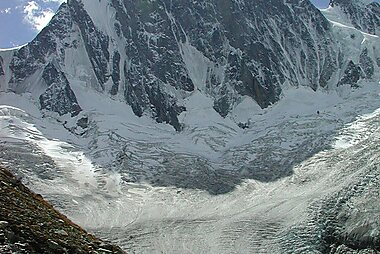
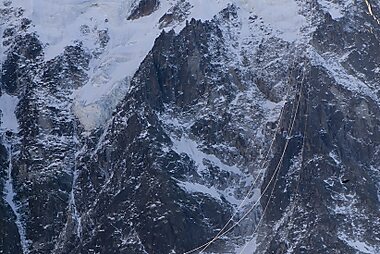
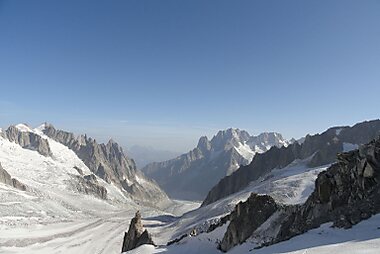

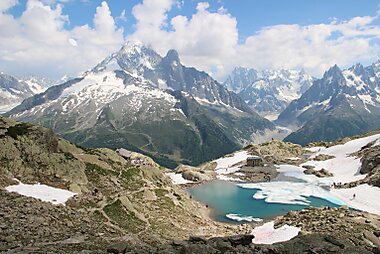

Mont Blanc - Monte Bianco is the highest peak in the Alps and Western Europe, at around 4,805 m. Only experienced climbers with a guide reach the summit, but the mountain dominates every view from town.
Aiguille du Midi is a cable car station at 3,842 m, among the highest in the world. The glass-floored Pas dans le Vide skywalk and the Panoramic Mont-Blanc gondola to Italy's Punta Helbronner both start here.
Mer de Glace is France's largest glacier, reached by a historic cog railway. Its ice has thinned sharply in recent decades, and signposts along the path mark how far it has retreated.
Le Brévent faces Mont Blanc directly across the valley and gives one of the best views of the whole massif. A cable car runs to the summit from the edge of town.
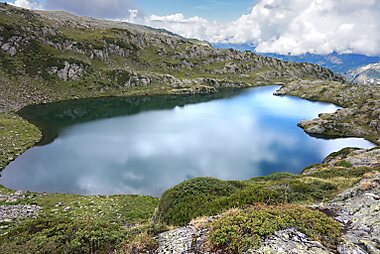
Lac Blanc is a turquoise lake below the Aiguilles Rouges, reached on a half-day hike from the La Flégère cable car. On clear days it reflects Mont Blanc.
Grands Montets – Argentière (Chamonix) is the valley's most challenging ski area, with long, steep runs and reliable snow into spring.
Église Saint-Michel is Chamonix's parish church, rebuilt in the 18th century and the main landmark on the town's central square.
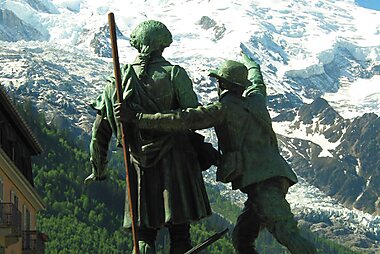
Statue of Horace Bénédict de Saussure stands in the town center and marks the men who first climbed Mont Blanc in 1786, a moment widely considered the birth of mountaineering.
Featured Lists


What to experience
- Ride the Panoramic Mont-Blanc gondola from the Aiguille du Midi across the glacier to Punta Helbronner in Italy, one of the highest border crossings by cable car in the world.
- Watch, or join, the Ultra-Trail du Mont-Blanc in late August, when thousands of runners pass through town on a route that circles the entire massif.
- Try the Vallée Blanche, a 20 km off-piste ski descent from the Aiguille du Midi across a glacier; book a mountain guide, since crevasses make it unsafe alone.
- Spend a night in a mountain refuge partway up a trail, waking up at altitude before the day's crowds arrive.
Tours & Activities
Chamonix — Map

 Open the interactive map
 Day trips
Chamonix sits close to the French, Italian, and Swiss borders, so several very different day trips are within reach.
- Les Houches - 10 minutes by car or train, a quieter ski and hiking village at the start of the Tour du Mont-Blanc trek.
- Servoz - 20 minutes by car or train, gateway to the Gorges de la Diosaz, a dramatic river canyon with waterfalls and walkways.
- Courmayeur - 35-45 minutes by car through the Mont Blanc Tunnel, an Italian Alpine town with its own cable car, the Skyway Monte Bianco, up to Punta Helbronner.
- Martigny - about 1 hour by car, or closer to 2 hours by train with a change at the border, a Swiss town with Roman ruins and the Fondation Gianadda art museum.
- Annecy - about 1.5 hours by car, or closer to 2.5 hours by train with a change, a lakeside old town with canals and a well-preserved medieval quarter.
Getting there
- By air: Geneva Airport (GVA) in Switzerland is the main gateway, about 90 km away. Shuttle buses and private transfers take roughly 1-1.5 hours. Lyon-Saint-Exupéry (LYS) is a second option, about 2.5 hours away by car.
- By train: Take a train to Saint-Gervais-les-Bains-Le Fayet, reachable directly from Paris, then change to the narrow-gauge Mont-Blanc Express, which climbs to Chamonix in about 40 minutes. Book both legs via SNCF Connect.
- By bus: Regular coaches connect Chamonix with Geneva Airport, Geneva city center, and Annecy, useful when flying into Geneva without a rental car.
Getting around
- Public transit: A local shuttle bus connects the center with outlying hamlets like Argentière and Les Houches; guests holding the resort's guest card ride free, others buy a ticket on board. The Mont-Blanc Express train also stops at village stations along the valley floor.
- Taxi / ride-hailing: Local taxi companies serve the valley; app-based ride-hailing is limited outside peak season.
- On foot / cycling: The town center is compact and easy to explore on foot. A flat, paved cycle path runs the length of the valley between Chamonix and Servoz, a pleasant way to see several villages without a car.
Driving
- Is a car worth it? Not needed for the town center, which is compact and walkable, but useful for day trips to Courmayeur, Martigny, or Annecy and for reaching outlying hamlets and trailheads.
- Parking: Several paid car parks sit around the center, including near the train station and the Aiguille du Midi cable car base; pay by app or at machines. Street parking in the center is limited and metered.
- Restrictions: The Mont Blanc Tunnel toward Italy charges a toll; carry a card or cash for the booth.
Food & drink
Chamonix's kitchens lean into Savoyard mountain food: melted cheese dishes like fondue and raclette, tartiflette (potatoes baked with reblochon cheese, bacon, and onion), and diots (small pork sausages) simmered in white wine. After a day on the mountain, a génépi liqueur is a common way to finish a meal.
For a sit-down meal, the streets around Place Balmat and Rue du Docteur Paccard in the old center have the highest concentration of restaurants. A handful of Michelin-recognized kitchens in town are worth booking ahead for something more distinctive.
Safety & health
Chamonix is generally very safe. Petty theft is rare but does happen around cable car queues and train stations in peak season, so keep bags zipped and in sight.
The real risks here are outdoors: mountain weather changes fast, glaciers hide crevasses, and altitude affects even short excursions above 3,000 m. Never leave marked trails or step onto a glacier without a guide, and check conditions before any high-altitude trip. In winter, avalanche risk off-piste is real; always check the daily bulletin before leaving the marked runs. Mountain rescue is well organized, but a rescue can be costly without travel insurance that covers mountain activities.
Tap water is safe to drink everywhere in town.
History
Chamonix was a quiet farming valley until Jacques Balmat and Michel-Gabriel Paccard reached the summit of Mont Blanc - Monte Bianco on 8 August 1786, spurred by a prize offered by the scientist Horace-Bénédict de Saussure. Their climb is widely considered the birth of modern mountaineering, and the town has drawn climbers ever since. A statue in the town center, Statue of Horace Bénédict de Saussure, marks the achievement.
Tourism grew through the 19th century as roads and hotels reached the valley, and the Mer de Glace glacier became a stop on the Grand Tour of Europe. In 1924, Chamonix hosted the first Winter Olympic Games, cementing its place as a mountain sports capital. The Mont Blanc Tunnel, opened in 1965, connected the valley directly to Italy and reshaped Chamonix into the year-round resort it is today.
Country facts
Quick practical facts for France at a glance:
- Currency
- Euro EUR € · Card payments · Widely accepted
- Emergency numbers
- 112
- Electricity
- 230 V · 50 HzType C / Type E
- Languages
- French
- Tap water
- Safe to drink
- Driving side
- Right
- Calling code
- +33


Chamonix – Plan Your Days
Turn the places from this guide into a real itinerary, with smart routing, time estimates, and everything you need for a perfect trip.




