



Jordan
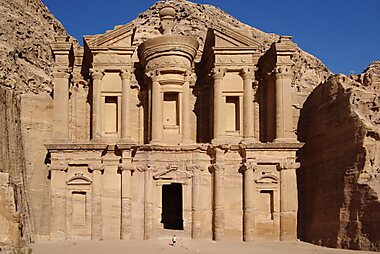
Jordan is a small country in the Middle East, packed with historic and natural sights: the rock-cut city of Petra, the desert landscapes of Wadi Rum, and the mineral-rich waters of the Dead Sea. It has stood as a crossing point between Africa, Asia, and Europe for thousands of years, and its Roman ruins, Byzantine churches, and Crusader castles reflect that long history. Jordan has stayed peaceful and stable through decades of regional turmoil, and its people are known for warm hospitality toward visitors.
The country suits a wide range of travelers: history lovers exploring ancient ruins, hikers drawn to canyons and desert trails, and anyone wanting to float in the Dead Sea or relax on the Red Sea coast at Aqaba. Most trips combine the capital, Amman, with a loop south through Petra and Wadi Rum. Jordan is compact, so a week to ten days is enough to see its main highlights.




Jordan – Planning a Trip?
Build your day-by-day itinerary in the Tripomatic app.


Money & payments
Carry cash for taxis, small shops, and sites outside the main cities — card machines are not always available there. ATMs are easy to find in Amman and the main tourist areas.
Featured Lists

Jordan's Absolute Essentials
Jordan offers a diverse range of historical and natural landmarks. This selection includes the Nabatean wonders of Petra, such as the rose-red Treasury and the Siq's sandstone canyon. In the desert, Wadi Rum features massive granite formations and red dunes, while Quseir Amra and Shoubak showcase Umayyad and Crusader architecture. The Dead Sea provides hyper-saline waters and panoramic views from its cliffs. In Madaba, ancient Byzantine mosaics are preserved in Saint George Church and local museums, reflecting the region's deep religious heritage.
13 places
Jordan's Archaeological Wonders
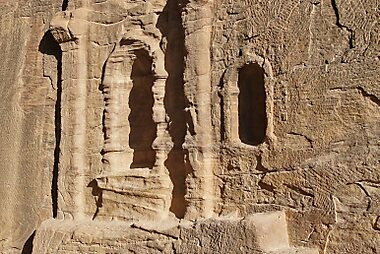
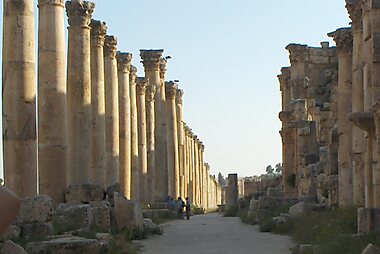
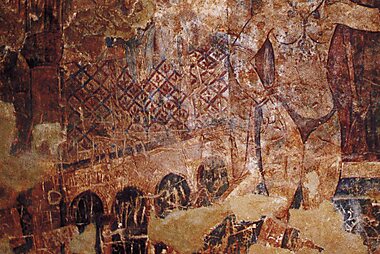
Jordan's landscape serves as a vast open-air museum, spanning the Early Bronze Age at Bab edh-Dhra to the 8th-century Umayyad desert castles like Quseir Amra and Qasr Mshatta. This collection highlights the Nabataean architectural mastery found in the rock-cut tombs and temples of Petra and Little Petra, alongside the Greco-Roman urban planning of the Cardo Maximus. From the Thamudic inscriptions in Wadi Rum to the medieval ruins of Ayla, these sites preserve the legacies of successive civilizations along ancient trade routes.
19 places


Tours & Activities
Jordan — Map

 Open the interactive map
 Tipping
10% if service charge not already added
1-2 JOD per bag for porters
round up the fare
5-10 JOD per day
round up or 10%
Tipping is appreciated but rarely mandatory. Many restaurants add a service charge to the bill; check before adding more on top. Tour guides and drivers who spend a full day with you are the exception — a tip is expected there. Hotel porters and housekeeping welcome a small amount left in the room.
Electricity
Jordan uses several plug shapes, so check yours against the ones below before you pack. Most modern phone and laptop chargers handle the voltage automatically, but travelers from North America may need a plug adapter and, for higher-wattage devices, a voltage converter.
Language
Arabic is Jordan's official language. Modern Standard Arabic appears on signs and menus alongside the Jordanian dialect spoken day to day. English is widely spoken in Amman, Petra, and other tourist areas, especially in hospitality jobs, but less so in smaller towns and rural areas. Arabic script reads right to left and looks very different from Latin letters, so signs outside the main tourist routes may only appear in Arabic — a translation app helps.
Staying connected
Local SIM cards and eSIMs are sold at Queen Alia International Airport and phone shops in Amman. Bring your passport, since registration is required for prepaid SIMs, a stricter rule than in many countries.
Safety & emergencies
Jordan is considered one of the safer countries to visit in the Middle East, with low rates of violent crime against tourists. The most common issues are overcharging in unmetered taxis and persistent touts near major sites like Petra — agree on a taxi fare before getting in, or ask the driver to use the meter. Several governments advise against travel near the borders with Syria and Iraq; check current travel advisories before planning a route through the north or east of the country.
Health
Tap water is treated in most cities, but many residents and hotels drink bottled water instead, which is cheap and widely available — a safe default for visitors too. Pharmacies are common in cities and well stocked, and many pharmacists speak English and can advise on minor ailments. No special vaccinations are required for entry, though it is worth checking with your doctor before travel, especially if you plan to visit rural areas.
Visas & entry
Most Western passport holders, including from the US, UK, Canada, and EU countries, can get a visa on arrival at Jordan's airports and most land borders. The King Hussein Bridge crossing from the West Bank is an exception — it does not issue visas on arrival, so arrange one in advance if entering that way.
The Jordan Pass bundles the entry visa with prepaid admission to Petra and dozens of other sites. Buying it online before you arrive waives the standard visa fee for stays of three nights or longer, and is worth it for most visitors.
Visa and entry requirements change frequently. Verify current requirements with the official immigration authority or your country's embassy before travel.
Etiquette
Jordan is a Muslim-majority country. Dress modestly at religious sites and in conservative areas — shoulders and knees covered for both men and women; women may want to bring a scarf for mosque visits. Hotel pool and beach areas are more relaxed.
Greet people and hand over items with your right hand; the left hand is considered less polite for eating or exchanging things. Ask before photographing people, especially women, and avoid photographing military or government buildings.
Bargaining is expected in souks and with taxi drivers who don't use a meter, but fixed-price shops and restaurants do not expect haggling. During the holy month of Ramadan, many restaurants close during daylight hours; eating or drinking in public during fasting hours is considered disrespectful, even for non-Muslims.
Holidays & opening hours
Friday is the main day of rest in Jordan; many shops and government offices close or open later than usual, while Saturday is often a working day. During the holy month of Ramadan, many restaurants close during daylight hours and some sites adjust their opening times — plan around this if visiting during Ramadan.
Getting around
- By bus: JETT operates comfortable long-distance coaches between Amman, Petra, Aqaba, and other major destinations — JETT sells tickets online and at its stations. Cheaper shared minibuses connect smaller towns but run on informal schedules.
- By car: Renting a car or hiring a driver is the most flexible way to see the country, since public transport between sites outside the main cities is limited. Roads connecting major destinations are in good condition.
- By air: A short domestic flight between Amman and Aqaba saves several hours compared to driving, useful if your time is limited.
- By taxi: Metered yellow taxis operate in Amman and other cities; ride-hailing apps such as Careem also work well and avoid fare negotiation.
Driving
- Rules: Seatbelts are mandatory in the front seats, and using a handheld phone while driving is illegal. Police checkpoints are common on major highways, especially near borders — carry your passport and rental documents.
- Parking: Street parking is common in cities, usually free or low-cost; larger hotels and malls have their own car parks.
- Fuel: Stations are staffed — an attendant pumps the fuel for you — and most accept cash; card payment is not universal, especially outside Amman.
- Electric vehicles: Charging infrastructure is still limited outside Amman, so an EV rental is not yet practical for touring the whole country.
Food & drink
Breakfast in Jordan is often a shared spread of flatbread, hummus, falafel, olives, and labneh. Lunch is usually the main meal of the day, while dinner tends to be lighter. Mansaf — lamb cooked in a fermented yogurt sauce and served over rice — is the national dish and a centerpiece of celebrations and family gatherings.
Street food is easy to find in cities: falafel and shawarma stands are everywhere, and knafeh, a warm cheese pastry soaked in syrup, is a popular sweet treat. Arabic coffee, flavored with cardamom, is a gesture of hospitality and often offered to guests; mint tea is another common drink throughout the day. Restaurants range from simple family-run spots to upscale dining in Amman, and eating out is generally affordable.
Where to explore
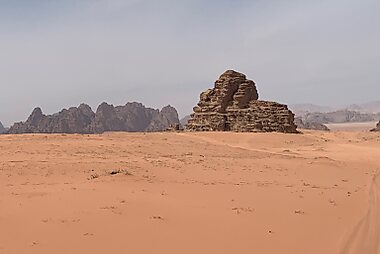
Petra, the rock-cut Nabatean city, and Wadi Rum, a desert of red sand and towering rock formations, are Jordan's two essential stops and anchor most itineraries. The Red Sea port of Aqaba pairs well with either, adding diving, snorkeling, and a beach stop.
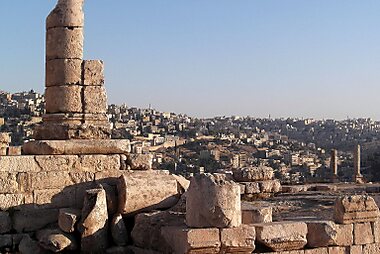
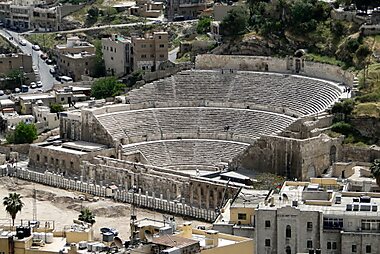
The capital, Amman, holds a Roman theater and hilltop citadel and is worth a day or two on its own. North of the city, Jerash has one of the best-preserved Roman provincial cities anywhere, Ajloun has a 12th-century Islamic castle in forested hills, and Salt is known for its Ottoman-era architecture. Further north, Umm Qais overlooks the Sea of Galilee from the ruins of ancient Gadara, near the regional hub of Irbid.
South of Amman, Madaba is known for its Byzantine mosaics, including the oldest surviving map of the Holy Land, and the hilltop crusader fortress at Al-Karak guards the old King's Highway. For hiking, Dana Biosphere Reserve is Jordan's largest nature reserve, and Wadi Mujib offers a canyon trail that ends in a waterfall, a popular day trip from the Dead Sea.
Jordan – Plan Your Trip
Pick the places you want to see and Tripomatic turns them into a day-by-day route, with smart routing, time estimates, and everything you need for a perfect trip.


Related destinations


Data: © OpenStreetMap contributors, Wikidata, Wikipedia, Tripomatic, Official websites, geoBoundaries (CC BY 4.0). Tours by GetYourGuide. We earn commission from bookings. Travel guide generated with AI.