



Laos
Laos is a landlocked country built around the Mekong River. Mountains cover most of the land, and small cities move at a slow pace. Buddhist temples, French colonial buildings, and hill-tribe villages sit close together. Outside the two biggest towns, daily life still follows the river and the rice harvest.
The north holds forested mountains, trekking routes, and the former royal capital Luang Prabang. The south centers on the Mekong itself, with river islands, waterfalls, and coffee farms on the Bolaven Plateau. Laos suits travelers who want a slower pace than neighboring Thailand or Vietnam, and who don't mind basic infrastructure in exchange for quiet temples, river towns, and mountain scenery.



Laos – Planning a Trip?
Build your day-by-day itinerary in the Tripomatic app.


Money & payments
Laos uses the Lao kip, though US dollars and Thai baht are also accepted for larger purchases in tourist areas and at border crossings.
ATMs are common in Vientiane and Luang Prabang. They are scarce in rural areas and on the Mekong islands in the south, so carry enough cash before heading to smaller towns. Withdrawal fees are high, so plan for fewer, larger withdrawals rather than many small ones.
A budget traveler can get by on $25-35 a day covering guesthouses, street food, and local buses. Mid-range travel with private transport, hotels, and restaurant meals runs closer to $60-100 a day.
Featured Lists


Hidden Gems in Laos
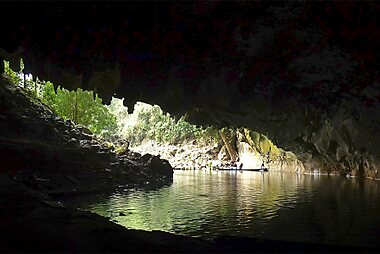
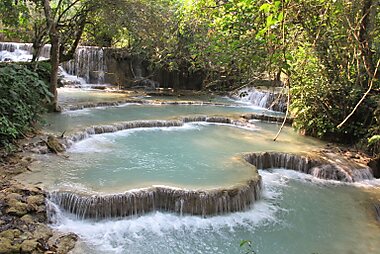
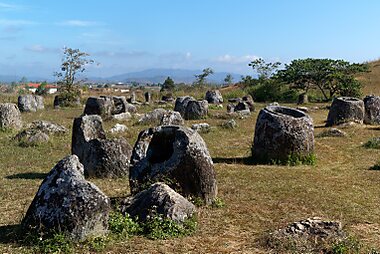
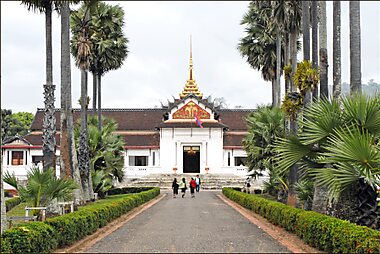
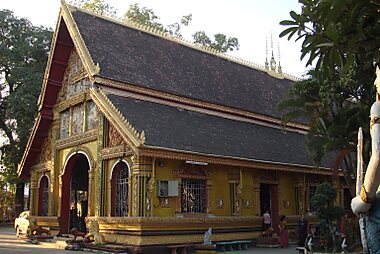
Beyond the primary tourist hubs, Laos contains unique archaeological and natural landmarks. This selection features the megalithic Plain of Jars, a UNESCO World Heritage site with thousands of ancient stone vessels, and the 7-kilometer underground river at Konglor Cave. In Vientiane, the COPE Visitor Centre provides insight into the country’s history with unexploded ordnance, while temples like Wat Mixay showcase traditional Lao architecture. Natural sites include the multi-tiered Tad Sae Waterfall and the 40-meter drop of Tad Yuang on the Bolaven Plateau.
11 places


Tours & Activities
Laos — Map

 Open the interactive map
 Tipping
Tipping is not a deep-rooted tradition in Laos, but it has become common in tourist restaurants, on organized tours, and with drivers.
round up or 5-10%
small note for housekeeping/porters
round up
a few dollars per day on multi-day tours
Rounding up the bill or leaving small change is enough at most restaurants. Guides and drivers on multi-day trips appreciate a modest tip at the end; it is not expected at local noodle shops or markets.
Electricity
Laos uses Type A, B, C, E, and F plugs at 230 V / 50 Hz — the same voltage as Europe, so most phone and camera chargers work without a converter.
Language
Lao is the official language. English is spoken in guesthouses and restaurants in Vientiane, Luang Prabang, and Vang Vieng, but drops off quickly outside the main tourist towns.
Lao uses its own script, unrelated to Latin letters, so road signs and menus outside tourist areas are often written only in Lao. Learning a few basic phrases helps a lot with transport and markets.
Staying connected
Prepaid SIM cards are sold at the airport and in phone shops in every city, with no registration hassle beyond showing a passport. A basic data package costs only a few dollars for several gigabytes.
Mobile coverage is reliable in cities and along the main roads, but drops out in mountain areas and on some of the smaller Mekong islands in the south.
Safety & emergencies
Laos is a safe country for visitors, with low rates of violent crime. The main risks are petty theft on night buses and around bus stations, and traffic accidents on poorly lit rural roads.
Unexploded ordnance from the Vietnam War era remains in the ground in parts of rural Laos, especially in the northeast. Stay on marked paths and roads outside towns, and never touch old metal objects found in fields or forests.
Health
Tap water is not safe to drink; use bottled or filtered water, including for brushing teeth in more remote areas. Ice in restaurants in the main tourist towns is generally made from treated water, but ask if unsure.
Pharmacies are well stocked in Vientiane and Luang Prabang, with English-speaking staff at the larger ones. Options are limited in smaller towns and rural areas, so bring a basic first-aid kit and any regular medication with you.
Check with a travel clinic about routine vaccinations and malaria precautions before visiting rural or forested areas.
Visas & entry
Most nationalities can get a visa on arrival at major airports and land border crossings, or apply in advance for an e-visa online. Both typically allow a stay of up to 30 days. This can be extended once, for a further 30 days, at an immigration office inside the country. Citizens of Thailand, Vietnam, Cambodia, Malaysia, Singapore, and several other neighboring countries can enter without a visa for shorter stays.
Visa and entry requirements change frequently. Verify current requirements with the official immigration authority or your country's embassy before travel.
Etiquette
Dress modestly when visiting temples: shoulders and knees covered, shoes off before entering a temple building. Women should not touch monks or hand things directly to them — set an item down for a monk to pick up instead.
The head is considered the most sacred part of the body and the feet the least — avoid touching anyone's head, and don't point your feet at people, Buddha images, or altars.
If watching the early-morning alms-giving procession in Luang Prabang, keep a respectful distance, skip flash photography, and stay quiet. Buy sticky rice from an established stall rather than a vendor pushing rice on tourists moments before the monks pass.
Greet people with a slight bow and palms pressed together at chest height, known as the nop.
Holidays & opening hours
Public holidays, especially the Lao New Year (Pi Mai) in mid-April, can close shops, banks, and government offices for several days and fill buses and guesthouses in tourist towns.
Most shops and family-run restaurants open early and close by early evening, with some closing for an hour or two around midday. Government offices and banks close on weekends.
Getting around
- By train: The Laos-China Railway runs from Vientiane through Vang Vieng and Luang Prabang to the Chinese border. It cuts a trip that used to take a full day on the road down to about two hours. Book tickets a few days ahead in high season.
- By air: Domestic flights connect Vientiane with Luang Prabang and Pakse, saving a full day of driving on mountain roads.
- By bus: VIP and sleeper buses cover longer routes between provinces and are the main way to reach towns without an airport or train station. Roads are often narrow and winding in the north, so journeys take longer than the distance suggests.
- By boat: Slow boats on the Mekong River connect the northern border town of Huay Xai to Luang Prabang over two days, with an overnight stop partway.
Driving
- Key rules: An international driving permit is recommended alongside your home license. Roads outside the main highways are often unpaved or potholed, especially in the north and during the rainy season (June-October).
- Tolls: The Vientiane-Vang Vieng expressway charges a distance-based toll collected at gates along the route; other roads are toll-free.
- Parking: Parking is informal and inexpensive — a guesthouse or restaurant can usually point you to a nearby spot, and paid parking lots are rare outside the biggest cities.
- Fuel: Stations are staffed, and most take cash; card payment is not guaranteed outside the two largest cities. Pumps are labeled Gasoline 91, Gasoline 95, and Diesel.
- Electric vehicles: Charging is rare outside Vientiane. A regular fuel car is the more practical rental choice.
Food & drink
Sticky rice, eaten by hand from a small woven basket, is the base of most Lao meals, alongside grilled meat or fish, spicy salads, and soups. Breakfast is often a bowl of khao piak sen, a thick rice noodle soup, from a street stall.
Laap is the closest thing to a national dish: minced meat or fish tossed with herbs, lime, and toasted rice powder. Tam mak hoong, a spicy green papaya salad, is a common lunch. Grilled river fish, fresh spring rolls, and skewered meats are common snacks at markets and night markets.
Beerlao is the standard local beer, and lao-lao, a strong rice whiskey, is often shared at gatherings. Coffee from the Bolaven Plateau is served strong and sweet with condensed milk. Family-run noodle shops and market stalls are the everyday way to eat; sit-down restaurants are mostly found in the bigger towns and tourist areas.
Where to explore
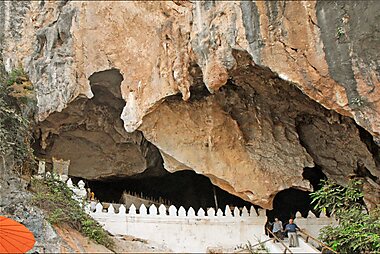
Vientiane, the capital, is a low-key riverside city with French colonial buildings, morning markets, and the golden stupa of Pha That Luang. Vang Vieng, a few hours north, sits among limestone karsts and caves along the Nam Song River, and draws travelers for kayaking, caving, and hot-air balloon rides.
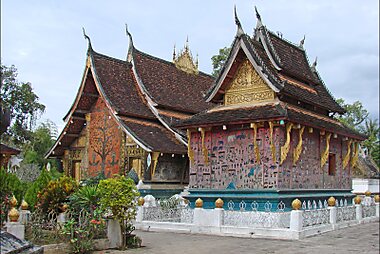
Luang Prabang, the former royal capital, is Laos's most visited town, with dozens of gilded temples, a UNESCO-listed old quarter, and nearby waterfalls. Luang Namtha, further north, is the main base for trekking through hill-tribe villages and protected forest.
Xiengkhouang province, in the northeast, holds the Plain of Jars, while Vieng Xay preserves the cave complex used as a hidden wartime capital.
In the south, Pakse is the gateway to the Bolaven Plateau's coffee farms and waterfalls, and to Champasak, home to the pre-Angkorian temple of Vat Phou. Si Phan Don, on the river islands of Si Phan Don near the Cambodian border, is the place to slow down completely.
Savannakhet and Thakhek, both on the Mekong in central Laos, see fewer visitors but are the starting points for the caves and karst scenery around Kong Lor.
Laos – Plan Your Trip
Pick the places you want to see and Tripomatic turns them into a day-by-day route, with smart routing, time estimates, and everything you need for a perfect trip.




