


Muscat
Muscat is Oman's capital, wrapped in a ring of bare desert mountains that drop straight into the Gulf of Oman. Building codes keep most structures low-rise and white or sand-colored, so the coastline stays open and its old forts do not disappear next to newer landmarks.
The city suits travelers who want a calm, safe introduction to the Arabian Peninsula without the scale or nightlife of Dubai. Expect a slower pace: souqs, forts, and modern architecture close enough together to see in a few days. Sultan Qaboos bin Said, who ruled Oman for nearly five decades after 1970, reshaped the city and funded many of the landmarks travelers visit today.

Muscat – Planning a Trip?
Build your day-by-day itinerary in the Tripomatic app.


When to visit
November through March is mild and pleasant, with warm days and cool evenings — the best time to visit. April and October are transitional: still warm, but manageable. From May to September, heat and humidity turn extreme, with little relief even after dark.
Plan a trip around the Muscat Festival, held annually in January. The celebration fills Qurum Park and Naseem Gardens with concerts, fireworks, and family activities, and it is the liveliest time to visit the city.
Best time to visit: January, February, March, November, December
Top sights






Sultan Qaboos Grand Mosque is Oman's largest mosque and the city's most photographed landmark. Non-Muslim visitors can enter outside prayer times to see the vast prayer hall, its single hand-woven carpet, and a chandelier studded with Swarovski crystals — modest dress is required, and women need a headscarf.
Rising above Shati Al Qurm, Royal Opera House Muscat is a modern opera house built in traditional Omani style, staging opera, ballet, and concerts inside a marble-and-teak auditorium.
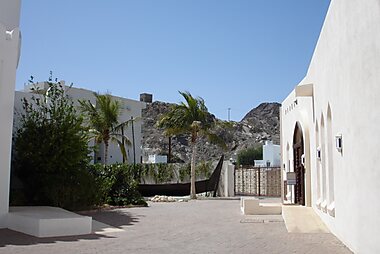
The Sultan's ceremonial residence, Al Alam Palace, is closed to visitors inside, but its gold-and-blue facade is one of Old Muscat's most striking sights, flanked on the harbor by the twin Portuguese forts Fort Al-Mirani and Al Jalali Fort.
Overlooking Mutrah's waterfront, Mutrah Fort is a 16th-century Portuguese fort that now hosts exhibitions and events, with views back over the harbor and Corniche.
Below it, Muttrah Souq is one of the oldest souqs in Oman, a warren of covered alleys selling frankincense, silver, and traditional Omani daggers.
National Museum traces the country's history from prehistory to the present, and is the best stop for context before exploring the older sites.
Featured Lists

Muscat Must-Sees
Muscat showcases Omani architecture and maritime history through landmarks like the Sultan Qaboos Grand Mosque, which features a massive hand-woven carpet and Swarovski chandelier. The waterfront district of Mutrah houses a centuries-old labyrinthine souq and a restored 16th-century Portuguese fort. Old Muscat contains the Al Alam Palace flanked by the twin forts of Al-Mirani and Al-Jalali, alongside the National Museum and Bait Al Zubair, which document the country’s archaeological findings and cultural traditions.
10 places

Historic Forts of Muscat
Muscat’s harbor is framed by a network of 16th-century Portuguese fortifications and Omani defensive structures. These sites, including the twin forts of Al Jalali and Al-Mirani, were strategically positioned to protect the city from maritime invasions. The list features well-preserved examples of military architecture, ranging from massive harbor-side strongholds to restored fortified houses like Bait Al-Maqham, reflecting the region's long history of coastal defense and maritime trade.
5 places

What to experience
Muscat's setting on the Gulf of Oman shapes many of its best activities.
- Take a morning boat trip to watch pods of wild dolphins, common year-round in the waters off the coast.
- Join a sunset dhow cruise along the Mutrah Corniche, watching the forts and the Grand Mosque catch the evening light from the water.
- Snorkel or dive the coral reefs inside Bandar Khiran, a short boat ride from the city marina.
Tours & Activities
Muscat — Map

 Open the interactive map
 Day trips
Muscat sits between mountains and sea, so several rewarding day trips are within reach.
- Bandar Khiran, ~45 min by car to the marina: A sheltered inlet of turquoise coves, reachable only by boat or kayak once there. Bandar Khiran protects the area's mangroves and reef life — book a boat trip from the marina.
- Nakhal, ~1 hour by car: A restored mountainside fort with sweeping views over the plain, paired with the natural hot spring at nearby Ain Al Thawarah.
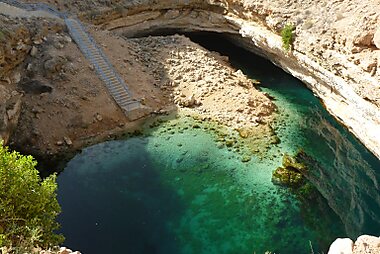
- Wadi Shab and Bimmah Sinkhole, ~1.5 hours by car: A short hike through a canyon leads to turquoise swimming pools at Wadi Shab. The nearby sinkhole is a quick swim in cool spring water.
- Nizwa, ~1.5-2 hours by car: Oman's former capital, known for its round fort, a lively Friday livestock and produce souq, and easy access into the Hajar Mountains.
A rental car or private driver gets you to the start of each trip — Bandar Khiran needs a short boat or kayak leg from there. Public transport does not serve any of these well.
Getting there
- By air: Muscat International Airport is Oman's main gateway, about 35 km northwest of the center. A taxi or ride-hailing car into town takes around 30–40 minutes; rental car desks are in the arrivals hall.
- By bus: Coaches connect Muscat to Dubai (about 6–7 hours) and other Gulf cities; Mwasalat also runs routes across Oman.
- By sea: Cruise ships calling at Port Sultan Qaboos dock within walking distance of Mutrah Souq during the winter season.
Getting around
- Public transit: Mwasalat runs city buses, but routes are limited and buses are infrequent — most travelers rely on taxis or a rental car instead.
- Taxi and ride-hailing: Metered taxis are uncommon; agree a fare before the ride, or use a ride-hailing app, which is available in Muscat and shows the price upfront.
- On foot and by bike: Old Muscat, Mutrah, and the Corniche are walkable in themselves, but the city stretches roughly 50 km along the coast, so getting between neighborhoods on foot is not practical. Cycling is uncommon outside a few dedicated paths, and the heat makes it impractical much of the year.
Driving
- Is a car worth it? Yes for exploring beyond the center — Muscat stretches roughly 50 km along the coast, and taxis add up quickly over a multi-day stay. For a trip focused only on Old Muscat and Mutrah, a car is not necessary.
- Parking: Malls, the Grand Mosque, and major sights have free parking. Street parking in Old Muscat and Mutrah is limited, especially around the souq in the evening.
- Fuel: Petrol stations are common and inexpensive by international standards; no tolls or congestion charges apply within the city.
Food & drink
Local specialties include shuwa — meat marinated in spices and slow-cooked overnight in an underground pit, traditionally for Eid — and fresh grilled kingfish and hammour sold along the coast. Omani halwa, a dense rosewater-and-cardamom sweet, is often served with kahwa, cardamom-spiced coffee poured from a long-necked pot.
For dinner, head to the restaurants along the Mutrah Corniche for seafood with harbor views, or to Qurum, where a wider mix of Omani and international restaurants clusters around the beach and shopping streets.
Safety & health
Muscat is one of the safer capital cities to visit — violent crime against tourists is rare, and petty theft is uncommon even in crowded places like Mutrah Souq. The most common risks are heat-related: drink water often and avoid strenuous activity outdoors during the hottest hours from May to September.
Flash floods can occur in wadis and low-lying roads after rare heavy rain, particularly during a cyclone remnant in autumn — check forecasts before a wadi day trip.
Tap water is heavily desalinated and technically safe, but most residents and visitors drink bottled water, which is inexpensive and widely available.
History
Muscat's harbor has been fought over for centuries. The Portuguese seized it in the 16th century and built Fort Al-Mirani and Al Jalali Fort to guard the entrance, before Omani forces expelled them in 1650. The same harbor is still watched over by Al Alam Palace, seat of the ruling Al Said dynasty since the 18th century.
The modern city dates to 1970, when Sultan Qaboos bin Said took power from his father in a bloodless palace coup and began what Omanis call the Renaissance — opening the country after decades of isolation, building roads, schools, and hospitals from almost nothing. National Museum covers this transformation in detail, alongside the older archaeology of the region.
Country facts
Quick practical facts for Oman at a glance:
- Currency
- Omani Rial OMR · Card payments · Commonly accepted
- Emergency numbers
- 968
- Electricity
- 240 V · 50 HzType C / Type G
- Languages
- Arabic
- Tap water
- Drink with caution
- Driving side
- Right
- Calling code
- +968
Muscat – Plan Your Trip
Pick the places you want to see and Tripomatic turns them into a day-by-day route, with smart routing, time estimates, and everything you need for a perfect trip.