



Namibia
Namibia is a big, empty country in southwest Africa. It has about 3 million people on an area more than twice the size of Germany, so distances are long and towns are far apart. Most visitors come for the landscapes and the wildlife. Highlights include the red dunes of Sossusvlei and the waterholes of Etosha National Park. The foggy Skeleton Coast Park and the rock art of Damaraland are also popular.
The country suits self-drive travellers who like space, quiet and nature, and who do not mind long days on gravel roads. Main roads are well maintained, and lodges and fuel stations are reliable. A first trip usually combines the desert in the south, the Atlantic coast around Swakopmund and a safari in the north. German colonial history (1884–1915) still shows in some town architecture, bakeries and street names. Namibia became independent from South Africa in 1990.





Namibia – Planning a Trip?
Build your day-by-day itinerary in the Tripomatic app.


Money & payments
The Namibian dollar is pegged 1:1 to the South African rand, and the rand is also legal tender in Namibia. You can pay with rand anywhere, but Namibian dollars are not accepted in South Africa, so spend or exchange them before you leave.
ATMs are easy to find in towns, but there are none between towns on long desert routes. Carry some cash for remote fuel stations, campsites, craft stalls and tips. Namibia is not a cheap destination: lodges in and near the national parks are expensive, while camping and self-catering keep costs down. A rental car is often the biggest single cost.
Featured Lists


Tours & Activities
Namibia — Map

 Open the interactive map
 Tipping
Tipping is expected in restaurants and for services. Fuel stations are staffed by attendants who fill the tank and clean the windscreen; give them a small tip. In towns, informal car guards watch parked cars and also expect a few dollars when you leave. On safaris and guided walks, tip the guide and, at lodges, use the shared staff tip box.
10 %
N$100–200 per person per day
staff tip box at lodges
round up
round up
Electricity
Namibia uses the same large round three-pin plugs as South Africa, so bring an adapter. Lodges in remote areas often run on solar power or generators with limited hours.
Language
English is the only official language, and you can use it everywhere in tourism. It is not the first language of most Namibians, though. Oshiwambo languages are spoken by the largest group, and Afrikaans is widely used as a common language, especially in the south and centre. German is still spoken in Swakopmund, in Windhoek and on many farms. A few words of Afrikaans are appreciated.
Staying connected
- SIM cards: MTC and TN Mobile sell prepaid SIM cards at the airport and in town shops. SIM registration is mandatory, so bring your passport when you buy one.
- Coverage: mobile signal is good in towns and along main roads, but there is often no signal at all in the desert, in Damaraland, in the Kaokoveld and inside large parks. Download offline maps before you leave town and tell your lodge your route.
Safety & emergencies
Namibia is one of the safer countries in the region for tourists. Road accidents are the biggest risk: gravel roads are slippery, cars roll over at speed, and animals cross at dawn and dusk. Do not drive after dark. In Windhoek and other towns, petty theft and car break-ins happen. Do not leave bags visible in the car, do not walk alone at night, and use a registered taxi or a lift arranged by your hotel after dark.
Health
- Malaria: there is a malaria risk in the north and northeast. This includes the Zambezi Region, Kavango, Kunene and the Etosha area. The risk is highest in the rainy season from November to June. Along the Kunene, Okavango and Zambezi rivers, the risk exists all year. The south and the coast are low-risk. Ask a travel clinic about tablets.
- Yellow fever: you need a vaccination certificate if you arrive from a country with a yellow fever risk.
- Water: tap water in Windhoek and the main towns is treated and generally safe. In remote areas, use bottled or filtered water.
- Heat and sun: the desert gets very hot. Carry more water than you think you need, especially on long drives.
- Pharmacies: good pharmacies and private hospitals exist in Windhoek and the larger towns. In remote areas, the nearest doctor can be hours away, so travel insurance with medical evacuation is strongly advised.
Visas & entry
Citizens of many African countries can visit visa-free. Since April 2025, travellers from a longer list of countries, including the United States, the United Kingdom and most EU countries, need a visa. It can be bought online as an e-visa before the trip, or on arrival at the main airport and main border posts. Your passport usually needs at least six months of validity and blank pages.
Visa and entry requirements change frequently. Verify current requirements with the official immigration authority or your country's embassy before travel.
Etiquette
- Greetings: Namibians greet before they ask a question. Start with "Good morning, how are you?" before you ask for directions or order.
- Photography: always ask before you photograph people. This is especially important in Himba villages in the northwest. Visit them with a local guide or a community-run project, and expect to pay a fee or bring agreed gifts.
- Driving courtesy: slow down when you pass people or other cars on gravel roads, because stones and dust fly.
- Bargaining: at roadside craft stalls, a little friendly bargaining is normal. In shops, prices are fixed.
Holidays & opening hours
Banks, government offices and many shops close on public holidays, and lodges and rental cars fill up quickly around Easter and in the December holidays.
Shops in towns usually open from about 08:00 to 17:00 on weekdays and close early on Saturday. Many shops close on Sunday, but supermarkets and fuel stations in bigger towns stay open.
Getting around
- By car: a rental car is the best way to see Namibia. A high-clearance car is enough for the main tourist routes, but the remote northwest needs a 4x4. Book early for the peak months of July to October. Remember that Namibia drives on the left.
- By air: FlyNamibia runs a small domestic network from Windhoek. Charter flights in small planes connect remote lodges; they are expensive but save long drives.
- By bus: Intercape coaches link Windhoek with the coast and the north. Buses do not go to the main parks, so they suit travel between towns only.
- Guided tours: small-group camping and lodge tours are a good choice if you do not want to drive yourself.
For trip planning, use the official Namibia Tourism Board site.
Driving
- Road types: only the main B-roads are tarred. Most C- and D-roads are gravel. Drive slower on gravel than on tar, especially on corners and in loose sand.
- Key rules: you need a valid licence in English, or carry an International Driving Permit. Seat belts are compulsory. Drive with headlights on, even by day, on gravel and dusty roads.
- Distances and fuel: fuel stations can be 200–300 km apart. Fill up in every town. Stations have attendants who fill the tank, and some remote ones take cash only. Petrol is sold as "Unleaded 95" (ULP) and diesel as "Diesel 50 ppm" or "Diesel 500 ppm".
- Tyres: punctures are common. Check that your rental car has two spare tyres and learn how to change one.
- Wildlife and livestock: animals often stand on the road. Do not drive at night.
- Tolls: there are no road tolls inside Namibia. If you bring a foreign-registered car, for example one rented in South Africa, you pay a Cross-Border Charge at the border.
Food & drink
Meat is at the centre of Namibian food. A braai (barbecue) of beef, lamb or game such as oryx and kudu is the classic evening meal at lodges and campsites. In the north, many people eat oshifima, a stiff porridge of mahangu (pearl millet), with stew. On the street, try kapana: small pieces of grilled beef sold with spicy salt at markets, especially in Katutura in Windhoek. Biltong (dried meat) is the national snack for long drives.
German traditions remain in bakeries and cafés, with fresh bread rolls, apple strudel and Black Forest cake, especially in Swakopmund. On the coast, oysters from Walvis Bay and Lüderitz are fresh and cheap. Windhoek Lager is the best-known local beer. Rock Shandy, a mix of lemonade, soda water and bitters, is the classic soft drink on a hot day.
Where to explore
The desert south
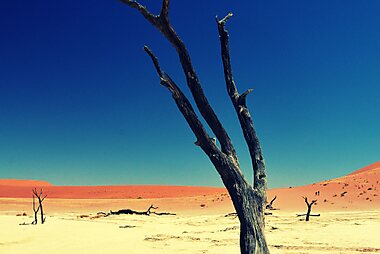
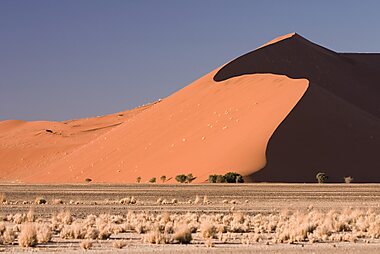
Namib-Naukluft National Park holds the red dunes of Sossusvlei, the white clay pan of Deadvlei and Dune 45. Further south are Fish River Canyon View Point, one of the largest canyons in the world, and the ghost town of Kolmanskop near the harbour town of Lüderitz.
The coast
Swakopmund is the country's holiday town, with German buildings, sand-dune activities and cool sea air. Walvis Bay, next door, is known for lagoon flamingos and boat trips. North of the coast, Cape Cross has a huge seal colony, and the Skeleton Coast Park stretches towards Angola.
Erongo, Damaraland and the northwest
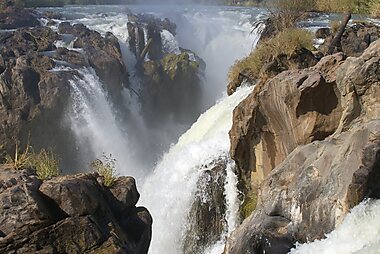
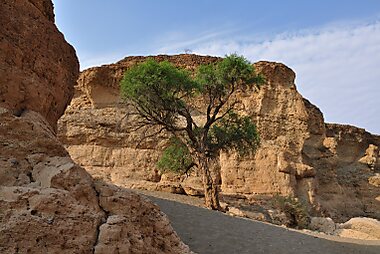
On the way inland from the coast are the granite peaks of Spitzkoppe. Further north, dry and rocky Damaraland has the rock engravings of Twyfelfontein Rock Engraving. In the far north, Epupa Falls is on the Kunene River at the Angolan border.
The north and the safari parks
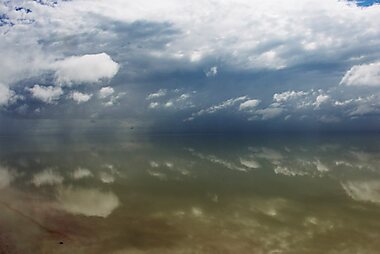
Etosha National Park is Namibia's main safari park, with the huge Etosha Pan at its centre. Nearby, Waterberg Plateau Park and the mining town of Tsumeb are good stops on the way.
The green northeast
Along the Okavango River, Rundu is the gateway to Bwabwata National Park. Further east, the Zambezi Region has rivers, wetlands and elephants, and is a common route to Victoria Falls.
Windhoek
The capital, Windhoek, is where most trips start. Its best-known landmark is Christ Church, a Lutheran church finished in 1910. The city also has a few museums, other colonial buildings and a good choice of restaurants. One or two nights are enough.
Namibia – Plan Your Trip
Pick the places you want to see and Tripomatic turns them into a day-by-day route, with smart routing, time estimates, and everything you need for a perfect trip.


Related destinations


Data: © OpenStreetMap contributors, Wikidata, Wikipedia, Tripomatic, Official websites, geoBoundaries (CC BY 4.0). Tours by GetYourGuide. We earn commission from bookings. Travel guide generated with AI.