


Tunisia
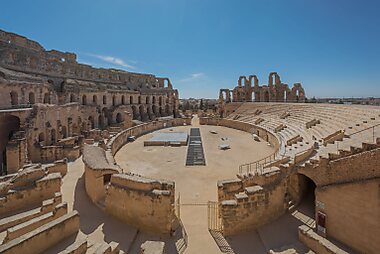
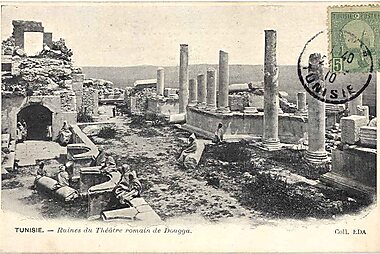
Tunisia packs Roman ruins, Islamic holy cities, Mediterranean beaches, and Sahara dunes into a small, easy-to-cross country. Its coastline runs from the whitewashed cliffs of Sidi Bou Saïd near the capital to the resort towns of the Cap Bon peninsula, while a short drive inland reaches Roman cities as complete as Dougga, and further south, the pre-Sahara landscapes around Tozeur and Douz. According to legend, the Phoenician queen Dido founded Carthage here in the 9th century BC after tricking a local ruler into giving her "as much land as an oxhide could cover" — she cut the hide into thin strips and used them to encircle an entire hilltop.
The country suits travelers who want variety without long distances: ancient sites and souks for history lovers, calm Mediterranean beaches for a slower pace, and Sahara oases and salt lakes for something more adventurous. Tunisia is a majority-Muslim country where French is spoken alongside Arabic almost everywhere, and it remains one of North Africa's more affordable destinations.



Tunisia – Planning a Trip?
Build your day-by-day itinerary in the Tripomatic app.


Money & payments
The Tunisian dinar (TND) is a closed currency — you cannot buy or exchange it before arriving, and taking more than a small amount out of the country is restricted. Exchange money at banks, official bureaux de change, or your hotel, and keep the exchange receipt: converting leftover dinars back to euros or dollars on departure requires proof of the original exchange.
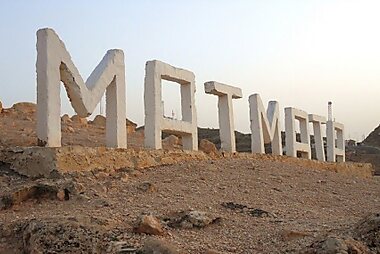
ATMs are common in cities and tourist areas but less reliable in small towns and the desert south, so withdraw what you need before heading to Douz, Tozeur, or Matmata. Cash is still expected at souks, louages (shared taxis), and small local restaurants, even though hotels and larger restaurants take cards.
Featured Lists


Tours & Activities
Tunisia — Map

Tipping
Tipping isn't obligatory in Tunisia, but rounding up or leaving a small amount is common and appreciated, especially where service is direct and personal.
5-10%, or round up
round up
1-2 TND per bag or per day for housekeeping
10-20 TND per day
round up
A guide or driver on a multi-day trip is the one role where a tip is genuinely expected. For everyday restaurant meals and taxis, rounding up the bill is enough.
Electricity
Tunisia uses Type C and E plugs at 230 V / 50 Hz — the same standard as continental Europe, so most European chargers and devices work without an adapter.
Language
Arabic is the official language, and Tunisian Arabic (Derja) is what you'll hear on the street. French is widely spoken as a second language — used in business, on menus, and on most signage — so a few French phrases go further than English outside major hotels and tourist sites. Road signs are usually bilingual Arabic/French near cities, but can switch to Arabic only in rural areas, so it helps to recognize a destination's name in Arabic script too.
Staying connected
Local SIM cards from Ooredoo, Orange, or Tunisie Telecom are cheap and widely available at the airport and in city kiosks — bring your passport, since registration is required. An eSIM from an international provider is an easy alternative if you'd rather set up data before you land.
Safety & emergencies
Tunisia is generally safe for tourists, and violent crime against visitors is rare. The most common issues are pickpocketing in crowded souks and at bus or train stations, and persistent touts near major sights who may steer you toward a shop or unofficial "guide" service for a commission — a polite, firm decline works fine. Government buildings, synagogues such as El Ghriba Synagogue, and some tourist sites have visible security checkpoints; this is routine, not a sign of danger.
Health
Tap water is treated and technically drinkable, but it often tastes strongly of chlorine or minerals, so most locals and visitors stick to bottled water, which is cheap and sold everywhere. Pharmacies, marked with a green cross, are common in every town and can handle minor ailments; many pharmacists speak French. No vaccinations are required for entry, though routine ones should be up to date, and sun protection matters year-round, especially in the desert south.
Visas & entry
Citizens of the EU, UK, US, Canada, and many other countries can enter Tunisia visa-free for stays of up to 90 days with a passport valid for at least three months beyond arrival. Travelers from countries without a visa-free arrangement can usually apply for a visa through a Tunisian embassy or consulate before travel.
Visa and entry requirements change frequently. Verify current requirements with the official immigration authority or your country's embassy before travel.
Etiquette
Tunisia is a Muslim country but a relatively relaxed one for visitors, especially in tourist areas and coastal resorts.
- Dress modestly at mosques and religious sites — shoulders and knees covered, and a headscarf for women at some sites. Non-Muslims cannot enter the prayer hall of most active mosques, including Great Mosque of Kairouan, though the courtyard is usually open to visitors.
- Greetings matter. A handshake and a few words of Arabic or French go a long way; take a moment for small talk before getting to business.
- Bargaining is expected in souks and markets, but not in shops with marked prices or in supermarkets.
- During Ramadan, many restaurants close during daylight hours outside tourist hotels — plan meals accordingly, and avoid eating or drinking in public during the day out of respect.
- Ask before photographing people, especially women.
Holidays & opening hours
Public holidays can close banks, government offices, and some shops for the day, though transport still runs, often less frequently.
Most shops open Monday to Saturday, often with a long midday break in summer, and run reduced hours on Fridays and Sundays. During Ramadan, opening hours shift later in the day and many businesses close before sunset for iftar.
Getting around
- By train: The SNCFT network links Tunis with the coast down to Sfax, including stops at Sousse and Monastir — slow but comfortable and inexpensive. Book at the station or through SNCFT.
- By louage: Shared taxis (louages) connect almost every town, leaving as soon as they fill up. They're faster than the train and the main way to reach southern and Saharan towns like Tozeur.
- By bus: SNTRI runs long-distance coaches to towns the railway doesn't reach, including the far south.
- By air: Domestic flights aren't really necessary given Tunisia's small size — a train or louage covers most routes in a few hours.
Driving
- Key rules: A red warning triangle and a reflective vest are mandatory equipment in the car, and the blood alcohol limit for driving is zero. Seatbelts are mandatory for all occupants.
- Congestion: Tunis's center can be heavily congested at rush hour, and parking inside any old medina is very limited.
- Parking: Look for a gardien de parking, an attendant who watches cars on the street in most town centers — a small tip of 1–2 TND is customary.
- Fuel: Stations are usually attended, not self-service. Ask for essence or sans plomb for petrol and gasoil for diesel; carry cash for stations outside major towns.
- Electric vehicles: Charging infrastructure is minimal outside Tunis — not yet a practical option for touring by EV.
Food & drink
Tunisians eat a light breakfast of bread, olive oil, and coffee, then take lunch as the main meal of the day, often with a rest afterward in summer. Dinner is later and lighter, and hospitality runs deep — being invited to share a meal, even briefly, is common, and it's polite to accept at least a little.
Couscous is the everyday staple, but the dish that defines Tunisian food for most visitors is its heat: nearly every meal comes with harissa, the country's signature chili paste, and dishes lean spicier than elsewhere in North Africa. Street food centers on brik, a crisp egg-filled pastry, alongside grilled fish and merguez sausage sandwiches.
Mint tea, poured strong and sweet with pine nuts, is the default drink at any café, and coffee culture runs deep in cities. Alcohol is available in licensed restaurants, hotels, and some bars in tourist areas, though it isn't part of everyday life outside them.
Where to explore
Tunisia's cities cluster along the coast, with the Sahara reachable within a day's drive from the south.
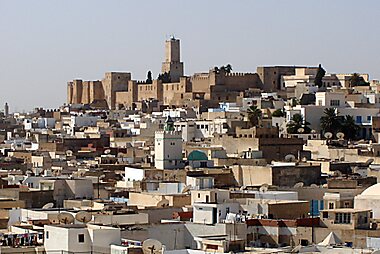
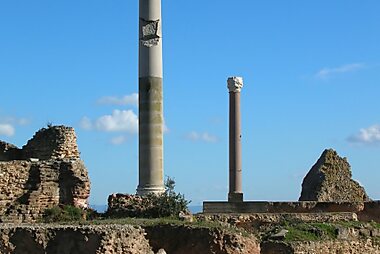
Tunis, the capital, sits beside the ruins of ancient Carthage and the hilltop village of Sidi Bou Saïd. South along the Sahel coast, Sousse and Monastir are resort towns with well-preserved old medinas, and Sfax is Tunisia's second city, a working port with a less touristy character.
Inland, Kairouan is one of the holiest cities in Islam and home to North Africa's oldest mosque. On the northern coast, Tabarka is a quieter beach and diving town near the Algerian border. In the south, Djerba is a laid-back island known for its whitewashed architecture and Jewish heritage, while the oasis town of Tozeur is the usual gateway to the Sahara, the troglodyte village of Matmâta, and the desert further south around Douz and Tataouine.
Tunisia – Plan Your Trip
Pick the places you want to see and Tripomatic turns them into a day-by-day route, with smart routing, time estimates, and everything you need for a perfect trip.
Related destinations


Data: © OpenStreetMap contributors, Wikidata, Wikipedia, Tripomatic, Official websites, geoBoundaries (CC BY 4.0). Tours by GetYourGuide. We earn commission from bookings. Travel guide generated with AI.