



Yerevan
Yerevan is Armenia's capital and by far its largest city, home to over a million people. It sits on a plain ringed by mountains, with views of Mount Ararat on clear days. Much of the center is built from pink and orange volcanic tuff, which gives Yerevan its nickname, the Pink City.
The city traces its roots to the Erebuni fortress, founded in 782 BC, making it one of the world's oldest continuously inhabited cities. Its current look is mostly 20th century: after 1920, architect Alexander Tamanyan redesigned Yerevan around wide boulevards, circular squares, and tuff-stone facades. The result is a compact, walkable center that mixes ancient history, Soviet-era planning, and a fast-growing café and arts scene. It suits a traveler who wants a few days of museums, squares, and easy mountain day trips, without a huge city to navigate.

Yerevan – Planning a Trip?
Build your day-by-day itinerary in the Tripomatic app.


When to visit
Spring and autumn are mild and the best time to visit. Summer is long, hot, and dry, while winter is cold with occasional snow.
Plan around Vardavar in late July, a countrywide water festival where people douse each other with water in the streets — it falls 14 weeks after Easter, so the date shifts each year.
Best time to visit: April, October
September stands out, with warm, dry days and clear mountain views and little rain.
Top sights


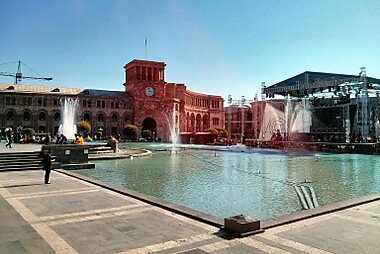
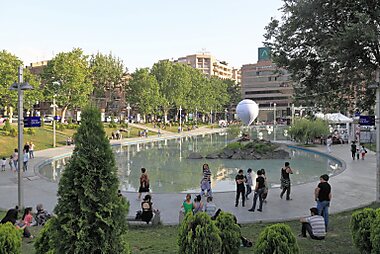
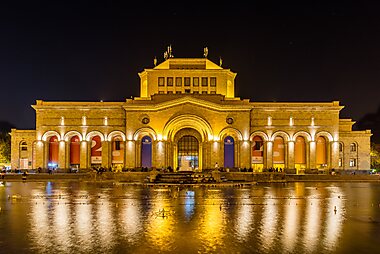
Republic Square is the heart of the city, ringed by pink-tuff government buildings and known for its evening singing fountains, timed to music and light.
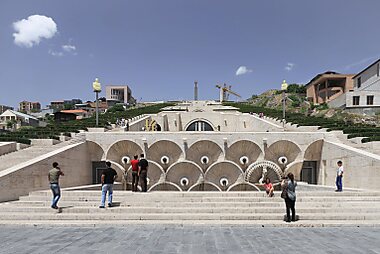
Cascade is a giant tiered stairway climbing the hillside north of downtown, lined with modern sculptures and outdoor art. Climb (or ride the escalators) to the top for a wide view over the city toward Mount Ararat.
Matenadaran holds one of the world's largest collections of ancient manuscripts, including illuminated Armenian gospels dating back over a thousand years.
Armenian Genocide Memorial is Armenia's memorial to the 1915 genocide, with an eternal flame and a museum that explains the events for visitors unfamiliar with the history.
Museum of History of Armenia sits right on Republic Square and covers the country's archaeology and history, with a strong collection of prehistoric and medieval artifacts.
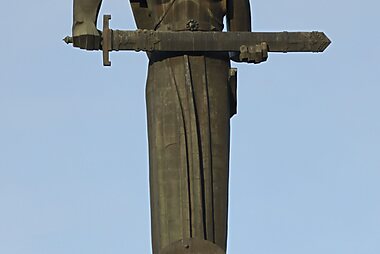
Mother Armenia is a monumental Soviet-era statue overlooking the city from Victory Park, with sweeping views over central Yerevan.
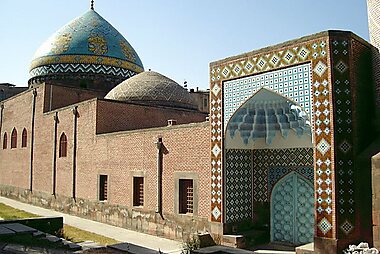
Blue Mosque is Armenia's only active mosque today, built in the 1760s during the city's Persian period, with a quiet inner courtyard garden.
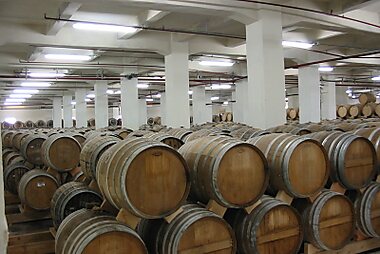
Yerevan Brandy Factory runs tours and tastings through its cellars of aging brandy, a local product exported worldwide under the Ararat label.
Featured Lists


Best Restaurants & Cafes
This selection highlights Yerevan's diverse dining scene, ranging from traditional Armenian taverns to specialized regional eateries. The list features restaurants housed in historic 19th-century buildings like Vostan, as well as unique concepts like Sherep’s open kitchen and Zhinglyanov Hats, which focuses on a single herb-stuffed flatbread specialty. Cuisines represented include authentic Caucasian, Middle Eastern kebabs, and a broad range of international flavors from Lebanese to Mediterranean.
10 places
What to experience
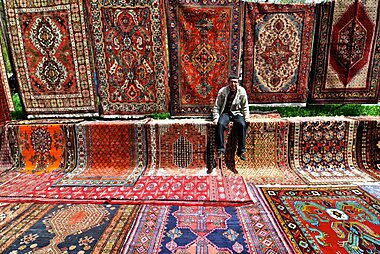
- Browse Vernissage, the weekend flea market, for hand-knotted carpets, Soviet-era antiques, and handmade crafts — bargaining is expected.
- In summer, rent a paddleboat or catch the fountain show at Swan Lake in the evening; in winter, the same spot turns into an open-air ice rink.
- Join a jazzve coffee ritual: order Armenian coffee at a downtown café and let the grounds settle before drinking, rather than stirring it in.
- If visiting in late July, join Vardavar, the citywide water-splashing festival — expect to get soaked on the street, tourists included.
Tours & Activities
Yerevan — Map

 Open the interactive map
 Day trips
Armenia is small, so several major sights sit within easy reach of Yerevan for a single-day trip.
- Vagharshapat — ≈25 min by car or marshrutka. The seat of the Armenian Apostolic Church, with its main cathedral and, nearby, the ruined Zvartnots Cathedral, a UNESCO World Heritage site.
- Garni and Geghard — ≈1 hour by car. A pagan-era colonnaded temple at Garni, paired with the cliffside monastery of Geghard, partly carved out of the rock — usually visited together.
- Khor Virap — ≈45 min by car. A hilltop monastery on the Ararat plain with the closest views of Mount Ararat from Armenian territory, and the pit where Armenia's patron saint was once imprisoned.
- Lake Sevan — ≈1 hour by car. A vast mountain lake with beaches and lakeside monasteries, popular for a swim or a fish lunch in summer.
Where to explore
Beyond the city, Yerevan is a gateway to Armenia's regions:
- Vagharshapat, just west of the city, is the spiritual center of the Armenian Church.
- Ararat stretches south along the Ararat plain, with vineyards and the best views of Mount Ararat.
- Gegharkunik Province, east of the city, is centered on Lake Sevan and its surrounding mountains.
- Vayots Dzor, southeast of the city, is wine country, home to some of the world's oldest winemaking sites.
Getting there
- By air: Zvartnots International Airport (EVN) is 15 km west of the city and handles almost all international arrivals. Bus 201 runs to the center roughly every 30 minutes (300 AMD) and connects to the metro at Yeritasardakan station; a taxi takes about 20 minutes.
- By train: Yerevan has rail links to Tbilisi in Georgia, though the journey is long and mainly of interest to rail enthusiasts. There is no passenger rail service to Iran or Azerbaijan.
- By bus: Long-distance buses and marshrutkas connect Yerevan to Tbilisi and to towns across Armenia from the Kilikia and Central bus stations.
Getting around
- Public transit: A single metro line runs north–south through downtown, and minibuses (marshrutkas) and buses cover the rest of the city. Tap a contactless bank card directly at metro turnstiles, or pay cash on board buses and marshrutkas. See Yerevan Metro for the map and schedule.
- Taxi / ride-hailing: Yandex Go and GG are the main ride-hailing apps and are cheap and reliable — use them instead of hailing a taxi on the street.
- On foot / cycling: The center is compact and flat, so walking covers most sights easily. Cycling is possible but traffic can be aggressive; dedicated bike lanes are limited.
Driving
- Is a car worth it?: Skip it for the city itself — walking, the metro, and cheap ride-hailing cover it well. A car (or driver) pays off for reaching Garni, Geghard, Khor Virap, or Lake Sevan independently.
- Parking: Metered street parking operates in the center; pay by SMS or a parking app, or look for staffed lots near major squares.
- Restrictions: No congestion or low-emission zones apply to visitors.
Food & drink
Yerevan's food scene centers on grilled meat, fresh bread, and strong coffee, alongside a growing wine and craft-cocktail scene downtown.
For a distinctive meal, look to Yerevan's cluster of restaurants and wine bars around the Cascade and Saryan Street, which pair Armenian dishes with the country's own wines. For everyday eating, the food stalls and bakeries around Republic Square are a good place to try lavash fresh from a clay oven.
Safety & health
Yerevan is a safe city for travelers, with low rates of violent crime. The main risks are ordinary ones: pickpocketing in crowded markets and overcharging by unmetered taxis — stick to Yandex Go or GG instead of hailing a cab on the street.
Tap water is safe to drink throughout the city, including from the many public drinking fountains (pulpulak) scattered along the streets.
History
Yerevan began as the Erebuni fortress, founded in 782 BC by the Urartian king Argishti I — older than Rome and one of the world's oldest continuously inhabited cities. For most of the following centuries it was a provincial town, changing hands between Persian, Ottoman, and Russian rule.
Its Persian-era legacy survives at Blue Mosque, built in the 1760s as the city's main mosque under the Erivan Khanate. Russia annexed the city in 1827, and it became capital of the short-lived First Republic of Armenia in 1918, then of Soviet Armenia.
The Soviet period reshaped Yerevan almost completely. Architect Alexander Tamanyan redrew the city around Republic Square and radial boulevards in the 1920s, using local pink tuff that still defines the skyline. Armenian Genocide Memorial was built in 1967 to commemorate the 1915 Armenian genocide, and remains the focus of the annual remembrance on 24 April.
Country facts
Quick practical facts for Armenia at a glance:
- Currency
- Armenian Dram AMD · Card payments · Commonly accepted
- Emergency numbers
- 112
- Electricity
- 220 V · 50 HzType C / Type F
- Languages
- Armenian
- Tap water
- Safe to drink
- Driving side
- Right
- Calling code
- +374


Yerevan – Plan Your Days
Turn the places from this guide into a real itinerary, with smart routing, time estimates, and everything you need for a perfect trip.




