


Alberobello
Alberobello is a small hill town in the Itria Valley of Apulia, famous for its trulli. These are white stone houses with cone-shaped grey roofs, built without mortar. Alberobello has more of them than anywhere else, and two whole districts are still made up of trulli. Together they form a UNESCO World Heritage Site.
The town is busy with day-trippers from late morning to late afternoon, especially in summer. Early mornings and evenings are much calmer. One night is enough for the town itself, but it is also a good base for the Itria Valley, with Polignano a Mare, Ostuni and Matera within easy reach by car. Many visitors stay in a restored trullo, which is part of the experience.

Alberobello – ¿Estás planeando un viaje?
Crea tu itinerario día a día en la app de Tripomatic.


Cuándo viajar
Late spring and early autumn are the best times, with warm days and fewer crowds than in summer. July and August are hot and very busy, and the stone lanes get hot at midday. Winter is cool and often rainy, but quiet. Many shops and restaurants stay open all year.
The biggest event is the Feast of Saints Cosmas and Damian, the town's patron saints, in late September. Pilgrims arrive on foot from nearby towns during the night, statues are carried in procession, and the main street is lit with festive lights. The feast ends with a fireworks competition.
Mejor época para viajar: mayo, junio, julio, agosto, septiembre
Lugares destacados
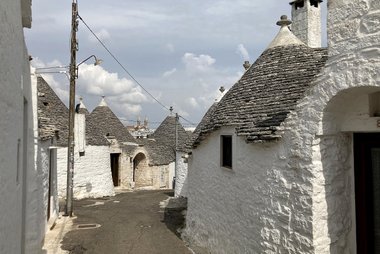
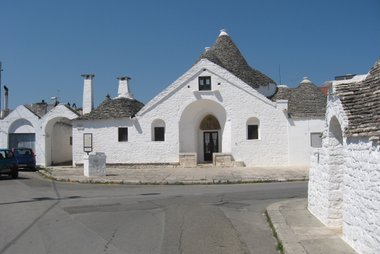

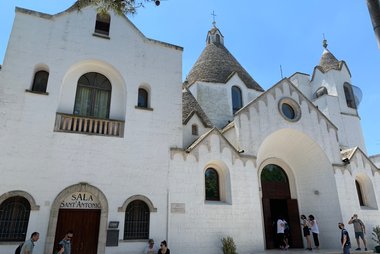

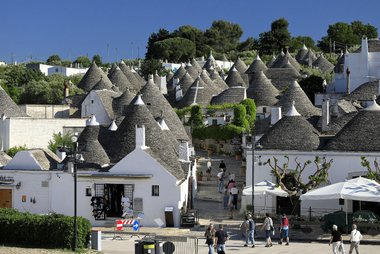
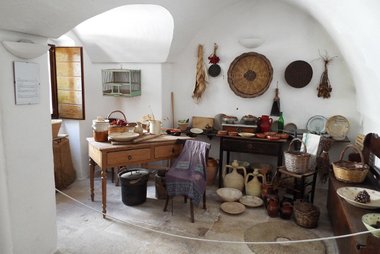
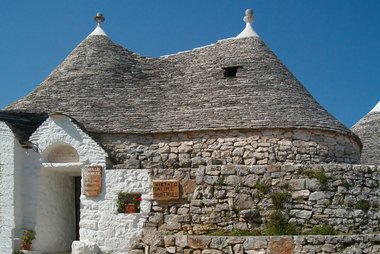
Everything in Alberobello is within walking distance, and most sights are in or around the two trulli districts.
- The Trulli are the reason to come. The largest group is in the Rione Monti district, where about a thousand trulli line steep lanes on the hillside. Many now house shops, cafés and guesthouses. Across the main road, the smaller Aia Piccola district is quieter and still mostly residential.
- Trullo Sovrano is the only trullo in town with two floors. It dates from the 18th century and is now a small house museum with period furniture.
- Chiesa Sant'Antonio stands at the top of Rione Monti. Built in the 1920s, it is a full-size church in trullo style, with a cone-shaped dome.
- Belvedere Santa Lucia is a viewpoint by the church of Santa Lucia. It gives the classic view over the rooftops of Rione Monti.
- Basilica minore dei Santi Cosma e Damiano is the town's main church, with a 19th-century façade and twin bell towers. It holds relics of the patron saints.
- Museo Casa Pezzolla is a local museum set in about 15 connected trulli. It shows how people lived and farmed in the Itria Valley.
- Casa d'Amore looks like an ordinary house, but it was the first building in town made with mortar, in 1797.
- Trullo Siamese is a double trullo with two cones and two doors. A local legend says two brothers who loved the same woman split the house between them.
Listas destacadas
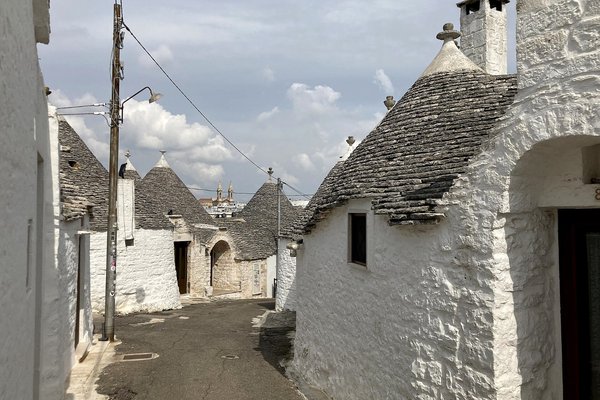
Qué experimentar
Alberobello is about more than looking at the trulli from the outside.
- Sleep in a trullo: many trulli are rented out as guesthouses and holiday homes. Spending a night in one is the best way to feel how cool the thick stone walls stay in summer.
- Look for the roof symbols: many cones carry white symbols painted in lime, such as crosses, hearts and astrological signs. The stone tips on top of the roofs, called pinnacoli, also come in different shapes.
- Watch the sunset over Rione Monti: in the evening, after most day-trippers leave, the Belvedere Santa Lucia viewpoint is quiet and the light turns the roofs golden.
- Cycle through the Itria Valley: ride along country lanes between vineyards, olive groves, old stone walls and scattered trulli in the fields.
Tours y actividades
Alberobello — Mapa

Excursiones de un día
The Itria Valley around Alberobello is full of small white towns, vineyards and old farmhouses. A car makes it easy to combine several in one day.
- Locorotondo (≈15 min by car or train): a round hilltop old town with white houses and views over the valley. It is known for its dry white wine.
- Martina Franca (≈20–25 min by car or train): an elegant town of Baroque churches and palaces. An opera festival takes place here every summer.
- Castellana Caves (≈20–25 min by car): a large system of show caves, with guided tours through long halls of stalactites.
- Cisternino (≈30 min by car): a small, whitewashed hill town. Its butcher shops grill meat to order in the evening.
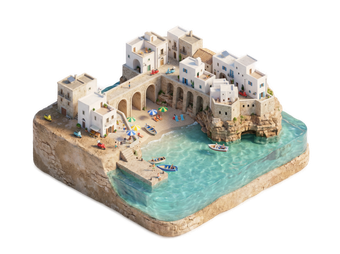
- Polignano a Mare (≈35 min by car): a seaside town on limestone cliffs, with a famous small beach in a narrow cove.
- Ostuni (≈45 min by car): the "white town", a maze of white lanes on a hill above olive groves.
- Matera (≈1–1.5 hours by car): the ancient cave districts called the Sassi, a UNESCO World Heritage Site.
- Bari (≈1.5–2 hours by train): Apulia's capital, with a lively old town and the Basilica of Saint Nicholas.
Qué explorar
Alberobello is in the middle of Apulia, between the Adriatic coast and the Itria Valley.
- Nearby coast and hill towns: Polignano a Mare and Ostuni are both less than an hour away. Matera lies just across the border in Basilicata.
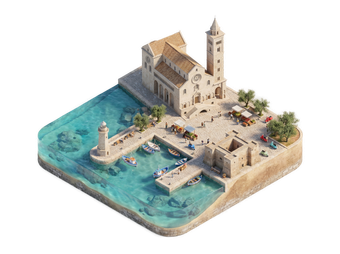
- Cities: Bari is the regional capital and main gateway. Trani has a cathedral right by the sea. To the south are Brindisi, the Province of Taranto and the Baroque Lecce Province.
- The Gargano in the north: the seaside towns of Vieste and Peschici, and the Isole Tremiti offshore.
Cómo llegar
- By air: the nearest airport is Bari Karol Wojtyła Airport, about 70 km away (≈1 hour by car). Brindisi Airport is a similar distance to the south. By public transport from Bari airport, take the train to Bari Centrale and change there.
- By train: Alberobello is on the Ferrovie del Sud Est line from Bari to Martina Franca. Trains leave from the separate FSE station at Bari Centrale and take about 1.5 to 2 hours. Services are less frequent on Sundays and holidays, so check the timetable before you travel. FS Sud Est
- By bus: the Trulli Link bus runs from the bus terminal at Bari Centrale to Alberobello. You can buy a combined train and bus ticket from Trenitalia. Trulli Link (Trenitalia)
- By car: the drive from Bari takes about 1 hour.
Cómo desplazarse
- On foot: the centre is small, and you can walk between all the sights in a few minutes. Rione Monti is on a slope with some steep lanes and steps, so wear comfortable shoes.
- Public transport: there is no need for local buses within town. The train station is about 10 minutes' walk from the trulli districts. Buy FSE train tickets at the station or online before boarding. FS Sud Est
- Taxis: there are only a few local taxis. Book through your accommodation, especially for early trains or the airport.
- Cycling: the town itself is hilly, but the quiet country roads of the Itria Valley are popular for cycling, and bikes and e-bikes can be rented locally.
Conducción
- Do you need a car? Not for the town itself, which is small and walkable. A car is the best way to explore the Itria Valley, since trains and buses between the villages are infrequent.
- Parking: use the paid car parks around the edge of the trulli area. Expect about 2 € per hour or a fixed day rate. Pay at the meters with coins or a card, or with apps such as EasyPark. Free parking near the centre is rare.
- Restrictions: the narrow lanes of Rione Monti and Aia Piccola are not for cars. Parking on the main street, Corso Vittorio Emanuele, is banned in the evening.
Gastronomía
The food here is simple Apulian country cooking. Try orecchiette pasta with turnip greens, fava bean purée with chicory, and local cheeses such as burrata. The Itria Valley is known for capocollo, a cured pork neck from nearby Martina Franca, and bombette, small rolls of pork stuffed with cheese and grilled. Locorotondo white wine and red Primitivo are the local wines.
Most restaurants in Rione Monti cater to day-trippers. For a more relaxed meal, look around Piazza del Popolo and the streets of Aia Piccola, or eat in the evening when the town is quieter. Many restaurants in the area are set inside trulli or old farmhouses called masserie.
Seguridad y salud
Alberobello is very safe, and serious crime against visitors is rare. The main nuisance is crowds in Rione Monti at midday, so keep an eye on bags in busy lanes.
Some shop owners invite you inside or onto a terrace for a view of the roofs. This is usually friendly, but they may hope you buy something. It is fine to say no politely. Many trulli are private homes, so do not enter courtyards or climb onto roofs uninvited.
In summer, carry water and a hat, because there is little shade in the trulli districts.
Historia
Alberobello grew from a forest settlement in the 16th and 17th centuries, on land owned by the Acquaviva family, the counts of Conversano. The counts made the peasants build their houses from dry stone, without mortar. Tradition says this let the houses be taken down quickly, so the counts could avoid taxes to the Kingdom of Naples on new towns.
In 1797 King Ferdinand IV of Bourbon made Alberobello a royal town and freed it from the counts' rule. People could now build with mortar, and Casa d'Amore was the first house built this way. The trulli remained the town's typical homes, and the Trulli became a UNESCO World Heritage Site in 1996.
The patron saints, Cosmas and Damian, have been honoured here since the 17th century. Their relics are kept in Basilica minore dei Santi Cosma e Damiano.
Datos del país
Quick practical facts for Italy at a glance:
- Moneda
- euro EUR € · Pago con tarjeta · Ampliamente aceptado
- Teléfonos de emergencia
- 112
- Electricidad
- 230 V · 50 HzTipo C / Tipo F / Tipo L
- Idiomas
- italiano
- Agua del grifo
- Potable
- Sentido de la circulación
- Derecha
- Prefijo telefónico
- +39


Alberobello – Planifica tus días
Convierte los lugares de esta guía en un itinerario real, con rutas inteligentes, estimaciones de tiempo y todo lo que necesitas para un viaje perfecto.


Destinos relacionados

Data: © OpenStreetMap contributors, Wikidata, Wikipedia, Tripomatic, Official websites, geoBoundaries (CC BY 4.0). Tours by GetYourGuide. We earn commission from bookings. Travel guide generated with AI.
Planifica tu viaje con Tripomatic
- Planificación con IAConsigue un día listo con un solo toque, deja que la IA distribuya tu lista de deseos a lo largo de tu viaje o planifícalo todo chateando.
- Alertas de viajeAvisos oficiales, alertas meteorológicas, huelgas y desastres naturales para los lugares de cada día de tu viaje.
- Festivos y eventosConsulta festivos, festivales y cierres durante los días de tu viaje, y qué implican para tus planes.
- Estimación de costesDesgloses de costes de viaje con IA para saber qué presupuesto necesitas antes de salir.
- Tours y entradasReserva tours, entradas sin colas y actividades directamente desde tu plan.