



Lago de Garda
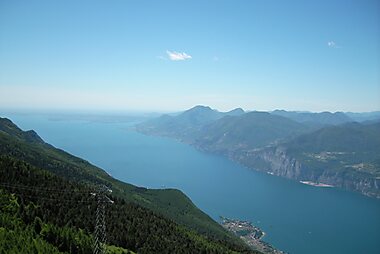
Lake Garda is the largest lake in Italy, held between the southern Alps and the plain of the Po. Its two halves feel like different places. The north is narrow and steep-sided, with rock walls dropping straight into the water and roads that run through tunnels. The south is wide and open, with low hills, olive groves and long pebble beaches. Three regions meet on its shores: Lombardy to the west, Veneto to the east and Trentino to the north.
The lake works best as a trip built around several towns rather than one base. Families come for the theme parks and shallow beaches in the south. Sailors and windsurfers come north for the winds that blow almost every day in summer. Walkers head up Monte Baldo, and wine travellers stay in the hills behind the eastern shore. The writer Gabriele d'Annunzio spent his last years above the western shore, and the Roman poet Catullus wrote about Sirmione two thousand years ago.

Lago de Garda – ¿Estás planeando un viaje?
Crea tu itinerario día a día en la app de Tripomatic.


Cuándo viajar
Spring and early autumn are the best times to come. The weather is mild, the gardens are open, and the roads and beaches are far quieter than in midsummer. July and August are hot and crowded, especially at weekends. Many hotels and gardens close from November to March, and the boat timetable shrinks to a minimum, so winter is a poor time for a first visit.
If you can choose, aim for the first half of October and the Festa dell'Uva e del Vino in Bardolino. The lakefront fills with stalls pouring the local wines, and the weather is usually still warm enough to sit outside.
Mejor época para viajar: mayo, septiembre, octubre
Lugares destacados
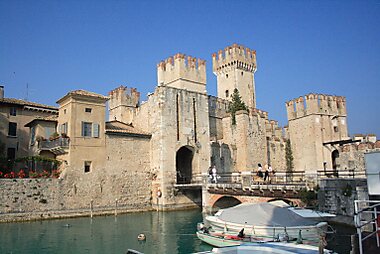


Rocca Scaligera stands at the entrance to Sirmione's old town, surrounded by a moat and reached over a drawbridge. It is one of the few castles in Italy with its own fortified harbour, built by the Scaliger lords of Verona in the 13th century.
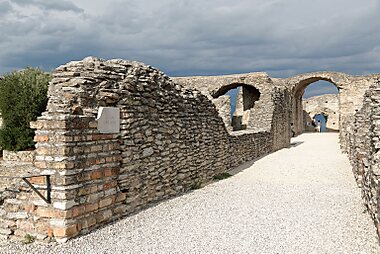
At the tip of the same peninsula, Grotte di Catullo is the ruin of a large Roman villa, set among olive trees several centuries old. The name honours a local tradition; the villa was actually built after the poet's death.
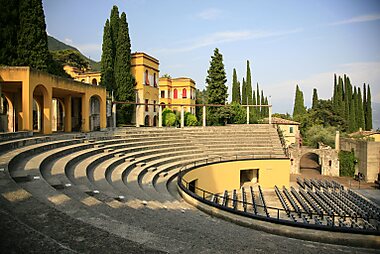
Il Vittoriale degli Italiani above Gardone Riviera was the home of the poet and soldier Gabriele d'Annunzio. He filled the house with objects from his life and had the prow of a warship built into the hillside garden. Allow at least half a day.
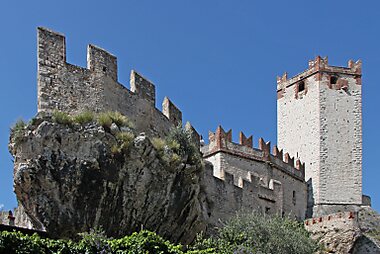
Castello Scaligero rises on a rock over Malcesine's harbour on the eastern shore. The German writer Johann Wolfgang von Goethe was briefly arrested here as a suspected spy while sketching the walls in 1786.
From the same town, Funivia Monte Baldo carries you to the ridge of Monte Baldo in about 20 minutes, with a change of cabin halfway up. The upper cabin turns slowly as it climbs, so everyone gets the view down the length of the lake.
Peschiera del Garda Fortress wraps the old town of Peschiera in a pentagon of Venetian walls and water. It was listed by UNESCO in 2017 as part of a group of Venetian defensive works.
Punta San Vigilio is a small wooded headland north of Garda town. An avenue of cypresses leads down to a tiny stone harbour. The bay next to it, Baia delle Sirene, is one of the nicest places to swim on the eastern shore.
Out in the water off San Felice del Benaco, Isola del Garda is the lake's largest island, with a neo-Gothic villa and terraced gardens. It is private, and can only be seen on a booked guided visit that arrives by boat.
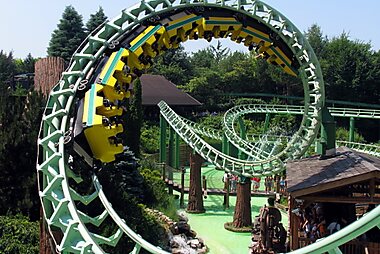
At the southern end, Gardaland Park is the biggest theme park in Italy and the single reason many families choose Garda. Go early or late in the season if you can; queues in August are long.
Listas destacadas


Historic Castles & Forts
Explore the strategic military history of Lake Garda through its diverse collection of medieval Scaliger castles, Roman ruins, and Austrian fortifications. This selection features iconic structures like the water-bound Sirmione fortress and the Roman villa at Grottoes of Catullus, alongside 19th-century defensive batteries on Monte Brione. These sites highlight the region's architectural evolution from 1st-century BC settlements to the 14th-century strongholds of the Scaliger dynasty and the complex Quadrilateral defense systems used during the Italian Risorgimento.
18 lugares


Top Camps & Caravan Parks
This collection features ten well-equipped camp sites and caravan parks around Lake Garda, offering amenities such as showers, power supply, sanitary dump stations, and wi-fi. Locations include holiday parks and caravan sites with 24/7 access and facilities supporting tents and caravans, situated near key cultural and natural attractions in the region.
10 lugaresQué experimentar
Most of what people remember about Garda happens on or above the water.
- Sail or windsurf at Nago-Torbole in the early afternoon, when the southerly Ora wind arrives almost every summer day and fills the northern basin with sails.
- Ride the cycle path at Limone sul Garda, a walkway bolted to the rock face and hanging out over open water.
- Walk or cycle the Strada del Ponale, an old road cut into the rock face above Riva del Garda, now closed to cars and open to walkers and bikes.
- Drive the Strada della Forra above Tremosine, a narrow road that climbs through a gorge. Stop in the village at the Terrazza Panoramica / Terrazza del Brivido, a terrace built out from the cliff 350 metres above the lake.
- Paraglide from the top of Monte Baldo and land on the lakefront at Malcesine, a tandem flight of around 20 minutes.
- Take the car ferry across the lake at sunset just for the crossing, with the mountains on both sides turning pink.
Tours y actividades
Lago de Garda — Mapa

 Abrir el mapa interactivo
 Excursiones de un día
The lake sits within easy reach of several of northern Italy's best-known towns and wine regions.
- Verona: about 20 minutes by train from Peschiera del Garda, or 40 minutes by car from the eastern shore. A Roman arena that still hosts opera in summer, plus a compact old centre on a bend of the river.
- The Valpolicella wine hills: about 40 minutes by car from the eastern shore. Terraced vineyards and cellars producing Amarone, one of Italy's strongest and most famous red wines.
- Brescia: about 15 minutes by train from Desenzano, or 40 minutes by car. A large Roman forum, a UNESCO-listed monastery complex, and far fewer tourists than Verona.
- Trento: about 1 hour by car from Riva del Garda. An alpine city with frescoed facades, a hilltop castle, and a modern science museum designed by Renzo Piano.
- Mantua: about 1 hour by car from the southern shore. A Renaissance city ringed by three artificial lakes, with the vast Ducal Palace of the Gonzaga family.
Qué explorar
Each shore has a different character, and the ferry network makes it easy to see several towns in one day.
- Sirmione, on a long thin peninsula in the south, is the busiest place on the lake, with a castle, Roman ruins and hot sulphur springs.
- Desenzano del Garda is the largest town on the lake and has its own railway station, which makes it the easiest base to reach without a car.
- Peschiera del Garda, also on the rail line, sits inside Venetian fortress walls at the point where the river Mincio leaves the lake.
- Bardolino and Garda, on the eastern shore, are the centre of the lake's wine country and have wide lakefront promenades.
- Salò has the longest promenade on the lake and a quieter, more Italian feel than the resort towns.
- Gardone Riviera was built as a winter health resort and still has grand hotels and subtropical gardens.
- Torri del Benaco is a small harbour town on the eastern shore, and the terminal for the car ferry across to the west.
- Malcesine sits under Monte Baldo and has the lake's most dramatic castle setting.
- Limone sul Garda is squeezed between cliffs and water, and is known for the stone terraces once used to grow lemons.
- Riva del Garda and Nago-Torbole, at the northern tip, are the centre for sailing, windsurfing and climbing.
Cómo llegar
- By air: Verona Villafranca (VRN) is the closest airport, about 25 km from the southern shore. A shuttle bus runs to Verona Porta Nuova station in about 15 minutes, and trains from there reach Peschiera and Desenzano in 15 to 25 minutes. Bergamo Orio al Serio (BGY), Milan Malpensa (MXP) and Venice Marco Polo (VCE) all serve the lake too, with transfers of roughly 1.5 to 2.5 hours.
- By train: the Milan to Venice main line runs along the southern shore, with stations at Desenzano del Garda–Sirmione and Peschiera del Garda. From Verona the journey is about 15 to 20 minutes, and from Milan about 1 to 1.5 hours. There is no station at the northern end of the lake; for Riva del Garda, take the train to Rovereto and a bus from there.
- By bus: regional buses run from Verona up the eastern shore, from Brescia up the western shore, and from Rovereto and Trento down to the northern towns.
Cómo desplazarse
- Ferries: scheduled boats link almost every town on the lake and are the most pleasant way to move around. Buy tickets at the ticket office on each pier; day passes for a zone or the whole lake pay off quickly. A car ferry crosses between Toscolano-Maderno and Torri del Benaco, which saves a long drive around either end. Service is much reduced outside the summer season. Navigazione Laghi
- Bus: three different regional operators cover the lake, one per region, so a single ticket rarely works for the whole shore. Buses are useful for towns the boats skip, but they are slow in summer traffic.
- Taxi and water taxi: private boat taxis operate from the main harbours and are far quicker than the road for short hops, at a much higher price.
- On foot and by bike: every lakeside town is small enough to walk. A shore-long cycle route, Garda by Bike, is still being built, so finished stretches are not yet joined up.
Conducción
- Is a car worth it?: yes if you want to reach the hill villages, the wine country or Monte Baldo. No if you are staying in one lakeside town and using the boats. The two shore roads are narrow, tunnelled and slow, and summer weekends can be very congested.
- Parking: nearly all lakefront parking is paid and marked with blue lines, typically 1.50 to 3.50 € an hour, payable at a machine or through a parking app. Larger towns have cheaper lots on the edge of the centre.
- Restrictions: the historic centre of Sirmione is closed to non-resident cars, so park before the castle bridge and walk in. The Strada della Forra above Tremosine is closed to campervans and to anything over 2.2 metres wide.
Gastronomía
Garda cooking is lake food rather than seaside food. Look for coregone, a delicate whitefish usually grilled or baked, and dried lake sardines cured with olive oil and vinegar. Pike served with a caper and anchovy sauce is a classic of the western shore, often eaten with polenta. The hills around the lake are one of the northernmost olive-growing areas in Europe, and the local Garda DOP oil is lighter than southern Italian oil. Wine is split by shore: crisp white Lugana in the south, light red Bardolino and white Custoza on the east.
For eating, the promenades at Salò and Torri del Benaco have the best mix of view and quality, and the old harbour square in Desenzano del Garda is busy with locals in the evening. Prices on the water are noticeably higher than one street back.
Seguridad y salud
Lake Garda is a safe destination and violent crime against visitors is rare. The usual care applies against pickpockets on crowded ferries and in the narrow lanes of Sirmione in high season.
The real risks are on the water. Wind can rise quickly in the afternoon and the lake becomes rough within minutes, which catches out people on paddleboards and small rented boats. Check the forecast before going out, stay near the shore, and remember that the warm surface layer is thin: below roughly 10 metres the water stays cold all year. On land, the shore roads are narrow and full of tunnels, cyclists and scooters, so drive slowly. Tap water is safe to drink.
Historia
The Romans came here for the same reasons visitors do now. Grotte di Catullo at Sirmione was a luxury villa, and the mosaic floors of Villa romana di Desenzano del Garda survive from a country estate of the same era.
In the 13th and 14th centuries the Scaliger family of Verona took the lake and built a chain of castles to hold it. Rocca Scaligera was one link in that chain, and Castello Scaligero still guards the harbour at Torri del Benaco. Venice took over in the 15th century, and later ringed Peschiera with the bastions you can still walk today.
The hills just south of the lake saw one of the bloodiest days of the 19th century. On 24 June 1859, French and Piedmontese armies fought the Austrians at Solferino and San Martino. A Swiss traveller, Henry Dunant, arrived after the battle and was appalled by the treatment of the wounded. He went on to found the Red Cross. The Ossario di San Martino della Battaglia holds the remains of thousands of the dead.
The lake also gave its name to the last chapter of Italian fascism. From 1943 to 1945 the German-backed Italian Social Republic was run from villas along the western shore, and is still known as the Republic of Salò.
Datos del país
Quick practical facts for Italy at a glance:
- Moneda
- euro EUR € · Pago con tarjeta · Ampliamente aceptado
- Teléfonos de emergencia
- 112
- Electricidad
- 230 V · 50 HzTipo C / Tipo F / Tipo L
- Idiomas
- italiano
- Agua del grifo
- Potable
- Sentido de la circulación
- Derecha
- Prefijo telefónico
- +39


Lago de Garda – Planifica tus días
Convierte los lugares de esta guía en un itinerario real, con rutas inteligentes, estimaciones de tiempo y todo lo que necesitas para un viaje perfecto.




