



Verona
Verona is a compact, walkable city on a bend of the Adige River in northern Italy. Its old centre mixes a Roman amphitheatre, medieval towers and Renaissance palaces, and the whole historic city is a UNESCO World Heritage Site. Shakespeare set Romeo and Juliet here, and that story still draws many visitors.
The city suits a relaxed stay of two or three nights. You can see the main sights on foot, see an opera under the stars in summer, and use Verona as a base for Lake Garda, the Valpolicella wine hills and other cities of the Veneto. It is busy in summer and at weekends, but early mornings and evenings in the side streets stay calm.

Verona – ¿Estás planeando un viaje?
Crea tu itinerario día a día en la app de Tripomatic.


Cuándo viajar
Spring and autumn are the most pleasant times, with mild days and fewer crowds. Summer is hot and humid, with occasional afternoon storms. Winter is cool and often foggy, but the city fills with Christmas markets in December.
The biggest event is the Arena di Verona Opera Festival, which runs from mid-June to mid-September. Large-scale operas are performed at night inside the Roman amphitheatre, and it is worth planning a summer trip around a performance. Book tickets and hotels early for these months.
Mejor época para viajar: mayo, septiembre, octubre
Lugares destacados
Arena di Verona is the city's landmark, a Roman amphitheatre from the first century AD that still holds opera and concerts. You can walk the stone tiers by day when there is no show.
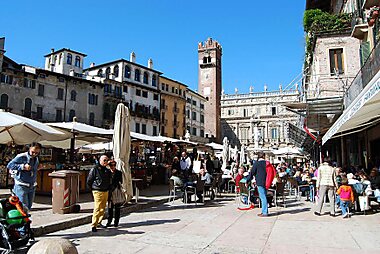
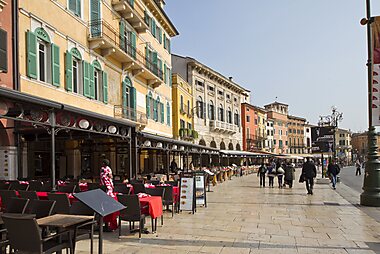
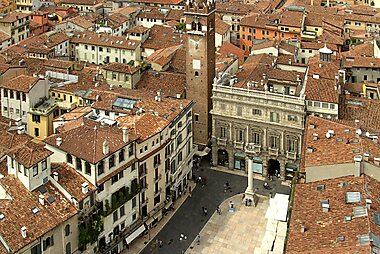
Piazza delle Erbe stands on the site of the Roman forum. Today it has market stalls, cafés and painted house fronts, and it is the natural centre of any walk.
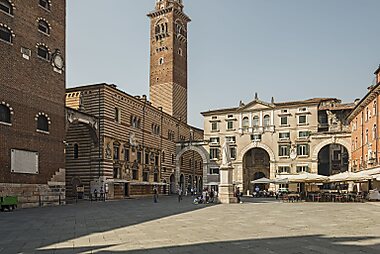
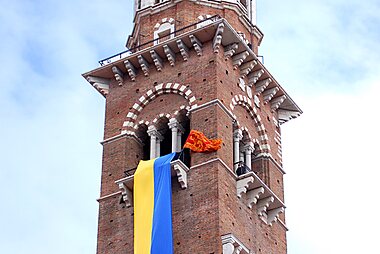
Just behind it, Piazza dei Signori is quieter and more formal, with a statue of Dante in the middle. Climb the 84-metre Torre dei Lamberti on its corner for the best view over the rooftops. Nearby are the Gothic tombs of the della Scala family, who ruled the city in the Middle Ages.
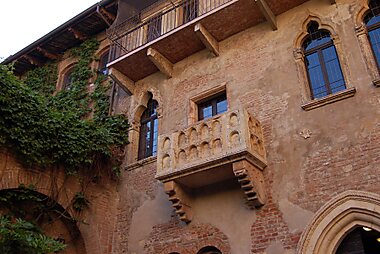
Juliet's House is a medieval house with the famous balcony linked to Shakespeare's Juliet. The courtyard is very crowded; entry now needs a timed ticket booked in advance.
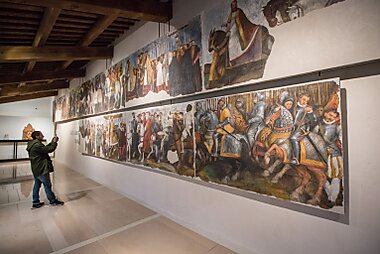
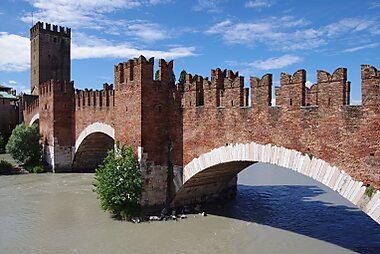
Castelvecchio is a 14th-century fortress that now holds a good museum of medieval and Renaissance art. Walk across its fortified red-brick bridge over the Adige.
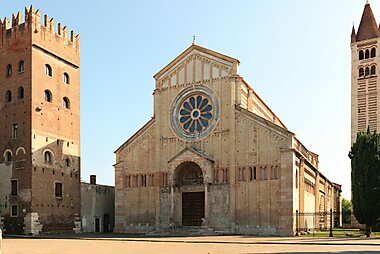
Basilica of San Zeno is one of the finest Romanesque churches in Italy, with carved bronze doors and a quiet cloister. It lies a pleasant 15-minute walk west of the centre.
Across the river, Ponte Pietra is the city's oldest bridge. From there, steps and a short funicular climb to Castel San Pietro for a wide view of the old town.
Listas destacadas


Tesoros Históricos de Verona
Descubre el extenso paisaje histórico de Verona a través de 19 sitios notables, incluyendo monumentos de la época romana como la Arena de Verona y el Teatro Romano, fortificaciones medievales como el Castelvecchio y su puente, e icónicos edificios religiosos que exhiben arquitectura gótica y románica. La lista también incluye antiguas puertas de la ciudad, plazas destacadas y legendarios monumentos shakesperianos vinculados a Romeo y Julieta, ofreciendo una visión completa de la rica herencia cultural y arquitectónica de la ciudad.
20 lugares


Opera and Historic Theatres
Verona’s performance history spans two millennia, centered on the first-century Roman Arena, which hosts a world-famous summer opera festival. The city features the ancient Roman Theater, an archaeological site used for summer concerts, and the 18th-century Teatro Filarmonico, the principal venue for winter opera and ballet. Complementing these are the Arena Museum Opera (AMO), housed in Palazzo Forti, and the 19th-century Teatro Nuovo, known for its classical architectural style and diverse theatrical season.
5 lugares
Best Dining & Cafes in Verona
Verona's culinary landscape centers around the historic Piazza Bra, Italy's largest square, and the pedestrianized Via Mazzini. This selection features traditional establishments like Trattoria Dal Gal, specializing in fresh pasta with locally sourced ingredients, and Il Cenacolo, focused on grilled meats and regional recipes. For classic Italian treats, the list includes Gelateria Savoia, an artisanal shop operating since 1939, and Caffè al Teatro, situated conveniently near the city’s historic performance venues.
6 lugaresQué experimentar
Verona's best moments often happen in the evening.
- Opera night at the Arena: watch a large-scale opera such as Aida or Nabucco in the Roman amphitheatre on a summer night. A cushion makes the stone seats in the cheaper unreserved tiers more comfortable.
- Sunset over the river: take the funicular or the steps up to Castel San Pietro in the early evening and watch the roofs and towers turn red.
- The evening stroll: join locals on the liston, the wide stone pavement along Piazza Bra, for a walk and an aperitivo before dinner.
- Christmas markets: in late November and December, wooden stalls fill Piazza dei Signori and Piazza Bra.
- Wine tasting: visit a cellar in the Valpolicella hills to taste Amarone and Recioto at their source.
Tours y actividades
Verona — Mapa

 Abrir el mapa interactivo
Excursiones de un día
Verona sits between Lake Garda, the wine hills and the art cities of the Veneto. Trains and buses make most of these easy to reach in a day.
- Valpolicella (≈20–30 min by car): wine villages and vineyards just north of the city, best known for Amarone. A car or an organised wine visit is the easiest way to explore.
- Peschiera del Garda (≈15 min by train): the nearest lakeside town, with Venetian walls and a lake promenade, and the easiest gateway to Lake Garda.
- Vicenza (≈30–45 min by train): a UNESCO-listed city of buildings by the architect Andrea Palladio, including the Teatro Olimpico.
- Mantua (≈45 min by train): a Renaissance city with lakes on three sides, with the vast Ducal Palace and the Palazzo Te.
- Bardolino (≈50 min by ATV bus): a wine town on the eastern shore of the lake, known for its light red wine.
- Sirmione (≈1 h by train to Desenzano, then a local bus): a lakeside town on a narrow peninsula, with a moated castle and Roman villa ruins.
- Padua (≈1 h by train): a lively university city, famous for Giotto's frescoes in the Scrovegni Chapel.
- Venice (≈1 h 10 min by high-speed train): the lagoon city is a long but easy day trip, though one night there is better.
Qué explorar
Verona is a good base for both the lake and the other cities of the Veneto.
- Lake Garda: Lake Garda begins about 25 km west of the city. Peschiera del Garda, Sirmione and Bardolino are the closest towns, while Malcesine, further north on the eastern shore, has a cable car up Monte Baldo.
- Cities of the Veneto: Vicenza, Padua and Venice lie one after another on the railway line east, each worth at least a day.
Cómo llegar
- By air: Verona Airport (Valerio Catullo, VRN) is about 10 km southwest of the centre. The Airlink bus (line 199) runs to Porta Nuova station in about 15 minutes; a taxi takes about 15 minutes. Venice Marco Polo and Milan Bergamo airports have more flights; each is roughly 2 hours away by bus and train.
- By train: Verona Porta Nuova is the main station and a major rail junction. High-speed trains reach Milan in about 1 h 15 min, Venice in about 1 h 10 min, Bologna in about 1 hour and Rome in about 3 h 20 min. Direct trains also run north to Innsbruck and Munich (about 5.5 hours). Trenitalia
- By bus: long-distance coaches stop at or near Porta Nuova station, with links to other Italian and European cities. ATV regional buses connect Verona with Lake Garda towns.
Cómo desplazarse
- On foot: the historic centre is small and mostly pedestrianised. Walking is the best way to see it; Porta Nuova station to the Arena takes about 20 minutes.
- Buses: ATV runs the city buses. You can pay by bank card directly on board, buy a QR-code ticket at a newsagent or ticket office, or use the Ticket Bus Verona app. Many buses from the station stop at Piazza Bra. ATV Verona
- Taxi: use official taxi ranks at the station and Piazza Bra, or call a radio taxi. Ride-hailing apps are of little use here.
- Cycling: the river paths are pleasant, but the narrow cobbled streets of the centre are better on foot.
Conducción
- Is a car worth it?: not for the city itself, which is compact and best on foot. A car is useful for the Valpolicella wine hills and the smaller villages around Lake Garda.
- Parking: use a car park outside the old centre, such as Parcheggio Centro (former Gasometro) near the river, or the garages at Cittadella and the Arena. Expect to walk 5–15 minutes to the main sights.
- Restrictions: the historic centre is a ZTL (limited traffic zone) controlled by cameras. Entering without a permit brings an automatic fine. If your hotel is inside the zone, give it your number plate before you arrive so it can register you.
Gastronomía
Verona's cooking is hearty. Look for risotto all'Amarone (risotto made with the local red wine), bollito con la pearà (boiled meats with a peppery bread sauce), pastissada de caval (a slow-cooked horse-meat stew) and bigoli, thick fresh pasta. Pandoro, the star-shaped Christmas cake, comes from Verona. Local wines include Valpolicella, Amarone, Soave and Bardolino.
The best eating is in the small streets around Piazza delle Erbe and in the old osterie (simple wine taverns) of the centre, where you can order a glass of wine with a few snacks. Across the river, the Veronetta district has cheaper places popular with students. Restaurants right on Piazza Bra are convenient but mostly aimed at tourists.
Seguridad y salud
Verona is a safe city for visitors. The main risk is pickpocketing in crowds, especially at Juliet's House, on Piazza delle Erbe and at the Arena on opera nights. Keep bags closed and phones out of back pockets.
Be careful with unofficial ticket sellers around the Arena and with street sellers who offer "free" bracelets or roses and then ask for money. In summer, carry water and a hat, because the stone squares get very hot. Tap water is safe to drink, and public fountains are common.
Historia
Verona was an important Roman town on the road across the Alps. You can still see this period in Arena di Verona, in Porta Borsari, a Roman city gate, and in Teatro Romano, built into the hillside across the river.
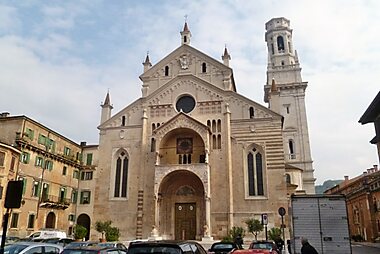
In the 13th and 14th centuries, the della Scala family (the Scaligers) ruled the city. Their greatest lord, Cangrande I, hosted the exiled poet Dante. The family left the towers, palaces and Gothic tombs around Piazza dei Signori. Cangrande II built the fortress of Castelvecchio and its fortified bridge in the 1350s; the museum inside came much later, in the 20th century.
From 1405 Verona belonged to the Republic of Venice for almost four centuries. The winged lion of St Mark on a column in Piazza delle Erbe recalls this time. Under Austrian rule in the 19th century, the city became a major fortress, which is why it still has such strong walls and gates. Retreating German troops blew up the city's bridges in April 1945. Ponte Pietra was rebuilt in the 1950s using its original stones.
Datos del país
Quick practical facts for Italy at a glance:
- Moneda
- euro EUR € · Pago con tarjeta · Ampliamente aceptado
- Teléfonos de emergencia
- 112
- Electricidad
- 230 V · 50 HzTipo C / Tipo F / Tipo L
- Idiomas
- italiano
- Agua del grifo
- Potable
- Sentido de la circulación
- Derecha
- Prefijo telefónico
- +39


Verona – Planifica tus días
Convierte los lugares de esta guía en un itinerario real, con rutas inteligentes, estimaciones de tiempo y todo lo que necesitas para un viaje perfecto.


Destinos relacionados



Data: © OpenStreetMap contributors, Wikidata, Wikipedia, Tripomatic, Official websites, geoBoundaries (CC BY 4.0). Tours by GetYourGuide. We earn commission from bookings. Travel guide generated with AI.