


Polignano a Mare
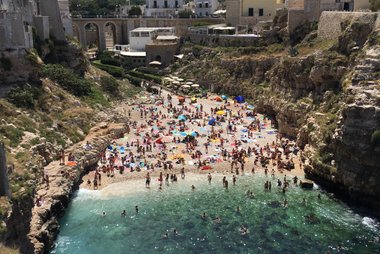
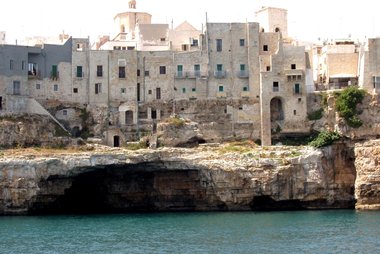
Polignano a Mare is a small town on the Adriatic coast of Apulia, about 35 km south-east of Bari. Its whitewashed old town sits on top of limestone cliffs, and the sea has cut deep caves into the rock below. The tiny pebble cove between two cliffs, seen from the bridge above, is the town's famous postcard view.
The town suits a short, relaxed stay: one or two nights for the cliffs, the terraces and the seafood, with easy trips to the trulli, the caves of Castellana and the white towns of the Itria Valley. It is also the hometown of the singer Domenico Modugno, famous for the song "Volare". Expect big crowds on summer weekends and a much quieter town from November to March.

Polignano a Mare – Utazást tervezel?
Állítsd össze a napi útvonalad a Tripomatic alkalmazásban.


Mikor érdemes utazni
May, June, September and early October are the best months: warm, sunny and good for swimming, with fewer crowds than in high summer. July and August are hot and very busy, especially at weekends, when the old town and the cove fill up. Winter is mild but often wet and windy, and some restaurants and boat trips close.
The biggest local event is the Feast of San Vito, the patron saint, in mid-June. The saint's relics arrive by sea on a decorated raft from the abbey of San Vito, followed by fishing boats, and land at Cala Paura. A procession through town and fireworks over the seafront follow.
A legjobb időszak a látogatásra: május, június, július, szeptember, október
Főbb látnivalók
Most sights are on the edge of the old town, within a few minutes' walk of each other.
Lama Monachile is the small pebble cove at the end of a narrow inlet between high cliffs. Look down on it from the road bridge above, or walk down the steps for a swim. It has no facilities and gets very crowded on summer afternoons.
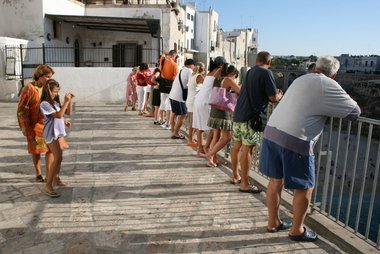
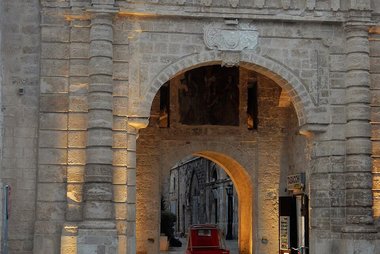
Porta Vecchia is the old arched gate from Piazza Garibaldi into the historic centre. Behind it, white lanes lead to small terraces built right on the cliff edge, with views over the sea and the caves.
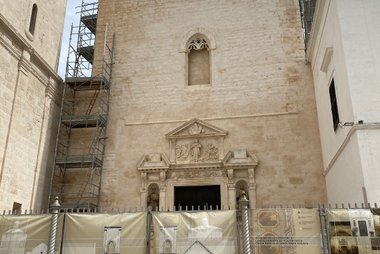
Chiesa Matrice Santa Maria Assunta stands on the main square of the old town. The church dates from the 13th century and was the town's cathedral until the 19th century.
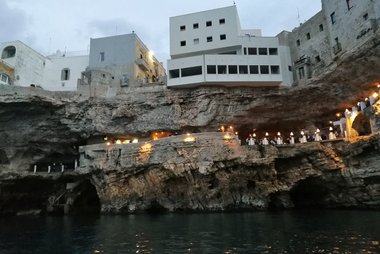
Grotta Palazzese is a large sea cave under the cliffs. In summer it holds a restaurant inside the cave, open only to guests with a booking. You can also see it from the sea on a boat trip.
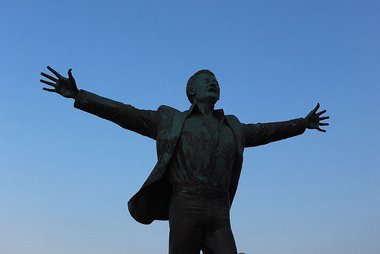
Monumento a Domenico Modugno stands on the seafront promenade north of the old town. The bronze statue shows the singer with his arms open towards the sea.
Museo Pino Pascali (Ex Macello) shows contemporary art in a former slaughterhouse on the seafront. The museum honours Pino Pascali, an important Italian sculptor of the 1960s who grew up in Polignano.
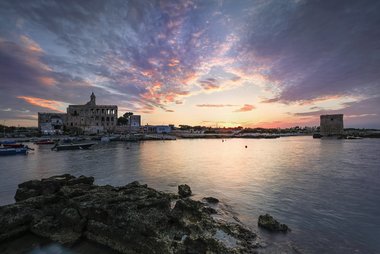
Complesso monastico Abbazia di San Vito is a quiet abbey complex beside a tiny fishing harbour, about 3 km north-west of the centre. It is a popular spot at sunset.
Kiemelt listák

Polignano a Mare: Absolute Must-Sees
Polignano a Mare is defined by its limestone cliffs and the deep inlet of Lama Monachile. This selection covers the cove and the bridge above it, the cliff-top terraces of the old town, the famous Grotta Palazzese sea cave, the Chiesa Matrice and the statue of singer Domenico Modugno, plus the seaside Abbey of San Vito and the Pino Pascali contemporary art museum.
12 hely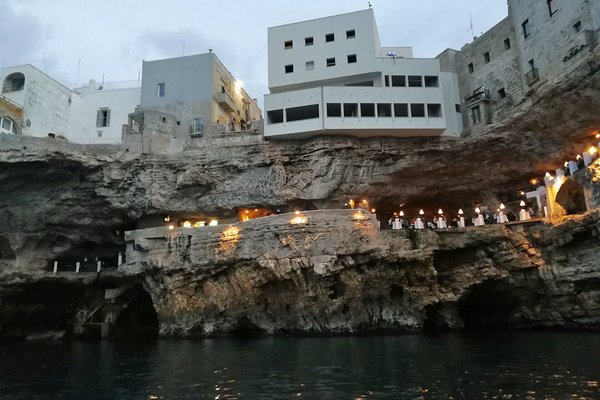

Partmenti kilátók és barlangok
Polignano a Mare 20 méter magas mészkősziklákra épült, amelyeket az Adriai-tenger több mint 70 tengeri barlangból és természetes boltívből álló komplex hálózattá formált. Ez a válogatás bemutatja a város ikonikus „balconate” (erkély) kilátóit, köztük a Lama Monachile római kori hídjára és a tágas Piazza Arditóra néző híres megfigyelőpontokat. Ezek a helyszínek az apuliai partvidék karsztgeológiáját emelik ki, és közvetlen kilátást nyújtanak a víz fölé magasodó, fehérre meszelt történelmi központra.
12 helyÉlmények
Life in Polignano is centred on the sea and the cliffs.
- See the sea caves by boat: a boat trip along the cliffs is the best way to understand the town. Boats go into or past several caves, including the one under the old town, and many trips stop for a swim.
- Watch cliff diving: Polignano regularly hosts a stop of the Red Bull Cliff Diving World Series, with athletes diving into the cove from a high platform. Local young people also jump from the rocks on summer days. Do not jump yourself unless you know the depth and currents.
- Swim from the rocks: away from the crowded cove, locals swim from the flat rocks along the coast north of the old town, near Cala Paura.
- Sunset at San Vito: drive or cycle to Complesso monastico Abbazia di San Vito at sunset, when the small harbour is at its quietest.
- The evening passeggiata: on summer evenings the whole town walks along the cliff-top terraces and the seafront promenade after dinner.
Túrák és tevékenységek
Polignano a Mare — Térkép

 Interaktív térkép megnyitása
Egynapos kirándulások
Polignano sits between the coast and the hills of central Apulia, so many good day trips are less than an hour away. A car makes most of them easier.
- Monopoli: about 5 to 10 minutes by train. A larger old town with an old harbour full of blue fishing boats, and good small beaches south of town.
- Conversano: about 20 minutes by car. A quiet hill town with a castle and a Romanesque cathedral.
- Castellana Caves: about 20 minutes by car. A large show cave with stalactites, visited on guided tours.
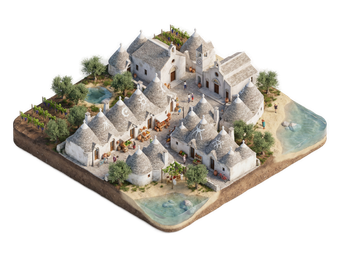
- Alberobello: about 30 minutes by car. The UNESCO town of trulli, the white houses with cone-shaped stone roofs.
- Bari: 25 to 45 minutes by train. The regional capital, with the Basilica of San Nicola and a lively old town.
- Ostuni: about 40 minutes by car. The "white town" on a hill above olive groves. Locorotondo and Cisternino in the Itria Valley make good stops on an inland route.
- Matera: about 1 hour 10 minutes by car. Famous for the Sassi, old cave houses carved into a ravine.
Mit érdemes felfedezni
Polignano a Mare is on the Adriatic coast of Apulia, south of Bari.
- Nearby towns: Alberobello and its trulli are inland, and Ostuni is further down the coast. Matera lies just across the border in Basilicata.
- Cities: Bari is the regional capital and main gateway. Trani has a cathedral right by the sea. To the south are Brindisi, the Province of Taranto and Lecce Province, home to Baroque Lecce.
- The Gargano in the north: the seaside towns of Vieste, Peschici and Vico del Gargano, and the Isole Tremiti offshore.
Odajutás
- By air: Bari Karol Wojtyła Airport is the closest, about 50 km away. Take the airport train (Ferrotramviaria, separate ticket) to Bari Centrale station (about 20 minutes), then a regional train to Polignano. By car or taxi it takes about 35 minutes. Brindisi Airport is about 80 km away, roughly 50 minutes by car.
- By train: Polignano a Mare is on the Adriatic railway between Bari and Lecce. Regional trains from Bari Centrale run often and take 25 to 45 minutes. The station is about 10 minutes' walk from the old town. Trenitalia
- By car: the coastal SS16 dual carriageway passes the town, with exits for Polignano. Bari is about 40 minutes away.
Közlekedés
- On foot: the old town, the cove and the seafront are close together and best explored on foot. The old town has some steps and uneven stone lanes.
- Public transport: you will not need buses within town. Use the train for Monopoli, Bari and other towns along the coast. Buy tickets in the Trenitalia app or at the station machines before you board, and validate paper tickets on the platform. Trenitalia
- Boat trips: in the warm months, small boats take visitors along the cliffs to see the sea caves from the water.
- Cycling: the coast road is fairly flat, and bikes and e-bikes can be rented locally, but summer traffic is heavy.
Vezetés
- Do you need a car? Not for Polignano itself, which is walkable and well served by trains to Bari and Monopoli. A car is very useful for the Itria Valley, Alberobello and the caves.
- Parking: use the paid car parks and blue-line street parking around the edge of the centre. Pay at the machines or the attendant. Yellow lines are for residents only. Spaces are hard to find on summer weekends, so arrive early.
- Restrictions: the old town behind the Arco Marchesale is a limited traffic zone (ZTL) with camera enforcement. Do not drive in unless your hotel has arranged a permit.
Ételek és italok
Seafood is the focus here. Look for crudo di mare (raw local fish and shellfish), octopus, and orecchiette pasta with turnip tops or fish sauces. Apulian street food is also easy to find: panzerotti (fried pastries filled with tomato and mozzarella), focaccia barese and taralli.
Polignano has its own coffee drink, the caffè speciale: espresso with lemon zest, sugar, cream and a dash of amaretto. It was created at the bar of the Campanella family, Il Super Mago del Gelo, near Piazza Garibaldi, which also sells gelato. Pescaria, a seafood sandwich shop that started here and is now known across Italy, has long queues in summer. For a sit-down dinner, the restaurants in the old town lanes and along the cliff terraces have the best views. Book ahead on summer weekends.
Biztonság és egészség
Polignano is a safe town. The main risks are crowds and the sea, not crime.
- Crowds: on summer weekends the old town and the cove get very busy. Keep an eye on bags and phones in crowded spots.
- Sea and cliffs: do not jump or dive from the cliffs unless you know the depth and the currents. The water near the cliffs gets deep quickly, and the sea can be rough when the wind blows from the north. Stay away from the foot of the cliffs, where rocks sometimes fall.
- Sun: there is little shade on the rocks and the pebble beach. Bring water, a hat and sun cream, and water shoes for the rocks.
Történelem
The old town grew on a limestone spur above the sea, protected by cliffs on three sides. The main route into it on land was through Porta Vecchia, which still leads into the maze of lanes today. The ancient Roman road Via Traiana, which connected Rome to Brindisi, crossed the inlet at Lama Monachile.
In the Middle Ages Polignano was a bishop's seat, and Chiesa Matrice Santa Maria Assunta served as its cathedral. Tradition says that the relics of Saint Vitus came here by sea, and the Benedictine monks of Complesso monastico Abbazia di San Vito kept them on the coast north of town. Coastal towers such as Torre Incina were built later to watch for pirate raids.
In the 20th century the town gave Italy two famous names: the singer Domenico Modugno, born here in 1928, and the artist Pino Pascali, who grew up here. Their memory lives on in the statue on the seafront and in Museo Pino Pascali (Ex Macello).
Országinformációk
Quick practical facts for Italy at a glance:
- Pénznem
- euró EUR € · Bankkártyás fizetés · Széles körben elfogadott
- Segélyhívó számok
- 112
- Elektromos hálózat
- 230 V · 50 HzC típus / F típus / L típus
- Nyelvek
- olasz
- Csapvíz
- Biztonságosan iható
- Közlekedés iránya
- Jobb oldali
- Nemzetközi előhívó
- +39


Polignano a Mare – Tervezd meg a napjaidat
Alakítsd át az útikönyvben szereplő helyeket valódi útitervvé okos útvonaltervezéssel, időbecslésekkel és mindennel, ami a tökéletes utazáshoz kell.


Kapcsolódó úti célok

Data: © OpenStreetMap contributors, Wikidata, Wikipedia, Tripomatic, Official websites, geoBoundaries (CC BY 4.0). Tours by GetYourGuide. We earn commission from bookings. Travel guide generated with AI.
Tervezd meg utazásodat a Tripomatic segítségével
- Mesterséges intelligenciával támogatott tervezésKészíts egy kész napot egyetlen koppintással, bízd a kívánságlistád elosztását az utazásodban az AI-ra, vagy tervezz meg mindent csevegve.
- Utazási figyelmeztetésekHivatalos figyelmeztetések, zord időjárás, sztrájkok és természeti veszélyek az utazásod egyes napjain szereplő helyekre vonatkozóan.
- Munkaszüneti napok és eseményekNézd meg az utazásod napjaira eső ünnepeket, fesztiválokat és zárvatartásokat, és hogy mit jelentenek a terveid szempontjából.
- KöltségbecslésAI-alapú költségbontás, hogy már indulás előtt pontosan tudd, mekkora költségvetéssel számolj.
- Túrák és jegyekFoglalj vezetett túrákat, soron kívüli jegyeket és élményeket közvetlenül az útitervedben.