


Quito
Quito is Ecuador's capital. It sits at about 2,850 m in a long Andean valley, with the Pichincha volcano rising behind it. Its colonial centre was on the very first UNESCO World Heritage List, in 1978, and it is still one of the best-preserved historic centres in Latin America. Gold-covered church interiors, busy plazas and steep lanes are all within walking distance of each other.
A stay of three or four nights suits most first-time visitors. Spend a day or two in the old town, ride the cable car for views of the volcanoes, and use the city as a base for day trips to the equator line, the cloud forest and the markets of the northern highlands. Take the first day slowly: the altitude makes many people breathless at first.

Quito – Utazást tervezel?
Állítsd össze a napi útvonalad a Tripomatic alkalmazásban.


Mikor érdemes utazni
Quito is mild all year because it lies almost on the equator, but it is high. Days are often warm in the sun and nights are cool. June to September is the drier season, with more clear mornings and better volcano views. From October to May, afternoon rain showers are common, so plan outdoor sights for the morning.
The biggest annual event is the Fiestas de Quito in the days before 6 December, the anniversary of the city's Spanish founding. Expect parades, concerts, street parties and open-sided party buses called chivas. Hotels fill up, so book early if you want to be there.
A legjobb időszak a látogatásra: augusztus
Főbb látnivalók
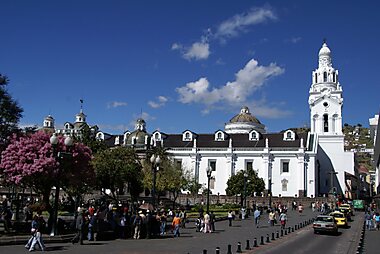




Quito Old Town is the heart of any visit: a grid of colonial churches, convents and plazas.
Church of La Compañía is the city's most famous church. Its Jesuit Baroque interior is almost completely covered in gold leaf.
Church and Convent of St. Francis faces a huge cobbled plaza. Work on it began in the 1530s, soon after the city was founded, and its museum holds a large collection of colonial religious art.
Independence Square, also called Plaza Grande, is the main square. The Cathedral of Quito and the presidential Palacio de Carondelet stand on two of its sides.
Basilica of the National Vow is a large neo-Gothic church. You can climb its towers for wide views over the old town.
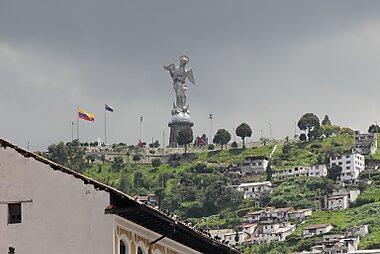
El Panecillo is a hill at the south end of the old town, topped by a 45 m aluminium statue of a winged Virgin. Go by taxi and enjoy the view over the whole valley.
Quito Cable Car lifts you from about 3,100 m to almost 3,950 m on the slopes of Pichincha. On a clear morning you can see several volcanoes, including Cotopaxi.
Chapel of Man displays the murals and paintings of Oswaldo Guayasamín, Ecuador's best-known modern artist. It stands in the hillside Bellavista district, north-east of the centre.
Museo de Arte Precolombino Casa del Alabado is a small, well-designed museum of pre-Columbian art in a restored colonial house near San Francisco.
Kiemelt listák


UNESCO World Heritage Sites
Quito’s historic center was the first city inscribed on the UNESCO World Heritage list in 1978, recognized for its exceptionally well-preserved colonial architecture. This selection features the massive Neo-Gothic spires of the Basilica of the National Vow, the Baroque interiors of the San Francisco complex, and the seat of Ecuadorian government at Carondelet Palace. The list encompasses grand 16th-century churches, the city's oldest cathedral, and former colonial mansions that now house museums dedicated to the city's art and history.
11 hely


Élmények
Some things are best done at a specific time of day or year:
- Watch the changing of the guard at Palacio de Carondelet. Soldiers in historic uniforms march with a band on the main square. The ceremony is held once a week around midday, so ask at your hotel for the current day.
- Spend an evening on Round Street. At night, this restored colonial lane fills with small bars, live music and stalls selling hot canelazo, a cinnamon drink.
- Join the Sunday Ciclopaseo. Every Sunday, about 29 km of main roads close to cars from 8:00 to 16:00, and locals cycle, run and skate across the city.
- See the Good Friday procession. Thousands of penitents in purple hoods, called cucuruchos, walk the old town streets behind the statue of Jesús del Gran Poder, starting from San Francisco.
- Go up the cable car early. Morning is the best time for clear views of the volcanoes. Some visitors continue on foot on the trail towards Rucu Pichincha. Do this only if you are used to the altitude.
Túrák és tevékenységek
Quito — Térkép

 Interaktív térkép megnyitása
Egynapos kirándulások
Quito is a good base for day trips into the Andes and the cloud forest. Nearest first:
- The equator line — Ciudad Mitad del Mundo is about 26 km north of the centre, roughly 1 hour by car or taxi. It has a 30 m monument, museums and the famous yellow line. Note that the true equator, measured by GPS, lies about 240 m to the north.
- Volcano country — Parque Nacional Cotopaxi is about 1.5–2 hours south by car. There you can walk at over 4,000 m below one of the world's highest active volcanoes. Entry is free. The gates close in the early afternoon, and the park can close at short notice when the volcano is active, so check before you go.
- Hot springs — Papallacta is about 1.5 hours east by car or bus, over a high pass. Soak in hot springs at about 3,300 m.
- Cloud forest — Mindo is about 2 hours west by bus or car. It is a small town in the cloud forest, known for birdwatching, butterflies and chocolate tours.
- Andean market town — Otavalo is about 2 hours north by bus from Terminal Carcelén. It has one of the best-known crafts markets in the Andes, and it is biggest on Saturdays.
Mit érdemes felfedezni
The city sits inside the wider Quito Metro district, which also includes the equator monument and the valleys around the city.
For nature close to town, Refugio de Vida Silvestre y Bosque de Proteccion Pasochoa protects Andean forest on the slopes of an old volcano south of Quito, and Mindo lies in the cloud forest to the west.
Odajutás
- By air: Mariscal Sucre International Airport (UIO) is about 18 km east of the city, near Tababela. Allow 45–60 minutes to the centre. Official airport taxis charge a fixed fare of around $25. Public buses (about $2–2.50) run to the Río Coca, Carcelén and Quitumbe terminals. They are cheap but slow and awkward with luggage. Quito Airport
- To the Galápagos: Flights to the Galápagos leave from this airport, many stopping in Guayaquil.
- By bus: Long-distance buses use two main terminals: Quitumbe in the south and Carcelén in the north. Both are far from the centre, so take a taxi to your hotel. Buses reach every major Ecuadorian city, including Guayaquil and Cuenca.
Közlekedés
- Metro and rapid buses: The single metro line runs north–south through the city and has a station, San Francisco, on the southern edge of the old town. The Trolebús and Ecovía bus lines run on dedicated lanes. A metro ride costs $0.45 and a Trolebús or Ecovía ride $0.35. Buy a single-trip QR ticket at a station window or ticket machine. For longer stays, get the free Tarjeta Ciudad card; register online with your passport and load credit. Metro de Quito
- Taxi: Taxis are cheap. Use a registered yellow taxi with a municipal number on the doors and windscreen, a radio taxi, or a ride-hailing app. Avoid hailing unmarked cars at night.
- On foot: The old town is compact and best seen on foot, but the streets are steep. The altitude makes every hill harder, so walk slowly on your first day.
Vezetés
- Is a car worth it?: Not for the city. Traffic is heavy, parking in the old town is scarce, and taxis are cheap. A car only helps for trips into the national parks and highlands.
- Pico y placa: On weekdays, private cars are banned from the city from 6:00 to 9:30 and from 16:00 to 20:00 on certain days, based on the last digit of the number plate. Ask your rental company which day your car is affected.
- Parking: Use guarded public car parks rather than the street, especially at night.
Ételek és italok
Quito's food is Andean highland cooking. Try locro de papa, a creamy potato and cheese soup with avocado, and hornado, slow-roasted pork. In the afternoon, locals drink hot chocolate with cheese, or canelazo on cold evenings. In late October and early November, bakeries sell colada morada, a spiced purple drink, with bread shaped like babies (guaguas de pan).
For good, cheap local food, eat at the market stalls of the Mercado Central near the old town, or at the traditional cafés on Calle La Ronda. Many restaurants serve a fixed-price lunch called almuerzo, with soup, a main course and a juice. The Floresta and La Mariscal neighbourhoods have more modern restaurants and cafés.
Biztonság és egészség
Quito is reasonably safe for visitors who take normal city precautions, but petty crime is common.
- Theft: Pickpocketing and bag snatching happen in the old town, on crowded buses and at bus terminals. Keep bags on your lap on long-distance buses rather than in the overhead rack.
- Taxis at night: Use registered taxis, radio taxis or ride-hailing apps rather than hailing a car in the street. Short "express kidnappings" have happened after people hailed taxis on the street.
- Quiet areas after dark: Stay in busy streets at night and take a taxi to and from El Panecillo rather than walking up.
- Altitude: At 2,850 m, headaches and shortness of breath are common on the first day or two. Rest, drink plenty of water and go easy on alcohol before going higher, for example on the cable car.
- Tap water: The city's tap water is treated to drinking standard. If you have a sensitive stomach, drink filtered or bottled water.
Történelem
Before the Spanish arrived, Quito was an important city in the northern part of the Inca Empire. Spanish forces under Sebastián de Benalcázar founded the colonial city on 6 December 1534, on the ruins of the Inca town. The date is still celebrated every year.
The religious orders soon built the great churches you see today. Work on Church and Convent of St. Francis began almost at once, and the Jesuits started Church of La Compañía in 1605. Local artists of the "Quito School" filled them with carvings and paintings that mix European and Indigenous styles.
On 10 August 1809, local leaders in Quito declared self-government from Spain, one of the first such moves in Latin America. Final independence came after the Battle of Pichincha on 24 May 1822, fought on the volcano slopes above the city. In 1978, UNESCO added the historic centre to its first-ever World Heritage List.
Országinformációk
Quick practical facts for Ecuador at a glance:
- Pénznem
- USA-dollár USD $ · Bankkártyás fizetés · Gyakran elfogadott
- Segélyhívó számok
- 911
- Elektromos hálózat
- 120 V · 60 HzA típus / B típus
- Nyelvek
- spanyol
- Csapvíz
- Csak óvatosan fogyasztható
- Közlekedés iránya
- Jobb oldali
- Nemzetközi előhívó
- +593


Quito – Tervezd meg a napjaidat
Alakítsd át az útikönyvben szereplő helyeket valódi útitervvé okos útvonaltervezéssel, időbecslésekkel és mindennel, ami a tökéletes utazáshoz kell.


Kapcsolódó úti célok


Data: © OpenStreetMap contributors, Wikidata, Wikipedia, Tripomatic, Official websites. Tours by GetYourGuide. We earn commission from bookings. Travel guide generated with AI.