


Ostuni
Ostuni is a hill town in Apulia, known as the "White City" because its old town is painted with white lime. The houses climb a hill above a wide plain of old olive trees, with the Adriatic Sea a few kilometres away. The old town is a maze of narrow lanes, steps and arches, with the cathedral at the top.
The town suits a slow stay of a few nights. Spend the evenings in the old town, the days at the beaches below or in the trulli country of the Itria Valley. Ostuni is also a good base for Alberobello, Polignano a Mare and Lecce, which are all within about an hour.

Ostuni – 旅行を計画中ですか?
Tripomaticアプリで日ごとの旅程を作成しましょう。


ベストシーズン
May, June, September and early October are the best months, with warm days and a sea warm enough for swimming. July and August are hot, crowded and the busiest time on the coast. Winter is mild but often wet, and some beach businesses close.
The main event is the Feast of Sant'Oronzo in late August, the patron saint's feast. Its highlight is the Cavalcata on 26 August: riders in costume on decorated horses escort the saint's silver statue through the town. The feast also brings processions, a band, street lights and crowds.
ベストシーズン: 5月, 6月, 7月, 9月, 10月
主要観光スポット

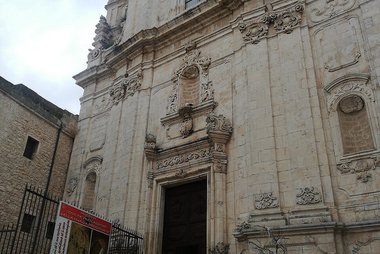
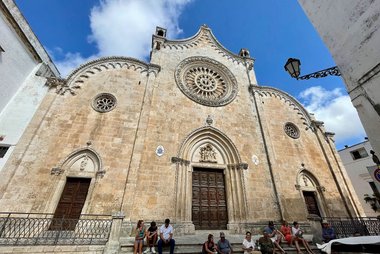
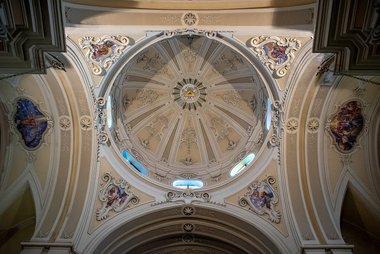
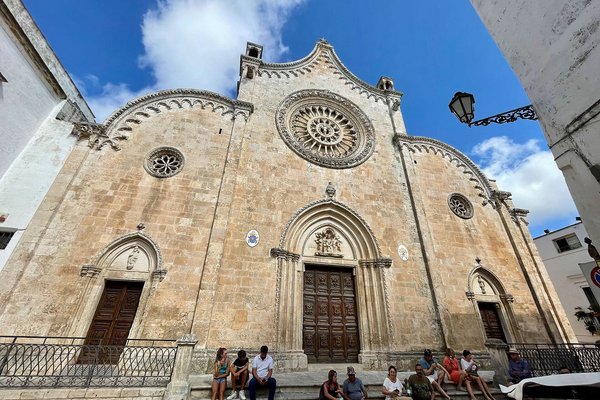
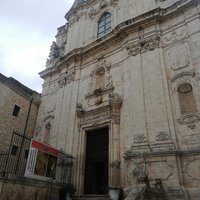
Chiesa Concattedrale Santa Maria Assunta stands at the top of the old town. It was rebuilt in late Gothic style in the 15th century, and its pale stone facade has a large rose window and a curved, three-part top.
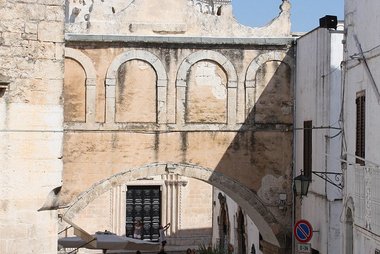
Arco Scoppa spans the lane next to the cathedral and links the Bishop's Palace with the old seminary. It frames one of the best-known views of the upper town.
Museo di Civiltà Preclassiche della Murgia Meridionale is in a former Carmelite monastery beside the church of San Vito. Its star exhibit is the burial of a young pregnant woman from about 28,000 years ago, known as the Woman of Ostuni.
Guglia di Sant'Oronzo rises over Piazza della Libertà, the main square between the old and new town. The Baroque column dates from 1771, and a statue of the saint on top blesses the town.
Complesso della Chiesa e del convento di San Francesco di Assisi also faces Piazza della Libertà. Its former convent next door is now the town hall.
Parco Archeologico e Naturalistico di Santa Maria di Agnano lies in the countryside a few kilometres from the centre. The cave where the Woman of Ostuni was found is here, with casts of the burials. It opens only on limited days, so check with the museum first.
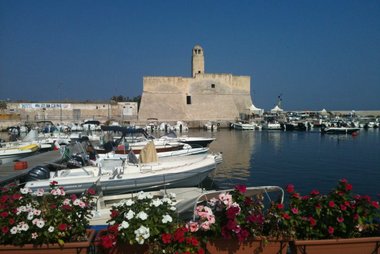
Castello di Villanova is a medieval castle-tower at the small port of Villanova, on the coast below the town. It is a pleasant stop on the way to the beaches.
注目のリスト
おすすめの体験
Ostuni is about slow days between the old town, the olive groves and the sea.
- Watch the sunset from the old town walls: the lanes on the edge of the old town look out over the olive plain to the sea. The white houses turn golden in the evening light.
- Cycle among the ancient olive trees: the plain between Ostuni and the coast is full of huge, twisted olive trees, many of them centuries old. Quiet farm lanes make it good for an easy bike ride.
- Walk the coastal dunes: the Dune Costiere regional park protects dunes, wetlands and Mediterranean scrub along the shore north-west of Villanova. It is quiet outside the summer season.
- Spend a day on the beach: the Ostuni coast has long sandy beaches and small rocky coves, such as Torre Pozzelle. Choose a beach club with sunbeds or a free stretch of sand.
ツアー&アクティビティ
Ostuni — 地図

日帰り旅行
Ostuni sits between the Itria Valley and the coast, so many good trips are close. Times are one way.
- Cisternino (≈20 min by car): a small white hill town with a quiet old centre and wide views over the Itria Valley.
- Torre Guaceto (≈20 min by car): a marine and nature reserve with dunes, a watchtower and clear water for swimming and snorkelling.
- Egnazia (≈25 min by car): the ruins of an ancient port city by the sea, with an archaeological museum.
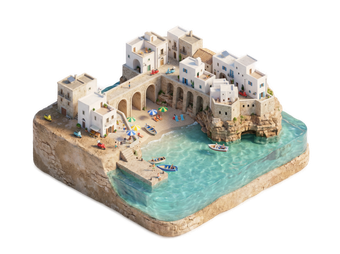
- Polignano a Mare (≈30 min by train, ≈40 min by car): a town on high cliffs above the sea, with a small cove beach in the centre.
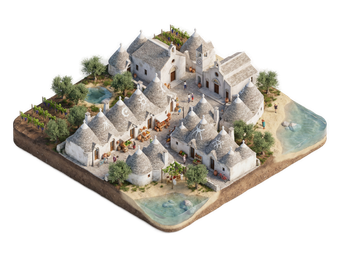
- Alberobello and the Itria Valley (≈45 min by car): the UNESCO trulli town. Combine it with Locorotondo and Martina Franca, two white towns on the way.
- Lecce (≈50 min by train): a city famous for its Baroque churches and palaces in soft golden stone.
- Matera (≈1 h 45 min by car): the UNESCO cave town in Basilicata, best seen with a full day.
探索したいエリア
Ostuni is in the province of Brindisi, in the south-east of Apulia.
- Nearby towns: Alberobello and Polignano a Mare are both within an hour. Matera lies across the border in Basilicata.
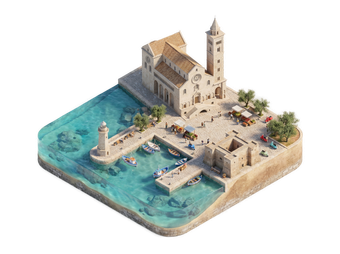
- Cities and provinces: Bari is the regional capital and main gateway. Trani has a cathedral right by the sea. Around Ostuni are the Province of Brindisi, the Province of Taranto and Lecce Province.
- The Gargano in the north: the seaside towns of Vieste and Peschici, and the Isole Tremiti offshore.
アクセス方法
- By air: Brindisi Airport is the closest, about 40 km away and roughly 30 minutes by car or taxi. By public transport, go to Brindisi station and take the train to Ostuni (about 20–25 minutes). Bari Airport is about 100 km away, roughly 1 hour by car. By train, change at Bari Centrale.
- By train: Ostuni station is on the main line along the Adriatic coast. Regional trains reach Bari in about 1 hour and Lecce in about 50 minutes. Some Frecciarossa and Intercity trains from northern Italy also stop here. The station is below the town, so take the bus or a taxi up the hill. Trenitalia
- By bus: long-distance coaches link Ostuni with other Italian cities, and regional STP Brindisi buses serve the nearby towns.
現地での移動
- On foot: the old town is small and best explored on foot. It is built on a hill, with steep lanes and many steps, so wear comfortable shoes.
- Station bus: an STP Brindisi bus links the train station with the town centre, a few minutes' walk from Piazza della Libertà. If you arrive by regional train, buy a combined train and bus ticket to "Ostuni Città" from Trenitalia. Ostuni Link (Trenitalia)
- Taxis: there are only a few local taxis. Book through your accommodation, especially for early trains or the airport.
- Coast and countryside: the beaches and farm estates are spread out. A car or a rented bike is the practical way to reach them.
運転・ドライブ
- Do you need a car? Not for the old town, which is walkable. A car makes it much easier to reach the beaches, the farm estates and the Itria Valley towns.
- Parking: park in the paid car parks and blue-line street spaces around the edge of the old town. In summer, paid parking applies until late at night, and spaces near the centre fill up in the evening.
- Restrictions: the old town is a limited traffic zone (ZTL), closed to visitors' cars. Do not follow your navigation app into the narrow lanes.
グルメ&ドリンク
Ostuni is surrounded by olive groves, and the local extra virgin olive oil is excellent. Look for Apulian classics such as orecchiette pasta with turnip greens, fava bean purée with wild chicory, and fresh burrata. Local wines include Ostuni DOC, made from the Ottavianello grape.
The best area for an evening meal is the old town, around the lanes below the cathedral, where restaurants set tables on steps and small squares. For a country meal, many old fortified farmhouses (masserie) around Ostuni now run restaurants. In nearby Cisternino, butcher shops grill meat to order in the evening.
安全&健康
Ostuni is a very safe town. Petty theft is rare, but keep an eye on your bag in the summer crowds and during the August feast.
- Steps and lanes: the old stone steps are worn smooth and can be slippery, especially after rain.
- Heat: July and August afternoons are hot. Explore the old town in the morning or evening, and carry water.
- Sea: lifeguards are usually only at beach clubs. Respect red flags on windy days.
- Country roads: rural roads are narrow and often unlit at night, so drive carefully.
歴史
People have lived around Ostuni for tens of thousands of years. The finds at Parco Archeologico e Naturalistico di Santa Maria di Agnano include Ice Age burials and a later sanctuary of the Messapians, the people who lived in this part of Apulia before the Romans. The most famous find is now in Museo di Civiltà Preclassiche della Murgia Meridionale.
The medieval town grew on the hilltop inside defensive walls, and parts of these walls still ring the old town. In the 15th century the town built Chiesa Concattedrale Santa Maria Assunta in late Gothic style, finishing it in 1495.
In 1656 and 1657, plague struck the Kingdom of Naples. Ostuni believed that Saint Oronzo had saved it, and in 1771 the town raised Guglia di Sant'Oronzo in his honour. Local tradition also links the white lime on the houses to this time, because lime was used as a disinfectant. Today the town keeps the custom of painting its houses white.
国の基本情報
Quick practical facts for Italy at a glance:
- 通貨
- ユーロ EUR € · カード決済 · 広く利用可能
- 緊急連絡先
- 112
- 電源・電圧
- 230 V · 50 HzCタイプ / Fタイプ / Lタイプ
- 言語
- イタリア語
- 水道水
- 飲用可能
- 通行区分
- 右側通行
- 国番号
- +39
Ostuni – 毎日のスケジュールを計画
このガイドの場所をもとに、スマートなルート案内や所要時間などを備えた本格的な旅程を作成しましょう。


関連する目的地

Data: © OpenStreetMap contributors, Wikidata, Wikipedia, Tripomatic, Official websites, geoBoundaries (CC BY 4.0). Tours by GetYourGuide. We earn commission from bookings. Travel guide generated with AI.