


Straatsburg
Strasbourg is the main city of Alsace, on the Rhine and the border with Germany. French and German influence shows in the buildings, the food and the local dialect. It is also a seat of European institutions, including the European Parliament and the Council of Europe.
The old centre is small, flat and easy to walk. Canals, half-timbered houses and a very large Gothic cathedral fill a few square kilometres. The city suits a trip of two or three nights, with good food, museums and day trips into the Alsace wine country. It is especially popular in December for its Christmas market.

Straatsburg – Reis plannen?
Stel je dagelijkse reisroute samen in de Tripomatic-app.
Beste reistijd
Late spring to early autumn is warm and good for walking and boat trips. Summer can bring storms. Winter is cold, with frost and some snow, but the city is at its most festive then.
The biggest event is the Christmas market. It runs from late November to 24 December in the old centre, around the cathedral and in several squares. Weekends in December are very crowded, so a weekday morning is easier.
Good Friday and 26 December are public holidays in Alsace, unlike most of France.
Beste reistijd: juni, juli, augustus, september
Topbezienswaardigheden
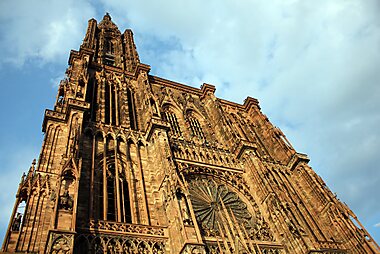
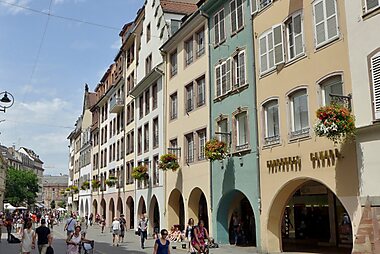


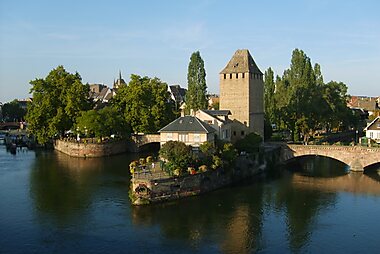

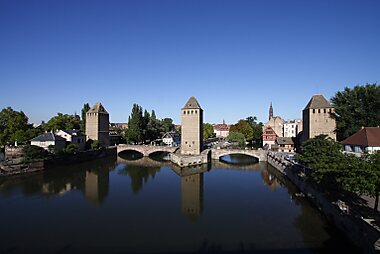
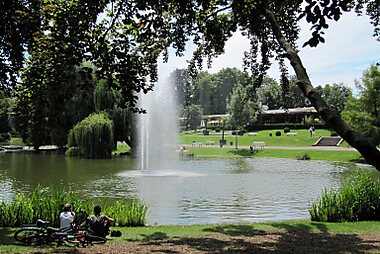
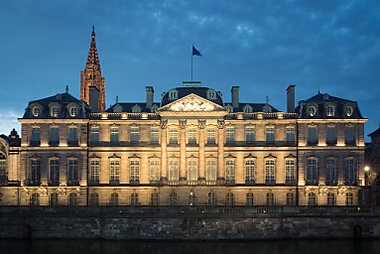

The historic centre sits on an island in the river Ill. Almost all main sights are within a 15-minute walk of each other.
- Cathedral of Our Lady is the symbol of the city. Its spire is 142 m high and was finished in 1439. For over 200 years it was the tallest building in the world. You can climb to a viewing platform at about 66 m.
- Horloge astronomique de Strasbourg is inside the cathedral. Its figures parade at 12:30, except on Sundays. Buy a small ticket and queue early, as the crowd is large.
- Grande Île is the UNESCO-listed historic centre, listed in 1988. Walk its lanes and squares without a plan.
- Covered Bridges are in Petite France, the old quarter of tanners, millers and fishermen. Half-timbered houses from the 16th and 17th centuries line the canals.
- Barrage Vauban is a dam built between 1686 and 1690. Its terrace gives a free view over the bridges and the old town.
- Palais Rohan is a baroque palace from the 1730s and 1740s. It holds the fine arts, decorative arts and archaeology museums.
- Musée de l'Œuvre Notre-Dame shows original cathedral sculptures and stained glass. It helps you understand what you see on the building outside.
- La Maison Kammerzell is a richly carved timber house next to the cathedral, with a stone ground floor from 1427. Today it is a restaurant.
- Palais du Rhin is the grand centrepiece of the Neustadt, the German district built after 1871. The district joined the UNESCO list in 2017.
- Parlement européen hosts the monthly sessions of the European Parliament. Outside session weeks, visitors can enter the hemicycle for free. Bring a passport or national ID card.
- Museum of Modern and Contemporary Art is a large modern and contemporary art museum, close to the Barrage Vauban.
- Tomi Ungerer Museum is about the illustrator Tomi Ungerer, who was born in Strasbourg. It suits families and art fans.
Aanbevolen lijsten


Parks and Playgrounds
Strasbourg offers a diverse range of green spaces, from the historic Square Louise Weiss in the Petite France district, overlooking the Ill River and Ponts Couverts, to the expansive Parc de la Citadelle, built within the remains of a 17th-century Vauban fortress. This collection includes numerous accessible playgrounds in the Neudorf and Bruckhof neighborhoods, alongside dedicated sports facilities like the grass soccer pitches at Stade Emile Stahl and Stade Langhaag.
11 plaatsenAudiogidsen – Straatsburg
Verken te voet met een zelfstandige audiotour die bij elke stop een verhaal vertelt zodra je er aankomt.


Luister naar de audiotours van Straatsburg
1 wandeling in Audiogidsen van Tripomatic


Wat te beleven
- Take a boat trip on the canals. Boats leave from the old centre and circle the Grande Île on the river Ill. A trip lasts about an hour and passes the Petite France locks and the European quarter.
- Visit the Christmas market. From late November to 24 December, wooden chalets fill the squares. The big tree stands on Place Kléber, and Petite France has its own market.
- Cycle the canals and the Ill. Rent a Vélhop bike and ride the paths along the water to the parks near the European institutions, such as Parc de l'Orangerie.
- Walk to Germany. Take tram line D to Kehl in about 20 minutes. Or cross the Rhine on the footbridge from Jardin des Deux Rives.
Tours en activiteiten
Straatsburg — Kaart

 Interactieve kaart openen
Dagtochten
Alsace has many small towns close by. Trains are frequent. Times below are one way and approximate.
- Obernai (about 30 min by train): a walled wine-road town with a pretty market square and half-timbered houses.
- Sélestat (about 30 min by train): a historic town with a famous Renaissance library. From here, a hilltop castle called Haut-Kœnigsbourg is a short drive away. It was rebuilt in the early 1900s.
- Colmar (about 35 min by regional train): canals, colourful houses and good museums. It is the most popular first choice for a day out.
- Wine Road villages such as Riquewihr and Eguisheim (about 1 h by car): small walled villages among vineyards. A car or a tour is easiest.
- Freiburg im Breisgau (about 1.5 h by train): a lively university city in Germany, at the edge of the Black Forest.
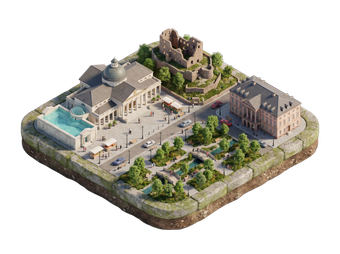
- Baden-Baden (about 1 h 15 by train): a spa town in Germany with thermal baths.
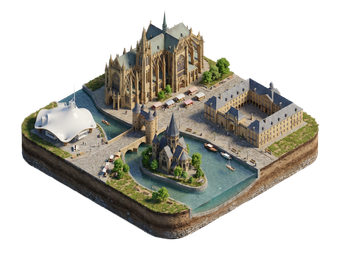
- Nancy and Metz (about 1.5 h by train each): Nancy has the grand Place Stanislas, and Metz has a cathedral with huge stained-glass windows.
Plaatsen om te ontdekken
These larger destinations are within easy reach by train.
- Alsace: Colmar and Mulhouse. Colmar is the better choice for a day out. Mulhouse is known for its car, train and technology museums.
- Lorraine: Nancy and Metz.
- Across the Rhine in Germany: Freiburg im Breisgau and Baden-Baden.
Bereikbaarheid
- By air: Strasbourg Airport (SXB) is about 10 km west of the centre. A regional train runs from Entzheim-Aéroport station to the main station in about 10 minutes. For more flight choice, fly to Paris Charles de Gaulle. It has direct high-speed trains to Strasbourg.
- By train: Trains arrive at Gare de Strasbourg, a historic building from 1883 under a glass canopy. High-speed trains from Paris Gare de l'Est take about 1 h 50. Direct trains also run to Lyon, Lille and Marseille, and to Frankfurt and Stuttgart in Germany. Regional trains reach Basel in about 1 h 20, and also serve Colmar, Mulhouse and Metz. Book French trains on SNCF Connect.
Vervoer ter plaatse
- Tram and bus: The CTS network has six tram lines and many buses. A single ticket is valid for one hour, including transfers. You can tap a contactless bank card or phone on the purple validators on tram platforms and in buses. Tap before you board a tram. More details on the CTS website.
- Cycling: The city is flat and has more than 500 km of bike paths. The Vélhop scheme rents bikes.
- On foot: The old centre is compact. Most sights are a short walk apart. Use the tram for the European quarter and the station.
Autorijden
- Is a car worth it? Not for the city. The centre is small, and trams are fast. A car is useful for the Alsace Wine Road and the castles.
- Parking: Use the park-and-ride car parks at the tram terminals. A day costs about 4 €, and the ticket includes tram and bus travel for up to seven people. Street parking in the centre is paid Monday to Saturday, 9:00 to 19:00, and is expensive.
- Restrictions: A low-emission zone covers the whole city area. You need a Crit'Air sticker, and vehicles with no sticker or with class 4 or 5 are not allowed. Order the sticker online before you travel. Parts of the old centre are pedestrian zones.
Eten en drinken
Alsatian food mixes French and German traditions. Look for tarte flambée (a thin tart with cream, bacon and onions), choucroute (sauerkraut with pork and sausages) and baeckeoffe (a slow-baked meat and potato casserole). Sweet choices include kougelhopf. At Christmas, look for small biscuits called bredele. Local white wines such as Riesling and Gewürztraminer, and sparkling Crémant d'Alsace, go with most dishes.
For a traditional meal, look for a winstub, a cosy tavern with regional dishes. They cluster in Petite France and in the streets around the cathedral. The Krutenau quarter, east of the old centre, is a relaxed area for casual meals. Book ahead on weekends and in December.
For a famous setting, try La Maison Kammerzell. It serves Alsatian dishes in a house from 1427.
Veiligheid en gezondheid
Strasbourg is a safe city for visitors. The main risk is pickpocketing in crowded places. Watch your bag around the cathedral, the station and the Christmas market. Lock your bike well, because bike theft is common.
In winter, wet cobblestones can be slippery. At the Christmas market, expect bag checks at entrances.
Geschiedenis
Strasbourg began as a Roman military camp called Argentoratum. In 842, the Oaths of Strasbourg were sworn here, in early forms of French and German. The city later became a free imperial city, and it adopted the Protestant Reformation in the 16th century. Église protestante Saint-Thomas is one of its main Protestant churches.
Printing also grew here. Johannes Gutenberg worked in Strasbourg in the 1430s and 1440s.
France took the city in 1681. Soon after, Vauban built the dam you can still cross at the Barrage Vauban. Alsace then changed hands four times between 1871 and 1945. After 1871, the German empire built the Neustadt. Palais du Rhin was built there as an imperial palace, and La Place de la République was part of the new city plan.
After the Second World War, the city became a symbol of reconciliation. The Council of Europe was set up here in 1949. Its home today, Palais de l'Europe, stands near the European Parliament.
Feiten over het land
Quick practical facts for France at a glance:
- Valuta
- Euro EUR € · Betalen met kaart · Algemeen geaccepteerd
- Noodnummers
- 112
- Elektriciteit
- 230 V · 50 HzType C / Type E
- Talen
- Frans
- Kraanwater
- Veilig om te drinken
- Rijrichting
- Rechts
- Landnummer
- +33


Straatsburg – Plan je dagen
Zet de plaatsen uit deze gids om in een echte reisroute, met slimme routes, tijdsinschattingen en alles wat je nodig hebt voor een perfecte reis.


Gerelateerde bestemmingen
Data: © OpenStreetMap contributors, Wikidata, Wikipedia, Tripomatic, Official websites. Tours by GetYourGuide. We earn commission from bookings. Travel guide generated with AI.
Plan je reis met Tripomatic
- Plannen met AIKrijg met één tik een kant-en-klare dag, laat AI je verlanglijst over je reis verdelen of plan alles via de chat.
- ReiswaarschuwingenOfficiële reisadviezen, noodweer, stakingen en natuurrampen voor de plaatsen op elke dag van je reis.
- Feestdagen en evenementenBekijk feestdagen, festivals en sluitingen op de dagen van je reis en wat ze betekenen voor je plannen.
- KostenramingDoor AI berekende reiskostenoverzichten, zodat je vooraf weet welk budget je nodig hebt.
- Tours en ticketsBoek tours, skip-the-line tickets en activiteiten direct in je reisplan.