


Castelló de la Plana
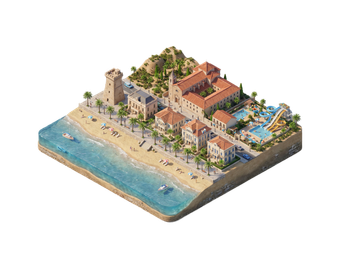
Castellón de la Plana is a coastal city on Spain's Costa del Azahar, in the Valencian Community, about 75 km north of Valencia. It has a pleasant center, a modern port area (El Grau) and long sandy beaches.
It is a relaxed provincial capital rather than a major tourist city, which makes it good value. It suits a short stay, and it is a good base for the beaches and hill towns of the region.

Castelló de la Plana – planujesz wycieczkę?
Stwórz swój plan podróży dzień po dniu w aplikacji Tripomatic.


Kiedy jechać
Late spring and early autumn are the best seasons, with warm weather and fewer people. Summers are hot and dry, and the sea is warm from June to October. Winters are mild.
The Magdalena festival in March is the biggest event, with a pilgrimage to a hermitage, parades and fireworks.
Najlepszy czas na wizytę: kwiecień, maj, czerwiec, lipiec, październik, listopad
Główne zabytki
- Cocatedral de Santa Maria is the main church of the city, on the Plaza Mayor.
- El Fadrí is an octagonal bell tower next to the church. It stands apart from the building and is a symbol of the city.
- The Plaza Mayor is the central square, with the town hall and the market building close by.
- The Basilica of Lledó is a sanctuary dedicated to the patron saint, in a park on the edge of the center.
- The Castell Vell is a ruined medieval castle on a hill to the north.
- The Magdalena Hermitage is a small chapel on a hill, and the destination of the festival pilgrimage.
- The Espai d'Art Contemporani is a contemporary art center.
- El Grau and the beaches (Pinar, Gurugú and Heliópolis) are east of the center.
Polecane zestawienia

Castelló de la Plana Essentials
Castelló de la Plana centers on the historic Plaza Mayor, where the Gothic Co-cathedral of Saint Mary stands alongside El Fadrí, a distinctive 16th-century octagonal bell tower. The city's architectural landscape includes the 18th-century Baroque Town Hall and the neoclassical Teatre Principal. Cultural highlights range from the traditional Mercat Central, housing over 60 food stalls since 1949, to contemporary spaces like the Espai d’Art Contemporani. Monuments throughout the center, such as the statue of King James I, reflect the city’s medieval foundations and Mediterranean history.
10 miejscCzego warto doświadczyć
- Spend a day on the beaches east of the city.
- Walk or cycle to the Magdalena hermitage for views.
- Try rice dishes in a restaurant in El Grau.
Wycieczki i aktywności
Castelló de la Plana — Mapa

Wycieczki jednodniowe
- Benicàssim (about 12 km, 15 minutes): a beach town with a long promenade and a music festival.
- Peñíscola (about 70 km, 1 hour): a walled town on a rocky headland with a castle.
- Desert de les Palmes (about 20 km): a natural park with hiking trails and a monastery.
- Columbretes Islands: a marine reserve of volcanic islets, reached by boat in season.
- Valencia (about 75 km, 1 hour by train): the region's biggest city.
Gdzie warto się udać
Other places nearby:
- Coast: Benicàssim and Peñíscola.
- City: Valencia.
Jak dotrzeć
- By air: Castellón airport (CDT) has few flights. Valencia airport is the main alternative, about 90 km away.
- By train: Trains connect Castellón with Valencia, Barcelona and the coast. Book on Renfe.
- By bus: Coaches run to Valencia, Barcelona and nearby coastal towns.
Poruszanie się na miejscu
- On foot: The center is flat and compact. The beaches are a few kilometers from the center.
- Cycling: The city is flat, and bike lanes link the center with the beaches.
- Public transport: City buses and a tram-like bus line link the center with El Grau and the beaches.
Prowadzenie samochodu
- Is a car worth it?: Not for the city. A car helps for the hill towns and the northern coast.
- Parking: Use an underground car park in the center.
- Restrictions: Parts of the center are pedestrian only.
Jedzenie i napoje
Castellón's food is Valencian, with rice dishes at the center. Paella, arroz al horno (baked rice) and fideuà (a noodle dish like paella) are common, and seafood from the port is fresh.
Oranges and other citrus fruits grow in the surrounding plain.
Bezpieczeństwo i zdrowie
Castellón is a safe city. Summer heat is strong, so wear sun protection and drink water. Take care in the sea when red flags are shown.
Historia
The city was founded in the 13th century, when the Christian king James I moved the population from a hill fort to the plain. It grew as an agricultural center, based on oranges and the port.
It became the capital of its province in the 19th century, and it is now a ceramic-tile industry and university center.
Informacje o kraju
Quick practical facts for Spain at a glance:
- Waluta
- euro EUR € · Płatności kartą · Powszechnie akceptowane
- Numery alarmowe
- 112
- Elektryczność
- 230 V · 50 HzTyp C / Typ F
- Języki
- hiszpański
- Woda z kranu
- Zdatna do picia
- Ruch drogowy
- Prawostronny
- Numer kierunkowy
- +34


Castelló de la Plana – zaplanuj swoje dni
Zmień miejsca z tego przewodnika w prawdziwy plan podróży z inteligentnym wyznaczaniem tras, szacowanym czasem i wszystkim, czego potrzebujesz na udaną wycieczkę.


Powiązane cele podróży


Data: © OpenStreetMap contributors, Wikidata, Wikipedia, Tripomatic, Official websites. Tours by GetYourGuide. We earn commission from bookings. Travel guide generated with AI.