


Catânia
Catania is Sicily's second-largest city, built at the foot of Mount Etna. The volcano shapes everything here. Lava and earthquakes have badly damaged the city several times, and after 1693 it was rebuilt in Baroque style from dark volcanic stone. The result is a city of grey-black churches and palaces and wide, straight streets. On clear days you can see Etna from many parts of the centre.
Catania feels less polished than Taormina or Syracuse, and it is a busy working city. Mornings at the fish market, late evenings on the main street and some of Sicily's best street food make it a good place for two or three nights. It is also the most practical base for eastern Sicily, with the island's busiest airport and good links to Etna and the coast. The opera composer Vincenzo Bellini was born here, and his name appears on the theatre, a park and many streets.

Catânia – A planear uma viagem?
Cria o teu itinerário dia a dia na app Tripomatic.


Quando visitar
Spring and autumn are the best seasons, with warm days and comfortable evenings. The sea stays warm enough to swim until October. Summer is very hot and humid, and July and August can feel heavy in the stone streets. Winter is mild and green, with some rainy days.
The big event is the Festa di Sant'Agata from 3 to 5 February, a huge religious festival. Hundreds of thousands of people follow the relics of the city's patron saint through the streets. Devotees wear white robes, and huge carved and gilded wooden candle towers called candelore are carried through the centre. Book accommodation early if you plan to visit then.
Melhor altura para visitar: abril, maio, junho, outubro, novembro
Principais atrações
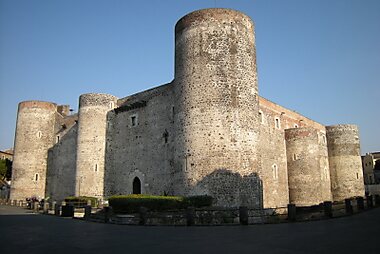
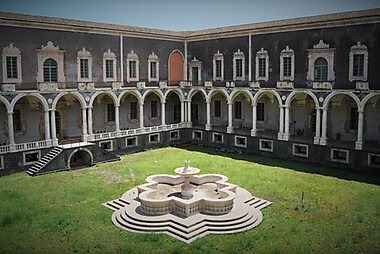
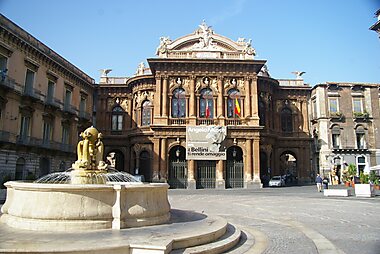
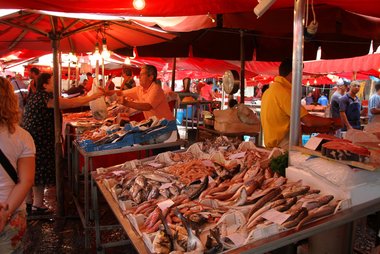
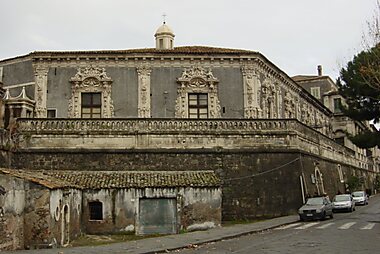
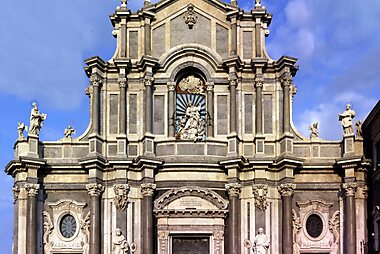
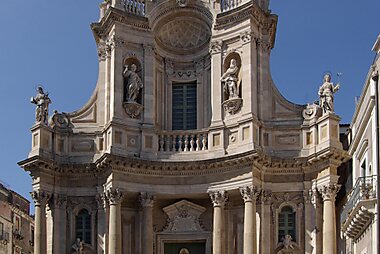
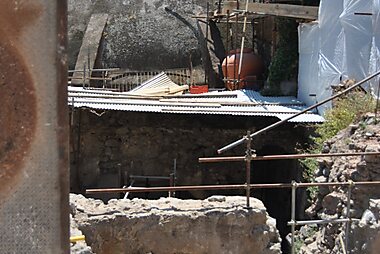
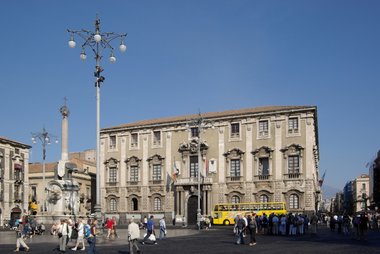
Most sights sit within a short walk of each other in the historic centre, part of a UNESCO World Heritage site.
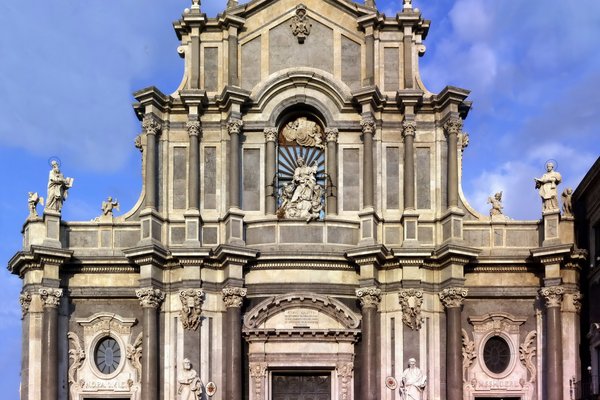
- Cattedrale di Sant'Agata dominates the main square. Its Baroque facade hides parts of the older Norman church, and it holds the relics of Saint Agatha and the tomb of Bellini.
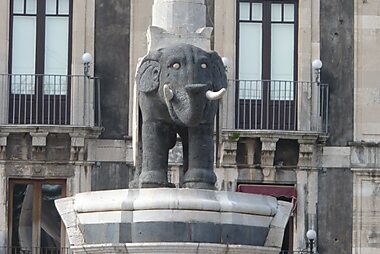
- Fontana dell'Elefante is the city's symbol: a small lava-stone elephant carrying an Egyptian obelisk, in the middle of Piazza del Duomo. Locals call it u Liotru.
- La Pescheria is the historic fish market just below the cathedral square. Go early in the morning to see swordfish, tuna and shellfish sold with loud sung calls.
- San Nicolò l'Arena is a huge former Benedictine monastery and church. It now belongs to the university, and guided tours show its cloisters, kitchens and Roman remains.
- Castello Ursino is a 13th-century castle built for Emperor Frederick II. It once stood by the sea, until the lava of 1669 pushed the shore away. Today it houses the city museum.
- Teatro Greco Romano lies hidden among houses off Via Vittorio Emanuele. You can walk on the old seating, with a smaller odeon next to it.
- Roman Amphitheater is partly visible from the street in Piazza Stesicoro. Most of this large arena still lies under the modern city.
- Badia di Sant'Agata faces the cathedral. Climb to the walkway around its dome for one of the best views over the rooftops to Etna.
- Teatro Massimo Bellini is the city's 19th-century opera house, named after Bellini, with a richly decorated interior.
Walk along Via Crociferi as well. This short, quiet street is lined with 18th-century Baroque churches and convents, one after another, and is part of the UNESCO site.
Listas em destaque


O que experienciar
These activities are typical of Catania and its coast.
- Swim off the black lava rocks: in summer, locals swim from the lava coast and the small black-sand cove at San Giovanni Li Cuti, north of the centre. For sandy beaches, head south to the long beach clubs of La Playa.
- Ride the Circumetnea railway: Ferrovia Circumetnea is a slow, single-track line that circles the volcano through lava fields, vineyards and hill towns. Its trains no longer leave from central Catania: take the metro to Nesima, then the connecting bus to the railway. Check the timetable before you go.
- Spend a night at the opera: check the programme of Teatro Massimo Bellini and book a seat for an opera, ballet or concert. Seeing a performance in the composer's home town is the best way to experience the building.
Excursões e atividades
Catânia — Mapa

 Abrir o mapa interativo
Passeios de um dia
Catania is the best base for exploring eastern Sicily. Many good trips start less than an hour away.
- Aci Castello and Aci Trezza (≈20–30 min by bus or car): two fishing villages on the lava coast north of the city. Aci Castello has a Norman castle on a black rock, and Aci Trezza faces the sea stacks of the Cyclops Riviera.
- Acireale (≈30 min by bus or train): a Baroque town on a cliff above the sea, known for one of Sicily's biggest carnivals.
- Taormina (≈1 hour by train or bus): a hilltop resort with an ancient Greek theatre and wide views of the sea and Etna.
- Mount Etna (≈1–1.5 hours by car to the southern slope): Europe's highest active volcano. Walk around old craters, or take the cable car and a guided trip higher up.
- Syracuse (≈1–1.5 hours by train or bus): a major Greek city of the ancient world. Visit the archaeological park and the old town on the island of Ortigia.
- Noto (≈1.5–2 hours by bus): a small town of honey-coloured Baroque churches and palaces, rebuilt after the 1693 earthquake.
- Piazza Armerina (≈1.5–2 hours by bus or car): famous for the Roman mosaics of the Villa Romana del Casale, a UNESCO World Heritage site.
Onde explorar
Catania sits in the middle of Sicily's east coast, close to many of the island's main destinations.
- The volcano and the coast: Mount Etna rises just north of the city, and Taormina looks down on the sea beyond it. The Aeolian Islands lie off the north coast.
- The Baroque southeast: Syracuse, Noto and Ragusa are easy to combine on a road trip.
- Further west: Palermo, Cefalù, the Greek temples of Selinunte and the Trapani and Paceco Salt Pans make a longer trip across the island.
Como chegar
- By air: Catania Fontanarossa Airport (CTA) is Sicily's busiest airport, about 5 km south of the centre. The Alibus runs every 20 minutes or so to the central station and the old town; the ride takes 15–20 minutes, and the ticket costs about 4 € on board. Taxis to Piazza del Duomo or the central station charge a fixed fare of 27 € as a trial until the end of 2026; confirm the price with the driver. Eruptions of Etna sometimes close the airport for a few hours. Catania Airport
- By train: Catania Centrale station has regional trains to Taormina, Syracuse and Messina. Long-distance trains to Rome and Naples cross the Strait of Messina on a ferry. Trenitalia
- By bus: regional coaches leave from near the central station. They are often faster than the train to Palermo (about 2 hours 40 minutes), Noto and Agrigento, and direct buses also run from the airport to many Sicilian towns.
Como se deslocar
- On foot: the historic centre is compact and flat around Piazza del Duomo and Via Etnea, and walking is the best way to see it.
- Buses: city buses are run by AMTS. Buy tickets in the AMT Catania app or at tobacconists and newsagents before boarding. The Alibus airport line also sells tickets on board. AMTS Catania
- Metro: one metro line links Piazza Stesicoro and the central station with the western suburbs. It does not reach the airport. Tickets are sold in the FCE app, at ticket offices and at resellers. Ferrovia Circumetnea
- Taxis: taxis are not usually hailed on the street. Use a taxi rank or call one.
- Cycling: traffic is heavy and drivers are fast, so cycling is not practical for most visitors.
Conduzir
- Is a car worth it?: not for the city itself. Traffic is heavy and parking is hard. A car is very useful for Etna and for the towns of the southeast, so pick one up at the airport when you leave the city.
- Parking: street parking inside blue lines is paid at meters or by app. AMTS runs park-and-ride car parks, including one at the airport linked to the Alibus.
- Security: car break-ins happen. Leave nothing visible inside, and use a guarded car park overnight.
Comida e bebida
Catania has some of Sicily's best street food. Try a cone-shaped arancino (fried rice ball), and pasta alla Norma with aubergine, tomato and salted ricotta, named after Bellini's opera. In the morning, locals eat almond or pistachio granita with a soft brioche. Street kiosks sell a salty, fizzy lemon drink that is very refreshing on hot days.
For eating, go to the streets around La Pescheria, where small restaurants cook the morning's fish. In the evening, Via Plebiscito is known for simple grills serving horse meat, a local tradition. The pastry shops and cafes along Via Etnea are best for granita, cannoli and almond biscuits.
Segurança e saúde
Catania is generally safe for visitors, but petty crime is more common than in smaller Italian towns. Watch your bag in crowds, at the fish market and on buses. Bag snatching by people on scooters happens, so carry your bag on the side away from the road. The streets around the central station and some backstreets of the old centre can feel empty and unsafe late at night.
In summer, protect yourself from the strong sun and heat. On Etna, follow the rules on access to the summit areas, which change with volcanic activity.
História
Greek settlers founded Katane in the 8th century BC, and the Romans turned it into a large and wealthy city. You can still see the Teatro Greco Romano, the Roman Amphitheater and the underground Terme Achilliane below the cathedral square.
In the Middle Ages, Frederick II built Castello Ursino on the coast. In 1669, a huge eruption of Etna sent lava into the city. It surrounded the castle and pushed the shoreline far out to sea. Only 24 years later, in 1693, an earthquake destroyed most of Catania and killed a large part of its people.
The city was rebuilt with wide, straight streets to make it safer, and with dark lava stone from the volcano. Architects such as Giovanni Battista Vaccarini designed the cathedral facade and the Fontana dell'Elefante. This Baroque centre is now part of a UNESCO World Heritage site.
Factos sobre o país
Quick practical facts for Italy at a glance:
- Moeda
- Euro EUR € · Pagamentos com cartão · Amplamente aceite
- Números de emergência
- 112
- Eletricidade
- 230 V · 50 HzTipo C / Tipo F / Tipo L
- Idiomas
- italiano
- Água da torneira
- Própria para beber
- Sentido de condução
- Direita
- Indicativo telefónico
- +39


Catânia – Planeia os teus dias
Transforma os lugares deste guia num verdadeiro itinerário, com rotas inteligentes, estimativas de tempo e tudo o que precisas para uma viagem perfeita.


Destinos relacionados


Data: © OpenStreetMap contributors, Wikidata, Wikipedia, Tripomatic, Official websites, geoBoundaries (CC BY 4.0). Tours by GetYourGuide. We earn commission from bookings. Travel guide generated with AI.
Planeia a tua viagem com o Tripomatic
- Planeamento com IAObtém um dia pronto com um toque, deixa a IA distribuir a tua lista de desejos pela tua viagem ou planeia tudo através do chat.
- Alertas de viagemAvisos oficiais, condições meteorológicas adversas, greves e perigos naturais para os lugares em cada dia da tua viagem.
- Feriados e eventosVê feriados, festivais e encerramentos nos dias da tua viagem e o impacto que têm nos teus planos.
- Estimativa de custosDiscriminação de custos de viagem com IA para saberes quanto orçamentar antes de ir.
- Excursões e bilhetesReserva excursões, bilhetes sem filas e atividades diretamente no teu plano.