


Noto
Noto is a small hill town in south-eastern Sicily, and a showcase of Sicilian Baroque architecture. After an earthquake destroyed the old town in 1693, Noto was rebuilt on a new site. Its churches, palaces and stairways were all built in the same soft local stone, which turns gold and honey-coloured in the evening light.
The old town is compact, so you can see the main sights in a day. Many visitors stay two or three nights to enjoy the evening stroll, the pastry shops and the nearby coast. Noto also makes a good base for the beaches of Vendicari and the other Baroque towns of the Val di Noto, which share a UNESCO World Heritage listing.

Noto – A planear uma viagem?
Cria o teu itinerário dia a dia na app Tripomatic.


Quando visitar
Spring and autumn are the best times to visit, with warm days and comfortable evenings for walking. July and August are very hot, so plan sightseeing for the morning and evening and spend the middle of the day at the beach. Winter is mild and quiet, with some rainy days.
The biggest event of the year is the Infiorata in mid-May. For a long weekend, artists cover the sloping Via Corrado Nicolaci with large pictures made of flower petals. The weekend also brings a Baroque costume parade and concerts. Expect crowds and book your room early.
Melhor altura para visitar: abril, maio, outubro, novembro
Principais atrações
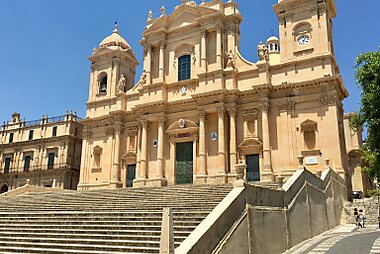
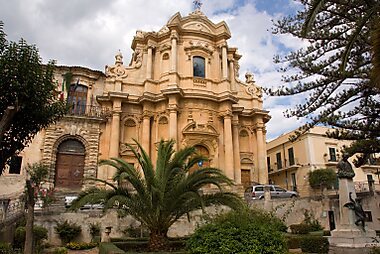

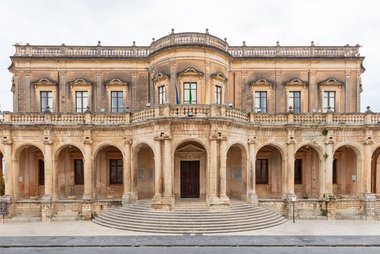
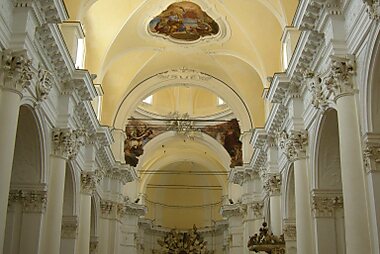
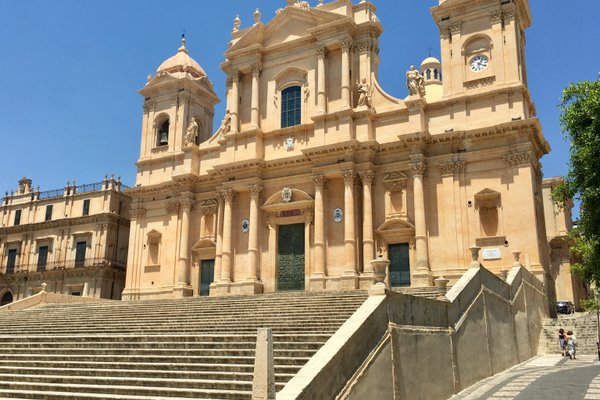
Noto Cathedral stands at the top of a wide flight of steps in the middle of town. Its dome collapsed in 1996 and was carefully rebuilt, and the church reopened in 2007.
Palazzo Ducezio faces the cathedral across the main street. Noto's town hall has a long arcaded front, and you can visit its oval Hall of Mirrors.
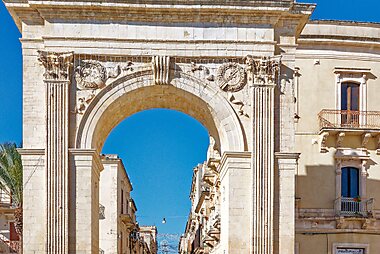
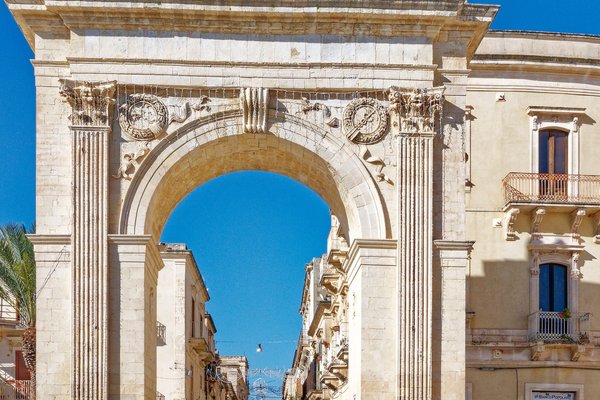
Porta Reale marks the eastern entrance to the old town. The gate was built in 1838 for a visit by King Ferdinand II. From here, Corso Vittorio Emanuele leads past most of the main churches and palaces.
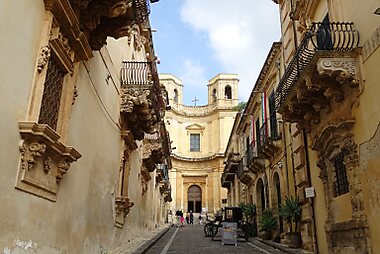
Palazzo Nicolaci is famous for its balconies. Their stone supports are carved as horses, lions, sirens and grotesque faces. Look up from Via Corrado Nicolaci, or buy a ticket to see the rooms inside.
Chiesa di San Domenico has a curved, two-level facade by Rosario Gagliardi. It overlooks Piazza XVI Maggio, a small garden square with an 18th-century fountain.
Chiesa di Santa Chiara has an elegant oval interior. Its roof terrace gives a close view of the cathedral dome and the main street.
Chiesa di San Carlo al Corso is another Baroque church on the main street. You can climb its bell tower for a view over the rooftops of the old town.
Listas em destaque


O que experienciar
Life in Noto moves slowly, and the best moments are about the light, the stone and the evenings.
- Join the evening passeggiata: after sunset, families stroll up and down Corso Vittorio Emanuele, past the floodlit churches and palaces.
- Join the feast of San Corrado: twice a year, in February and in late August, the silver casket with the relics of the patron saint is carried through the streets in a long procession.
- Watch flamingos at Vendicari: from autumn to spring, flamingos and herons feed in the lagoons of the reserve. Wooden hides along the paths let you watch them up close.
Excursões e atividades
Noto — Mapa

 Abrir o mapa interativo
Passeios de um dia
Noto sits between the sea and the limestone hills of south-eastern Sicily. Many of the best day trips are less than an hour away, but a car makes most of them much easier.
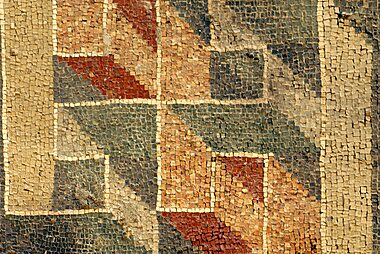
- Villa Romana del Tellaro — about 20 minutes by car. A late Roman country house with colourful floor mosaics, usually closed on Mondays. It pairs well with the Greek ruins of Eloro by the sea.
- Vendicari Nature Reserve — about 20–25 minutes by car. A protected coast with lagoons, an old tuna fishery and sandy beaches such as Spiaggia di Calamosche. Entry is paid.
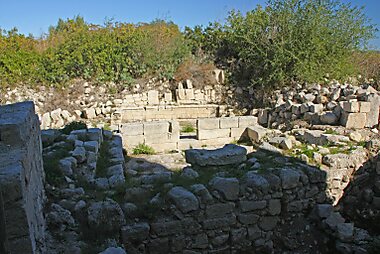
- Noto Antica — about 25 minutes by car. The ruins of the town destroyed in 1693 lie on a quiet hilltop among trees and wild flowers.
- Syracuse — about 35 minutes by car or train. Greek temples, a huge ancient theatre and the island old town of Ortigia.
- Cava Grande di Cassibile — about 40 minutes by car. A deep canyon with a steep path down to green river pools for swimming. Entry is paid, and good shoes are essential. The path can close in high fire risk, so check that it is open before you go.
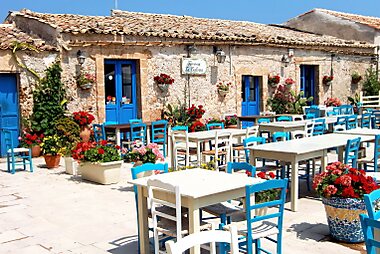
- Marzamemi — about 40 minutes by car. A small fishing village with a square built around an old tuna fishery, busy on summer evenings.
- Modica and Ragusa — about 40 minutes and 1 hour by car. Two more Baroque towns on steep hillsides. Modica is known for its grainy chocolate.
- Catania — about 1 hour 15 minutes by car, longer by bus. A big, lively city built of black lava stone, with a famous fish market.
Onde explorar
Como chegar
- By air: Catania Fontanarossa Airport (CTA) is the nearest airport, about 1 hour away by car. Interbus coaches run from the airport to Noto several times a day and take about 1.5 hours. They stop near the public gardens at the eastern end of the old town.
- By bus: Interbus and AST coaches link Noto with Syracuse, Catania and the nearby coast.
- By train: Regional trains on the line between Syracuse and Ragusa stop at Noto. Syracuse is about 30 minutes away. The station is about a 15-minute walk below the old town. Trains run several times a day, but fewer on Sundays, so check the timetable. Trenitalia
Como se deslocar
- On foot: The old town is small, and walking is the best way to see it. The main street is flat, but the side streets climb steeply, with many steps.
- Buses: Buses are of little use inside the old town. Regional buses link Noto with nearby towns, but services are limited. Buy tickets before boarding where possible, at a ticket office or in the operator's app.
- Taxi: Taxis are few. Ask your hotel to book one, especially for early trains or the airport.
- Car: You need a car, a tour or a taxi for most nature reserves, beaches and archaeological sites outside town.
Conduzir
- Is a car worth it?: Not for the old town, which is best on foot. A car is very useful for the beaches, nature reserves and nearby Baroque towns, which buses serve poorly.
- Restrictions: The central part of the main street is closed to cars, and nearby streets can have limited-traffic hours. Check the signs before you drive into the old town.
- Parking: Use the paid car parks and the blue-line street parking around the edge of the old town, then walk in. Parking is hard to find during the Infiorata and on summer weekends.
Comida e bebida
Noto is famous for its sweets. Almonds from the surrounding countryside go into almond milk, pastries and granita, the crushed-ice dessert that locals eat with a soft brioche for breakfast in summer. Try cannoli, cassata and the local almond biscuits. Local wines include Nero d'Avola and the sweet Moscato di Noto.
Caffè Sicilia on the main street is the town's best-known pastry shop, open since 1892 and run by the same family. For dinner, look for small restaurants in the lanes just above and below Corso Vittorio Emanuele. On summer evenings, many visitors also drive to the harbour square of Marzamemi to eat fresh fish.
Segurança e saúde
Noto is a very safe town for visitors. Normal care is enough, especially in crowds during the Infiorata and on summer evenings.
The summer heat is the main risk. Carry water, wear a hat and avoid long walks at midday. Take care on the steep path into Cava Grande di Cassibile, and on smooth stone steps in town, which can be slippery.
História
The first Noto stood on a hilltop about 8 km north-west of today's town. Tradition says it was the home town of Ducetius, a leader of the native Sicels in the 5th century BC. The town hall, Palazzo Ducezio, is named after him. Greeks, Romans, Arabs and Normans all ruled the old town in turn.
On 11 January 1693, a huge earthquake destroyed much of south-eastern Sicily, including old Noto. Its ruins survive as Noto Antica. The survivors built a new town on a lower slope closer to the sea. Architects such as Rosario Gagliardi and Vincenzo Sinatra laid out straight streets and terraces, and designed the churches and palaces you see today, including Chiesa di San Domenico and Chiesa di Santa Chiara.
In 1996, the dome of Noto Cathedral collapsed after years of damage. Its careful rebuilding became a symbol of the town's revival. In 2002, Noto and seven other towns of the Val di Noto were added to the UNESCO World Heritage list.
Factos sobre o país
Quick practical facts for Italy at a glance:
- Moeda
- Euro EUR € · Pagamentos com cartão · Amplamente aceite
- Números de emergência
- 112
- Eletricidade
- 230 V · 50 HzTipo C / Tipo F / Tipo L
- Idiomas
- italiano
- Água da torneira
- Própria para beber
- Sentido de condução
- Direita
- Indicativo telefónico
- +39

Noto – Planeia os teus dias
Transforma os lugares deste guia num verdadeiro itinerário, com rotas inteligentes, estimativas de tempo e tudo o que precisas para uma viagem perfeita.


Destinos relacionados


Data: © OpenStreetMap contributors, Wikidata, Wikipedia, Tripomatic, Official websites, geoBoundaries (CC BY 4.0). Tours by GetYourGuide. We earn commission from bookings. Travel guide generated with AI.
Planeia a tua viagem com o Tripomatic
- Planeamento com IAObtém um dia pronto com um toque, deixa a IA distribuir a tua lista de desejos pela tua viagem ou planeia tudo através do chat.
- Alertas de viagemAvisos oficiais, condições meteorológicas adversas, greves e perigos naturais para os lugares em cada dia da tua viagem.
- Feriados e eventosVê feriados, festivais e encerramentos nos dias da tua viagem e o impacto que têm nos teus planos.
- Estimativa de custosDiscriminação de custos de viagem com IA para saberes quanto orçamentar antes de ir.
- Excursões e bilhetesReserva excursões, bilhetes sem filas e atividades diretamente no teu plano.