


Hamburgo
Hamburg is Germany's second-largest city and its great port town, built where the Elbe river meets the North Sea. Merchant wealth from centuries of shipping trade shaped the city: grand warehouses, a soaring town hall, and one of Europe's busiest harbors, still active today alongside cruise ships and tour boats.
The city suits travelers who like a mix of history, water, and nightlife. Wander the red-brick canals of Speicherstadt und Chilehaus mit dem Kontorhausviertel, catch a concert at Elbe Philharmonic Hall, and spend an evening on the Reeperbahn, Hamburg's famous entertainment strip. Composer Johannes Brahms was born here, and the city still prides itself on live music.

Hamburgo – A planear uma viagem?
Cria o teu itinerário dia a dia na app Tripomatic.
Quando visitar
Spring and early autumn are mild and pleasant for walking the harbor and canals. Summer brings the warmest weather but also the most rain, so pack a jacket. Winter is cold and often grey, with the Christmas markets around the town hall as the main draw.
Plan around the Hafengeburtstag (Port Anniversary) in early May, when tall ships fill the harbor, tugboats parade, and fireworks light up the Elbe over three days. It is the city's biggest annual event and one of the largest harbor festivals in the world.
Melhor altura para visitar: junho, agosto
Rain gear is worth packing any month — even the driest spells rarely go more than a few days without a shower.
Principais atrações
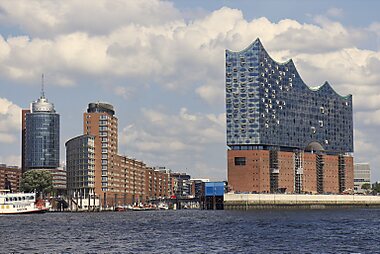


Elbe Philharmonic Hall is Hamburg's modern landmark, a glass concert hall rising above the harbor on top of a converted warehouse. Even without a ticket, the free public viewing platform gives sweeping views over the port.
Speicherstadt und Chilehaus mit dem Kontorhausviertel is the world's largest historic warehouse district, a UNESCO World Heritage site of red-brick buildings laced with canals, alongside the striking 1920s brick office quarter next to it.
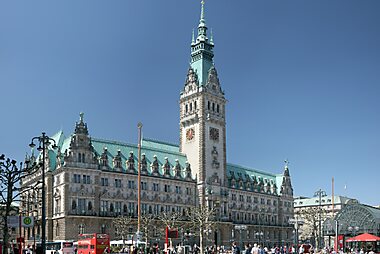
Hamburg City Hall is the seat of the city government, a lavish neo-Renaissance building on the main market square. Free guided tours run most days and take in the ornate council chamber.
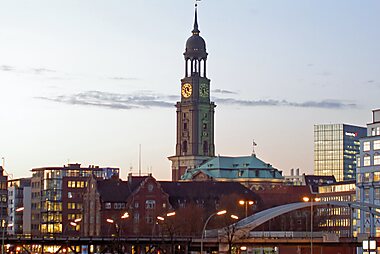
Nicknamed "Michel," St. Michael's Church is Hamburg's best-known church tower. Climb it for one of the best panoramas in the city, over the port and the Elbe.
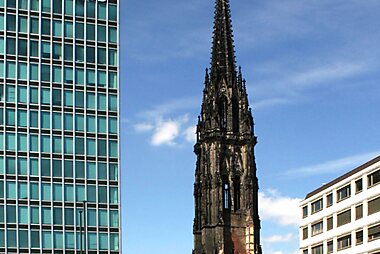
Kirchenruine St. Nikolai is the bombed-out shell of a Gothic Revival church, kept as a memorial to the victims of the Second World War. A glass elevator carries visitors up the tower for a view over the old town.
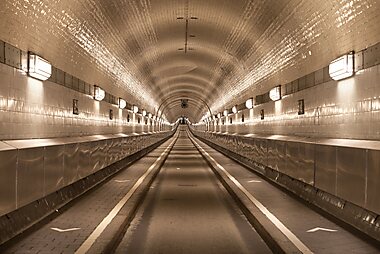
Landungsbrücken are the city's grand harbor piers, the departure point for boat tours and ferries. The historic St. Pauli-Elbtunnel runs beneath the river nearby and still carries pedestrians and cyclists to the far bank.
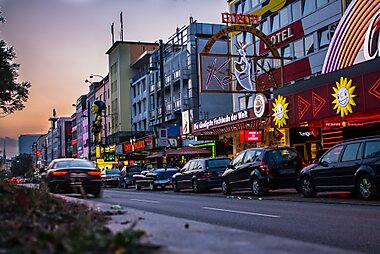
Reeperbahn is Hamburg's famous nightlife strip in St. Pauli, lined with clubs, bars, and theaters that stay lively into the early hours.
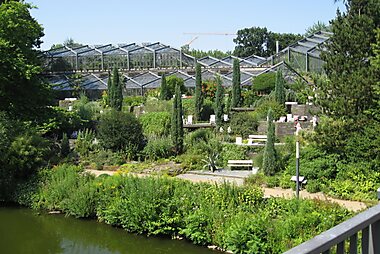
Planten un Blomen is a large formal park near the center, good for a quiet walk between sightseeing stops, with a Japanese garden and summer light shows.
Germany's most-visited tourist attraction, the model railway exhibition Miniatur Wunderland, sits inside the Speicherstadt warehouses and is worth booking ahead for.
Listas em destaque


Hamburg Museums & Galleries
Hamburg’s cultural institutions range from the Neo-Baroque Laeiszhalle concert hall to the sobering Neuengamme Concentration Camp Memorial. Art enthusiasts can explore Expressionist works at the Ernst Barlach House and the Bargheer-Museum, or visit independent venues like the street art school and DulsArt. For a glimpse into regional history, the Rieck-Haus open-air museum preserves 16th-century rural life in the Vierlande marshlands, while the island of Neuwerk hosts specialized galleries and amber collections.
9 lugares
Guias áudio – Hamburgo
Explora a pé com um passeio áudio autoguiado que narra cada paragem à medida que chegas.


Ouve os passeios áudio de Hamburgo
1 passeio na aplicação Guias de Áudio Tripomatic


O que experienciar
- Take a harbor boat tour or ride the public ferry across the Elbe at sunset, watching container ships and cruise liners pass close by.
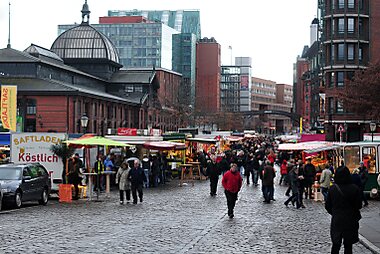
- Join the crowds at the Sunday morning Fischmarkt for live music, fresh fish rolls, and auctioneers shouting over crates of produce — a Hamburg tradition since the 18th century that runs until around 9:30am.
- Browse the seasonal Christmas markets around the town hall in December, with mulled wine and handicraft stalls.
- Cruise the Alster lakes by paddleboat or sailboat on a summer afternoon — a favorite local pastime just north of the center.
Excursões e atividades
Hamburgo — Mapa

 Abrir o mapa interativo
 Passeios de um dia
Hamburg sits close to several worthwhile towns and one flagship island escape.
- Luneburg — ≈35 min by train. A well-preserved merchant town with gabled brick houses, built on centuries of salt trading. The Lüneburg Heath nature reserve, famous for its purple heather in late summer, starts just outside town.
- Lübeck — ≈45 min by train. A former Hanseatic capital with a beautiful old town, twin-towered gate, and famous marzipan.
- Bremen — ≈55 min by train. Another old Hanseatic city, known for its UNESCO-listed town hall and the statue of the Town Musicians of Bremen.
- Sylt — ≈3 h by train. Germany's best-known North Sea island, with long sand beaches, dunes, and upscale seaside towns. A full day trip, but a popular one.
Como chegar
- By air: Hamburg Airport is 11 km north of the center. The S1 suburban train runs directly to the main station in about 25 minutes.
- By train: Hamburg Hauptbahnhof is a major hub with frequent high-speed ICE connections to Berlin (≈1 h 45 min), Bremen, and Frankfurt, plus international trains to Copenhagen. Deutsche Bahn
- By bus: The central bus station (ZOB), next to the main station, serves long-distance coaches from across Germany and neighboring countries.
Como se deslocar
- Public transit: The HVV network of U-Bahn, S-Bahn, buses, and harbor ferries covers the whole city. Tap your bank card or phone directly on board buses and at U-Bahn/S-Bahn validators — no need for a paper ticket or the app. HVV journey planner
- Ferry: HVV ferry line 62 crosses the harbor and doubles as a cheap sightseeing cruise, included in the regular transit fare.
- On foot / cycling: The city center, Speicherstadt, and harbor are flat and easy to walk. Bike lanes are extensive and a popular way to cover more ground.
Conduzir
- Is a car worth it?: No — the city center is compact and well served by transit, and traffic and parking make driving more hassle than it's worth for sightseeing.
- Parking: Park-and-ride lots at outer U-Bahn/S-Bahn stations are cheaper than city-center garages; pay-by-app options are widely available at street meters.
- Restrictions: Hamburg currently has no low-emission zone and no diesel driving ban — it's one of the few major German cities without either.
Comida e bebida
Hamburg's food culture is built on the harbor. Look for Fischbrötchen (a fish sandwich sold from harbor stalls), Labskaus (a corned beef, potato, and beetroot hash born from sailors' provisions), and Franzbrötchen, a cinnamon pastry unique to the city.
For a taste of the old harbor, the covered stalls and quayside cafés around Fischmarkt sell fresh fish rolls every Sunday morning. In the evening, the streets around the Schanzenviertel neighborhood cluster with casual restaurants and bars away from the tourist crowds of the Reeperbahn.
Segurança e saúde
Hamburg is a safe city for tourists by international standards. The main risks are pickpocketing on crowded transit and around the Reeperbahn at night, and the usual street scams (fake petitions, rigged games) near major sights. Keep valuables secure in nightlife areas, especially late at night.
Tap water is safe to drink straight from the tap.
História
Hamburg grew rich as a medieval trading port and became a leading member of the Hanseatic League, a network of merchant cities that dominated Baltic and North Sea trade for centuries. That wealth built the warehouses of Speicherstadt und Chilehaus mit dem Kontorhausviertel and funded the grand Hamburg City Hall that still governs the city today.
The Second World War hit Hamburg hard. Allied bombing raids in 1943, known as Operation Gomorrah, destroyed much of the city and killed tens of thousands of people. Kirchenruine St. Nikolai, the burned-out shell of a once-grand church, was deliberately left in ruins as a memorial to that destruction.
Postwar reconstruction and a later push to redevelop the old docklands gave the city its newest landmark, Elbe Philharmonic Hall, opened in 2017 on top of a former cocoa warehouse.
Factos sobre o país
Quick practical facts for Germany at a glance:
- Moeda
- Euro EUR € · Pagamentos com cartão · Geralmente aceite
- Números de emergência
- 112 Ambulância · Bombeiros
- Eletricidade
- 230 V · 50 HzTipo C / Tipo F
- Idiomas
- alemão
- Água da torneira
- Própria para beber
- Sentido de condução
- Direita
- Indicativo telefónico
- +49


Hamburgo – Planeia os teus dias
Transforma os lugares deste guia num verdadeiro itinerário, com rotas inteligentes, estimativas de tempo e tudo o que precisas para uma viagem perfeita.




