


Lucca
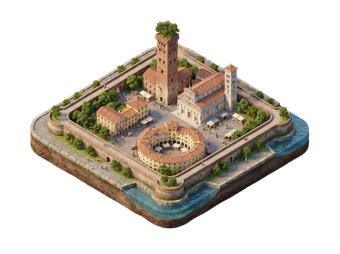
Lucca is a small, flat Tuscan city that still sits fully inside its Renaissance walls. The walls are wide enough to carry a tree-lined path, so the whole city has a green ring. You can walk around it in about an hour or cycle it in 20–30 minutes. Inside, there are Romanesque churches, medieval towers and narrow streets with very little car traffic.
It is a calm place for two or three nights. You can see the main sights on foot, eat well, and use Lucca as a base for Pisa, Florence and the coast. The composer Giacomo Puccini was born here, and his music is played in the city every evening from spring to autumn.

Lucca – Plánuješ výlet?
Zostav si itinerár deň po dni v aplikácii Tripomatic.


Kedy navštíviť
Spring and early autumn are the best times: warm, mostly dry, and good for walking and cycling on the walls. July and August are hot and humid. November is the wettest month, and winter is cool and quiet.
The biggest event is Lucca Comics & Games, one of Europe's largest comics and gaming festivals. It fills the old town for several days around the end of October and the start of November. Book accommodation months ahead, or avoid those days if you want a quiet visit.
Najlepší čas na návštevu: máj, september, október
Hlavné pamiatky


Mura di Lucca is the city's signature sight. The Renaissance walls run for about 4.2 km around the old town, and their wide top is now a tree-lined park.
Piazza Anfiteatro keeps the oval shape of a Roman amphitheatre. The houses follow the old curve, and the square is full of café tables.
San Michele in Foro stands on the site of the Roman forum. Its tall white façade is covered in small columns and topped by a large statue of St Michael.
Cattedrale di San Martino holds the Volto Santo, a wooden crucifix that is the city's most important relic. Look for the tomb of Ilaria del Carretto by Jacopo della Quercia and the small labyrinth carved into the porch.
Basilica di San Frediano has a large golden mosaic of the Ascension on its façade. Inside are a 12th-century baptismal font and the preserved body of Saint Zita.
Torre Guinigi is a 45-metre medieval tower with holm oak trees growing on its roof. Climb the 230 steps for the best view over the city.
Palazzo Pfanner is a 17th-century palace with a formal Italian garden. Statues line the central path, and lemon trees grow in old pots.
Museo-casa natale di Giacomo Puccini is the composer's birthplace; he was born here in 1858. The museum shows the piano he used to compose Turandot, his letters, and a Turandot costume from the opera's first performances.
Odporúčané zoznamy


Čo zažiť
- Cycle the walls: Rent a bike and ride the full circuit on top of Mura di Lucca. It takes about 20–30 minutes, and early morning or sunset is best.
- Hear Puccini every evening: From late March to October, short concerts of Puccini arias take place every evening in Santi Giovanni e Reparata. In winter they move to a nearby oratory on a few evenings a week.
- Luminara di Santa Croce: On the evening of 13 September, the city turns off its street lights. Thousands of candles line the route of a procession from San Frediano to the cathedral.
- Antiques market: On the third Sunday of each month and the Saturday before, antique stalls fill the streets and squares around the cathedral.
- Summer concerts: In June and July, the Lucca Summer Festival brings international pop and rock acts to Piazza Napoleone.
Prehliadky a aktivity
Lucca — Mapa

Jednodňové výlety
Lucca has good rail links, so most day trips work without a car.
- Villa Reale — about 15 min by car, north of the city. Elisa Bonaparte's former estate, with a hedged green theatre, water features and a lemon garden.
- Montecarlo — about 25 min by car. A small walled hill village known for its local wine.
- Viareggio — about 20–25 min by train. A beach resort with a long seafront promenade and Art Nouveau buildings. Torre del Lago, Puccini's lakeside home, is just south of it.
- Pisa — about 30 min by train. The Leaning Tower and the Piazza dei Miracoli make an easy half-day trip.
- Barga — about 45–50 min by train up the Serchio valley to Barga-Gallicano station, then a short taxi or bus ride up the hill. A hilltop old town with a Romanesque cathedral and wide mountain views.
- Pistoia — about 50 min by train. A quiet historic city with a fine cathedral square and few tourists.
- Florence — about 1 hr 20 min by train, with departures about every 30 minutes. A long but rewarding day for the Renaissance art and architecture.
- Cinque Terre National Park — about 2 hours by train via Viareggio and La Spezia. Go early and plan a full day for the five coastal villages.
Kam sa vybrať
Lucca lies in northern Tuscany, between the coast and the hills.
- Nearby cities: Pisa and Pistoia are short train rides away. Florence is the main city of the region.
- On the coast: Viareggio and Forte dei Marmi are the nearest beach resorts. Farther south, the port city of Livorno is known for its seafood.
- In the countryside: Montecarlo is a small wine village in the hills east of Lucca.
Ako sa tam dostať
- By air: The closest airport is Pisa International Airport (Galileo Galilei). Take the PisaMover shuttle to Pisa Centrale (about 5 min), then a regional train to Lucca (about 30 min). Florence Airport is the second option: about 1 hour by car, or closer to 2 hours by tram and train via Firenze Santa Maria Novella.
- By train: Lucca station is just outside the southern walls, a short walk from Porta San Pietro. Regional trains run to Pisa (about 30 min), Viareggio (about 20–25 min) and Florence (about 1 hr 20 min, about every 30 minutes). Trenitalia
- By bus: Regional buses stop at Piazzale Verdi, at the western edge of the old town. They are useful mainly for villages without a train station.
Doprava na mieste
- On foot: The old town is flat and compact. You can cross it in about 20 minutes, and most streets have little car traffic.
- Bicycle: Cycling is how many locals get around, and riding the circuit on top of the walls is a classic activity. Several shops near the gates rent bikes by the hour.
- Bus: Small city buses (lines 1+, 2+ and 3+) cross the historic centre. You can tap a contactless bank card or phone on board to pay, at the normal fare. Autolinee Toscane
- Taxi: Taxis wait at the station. Ride-hailing apps play only a small role.
Šoférovanie
- Is a car worth it?: Not for the city itself. A car helps only for villas, hill villages and the Garfagnana valley, which public transport serves poorly.
- Restrictions: Almost the whole area inside the walls is a restricted traffic zone (ZTL) with camera enforcement. Do not drive in without a permit, even to reach your hotel. Ask your hotel first if it can register your car.
- Parking: Park outside the walls and walk in. Paid car parks ring the walls close to the gates, and free lots include Piazzale Don Baroni, Tagliate and Macelli. Street parking is usually paid at a machine or with a parking disc.
Jedlo a pitie
Lucca's cooking is simple and hearty. Try tordelli, a meat-filled pasta served with meat sauce, and farro (spelt) soup from the nearby Garfagnana valley. Chestnut flour shows up in pancakes called necci. For something sweet, buy buccellato, a ring-shaped sweet bread with raisins and aniseed, or torta coi becchi, a pie with a green chard filling. The local olive oil from the Lucca hills is excellent.
For eating, head to the streets around Via Fillungo, the squares near San Michele in Foro, and the café tables in Piazza Anfiteatro. The squares are pleasant but busier and more expensive. Small trattorias on the side streets often give better value.
Bezpečnosť a zdravie
Lucca is a very safe city, including at night. Petty crime is rare, but keep an eye on your bag and phone in crowded places, especially during Lucca Comics & Games.
- Bikes: Always lock a rented bike, even for a short stop.
- Cyclists: Bikes are everywhere in the old town and on the walls. Look both ways before stepping into a street or onto the wall path.
- Summer heat: July and August can be very hot. Carry water and visit towers and gardens early in the day.
História
Lucca became a Roman colony in 180 BC, and the city still follows the Roman street grid. The forum stood where San Michele in Foro rises today, and the shape of the Roman amphitheatre survives in Piazza Anfiteatro.
In the Middle Ages, Lucca grew rich from the silk trade and banking. Wealthy families built tower houses, and Torre Guinigi is the best-known survivor. For almost 500 years Lucca was an independent republic. In 1805 Napoleon turned it into a principality for his sister Elisa Bonaparte. In 1806 she bought the estate now known as Villa Reale.
Work on Mura di Lucca began in 1504 and ended in 1648, but no army ever attacked them. They were tested only once, in the flood of 1812, when the gates were sealed and the city stayed mostly dry. In the 1820s, Duchess Maria Luisa of Bourbon turned the walls into the public park that people use today.
Fakty o krajine
Quick practical facts for Italy at a glance:
- Mena
- euro EUR € · Platby kartou · Široko akceptované
- Tiesňové čísla
- 112
- Elektrina
- 230 V · 50 HzTyp C / Typ F / Typ L
- Jazyky
- taliančina
- Voda z vodovodu
- Pitná
- Jazdná strana
- Vpravo
- Predvoľba
- +39


Lucca – Naplánuj si jednotlivé dni
Premeň miesta z tohto sprievodcu na skutočný itinerár s inteligentným plánovaním trás, časovými odhadmi a všetkým potrebným pre dokonalý výlet.


Súvisiace destinácie



Data: © OpenStreetMap contributors, Wikidata, Wikipedia, Tripomatic, Official websites, geoBoundaries (CC BY 4.0). Tours by GetYourGuide. We earn commission from bookings. Travel guide generated with AI.