



Griechenland
Greece is a Mediterranean country of mainland peninsulas and thousands of islands, the birthplace of Western philosophy, democracy, and theater. Its character ranges from the ancient ruins and busy streets of Athens to the whitewashed villages and beaches of the Cyclades, the dramatic monasteries of Meteora, and the mountains of the north. Most visits combine a few days in Athens with island-hopping or a road trip through the mainland.
Greece suits nearly every kind of traveler, from history lovers exploring Athens to beach-goers and sailors island-hopping through Mykonos or Rhodes. Ancient Greek civilization laid much of the groundwork for Western art, science, and government, and that legacy is visible everywhere, from the Acropolis to remote village churches.

Griechenland – Planst du eine Reise?
Erstelle deine Reiseroute Tag für Tag in der Tripomatic-App.


Geld & Bezahlen
The euro (EUR) is the currency nationwide.
Keep some cash for small tavernas, island buses, and rural shops, where card payment isn't always available, especially on smaller islands. ATMs are common in cities and larger towns, but can be scarce on small islands in peak season — withdraw cash before island-hopping.
Empfohlene Listen


Touren & Aktivitäten
Griechenland — Karte

 Interaktive Karte öffnen
 Trinkgeld
Tipping in Greece is modest and appreciated rather than required — rounding up or leaving 5-10% at restaurants for good service is standard.
5-10%
aufrunden
aufrunden
1-2 EUR/Gepäckstück
5-10%
Round up taxi fares, and leave a euro or two per bag for hotel porters. Tour guides on paid tours usually expect a small tip. Tipping is not customary at cafés, bars, or kiosks.
Strom & Stecker
Greece uses Type C and F plugs at 230 V / 50 Hz, the standard across most of continental Europe. Travelers from outside Europe will need a plug adapter.
Sprache
Greek is the official language nationwide, written in its own alphabet. English is widely spoken in Athens, Thessaloniki, and the islands' tourist areas, though less so in remote villages. Road signs in tourist areas are usually in both Greek and Latin script, but knowing the Greek alphabet helps with reading menus and smaller signs.
Internet & Mobilfunk
Prepaid SIMs and eSIMs from Cosmote, Vodafone, or Nova are easy to find at the airport or any phone shop; a passport is required to register a Greek SIM. Coverage is strong on the mainland and larger islands, but can be patchy on remote islands and mountain areas.
Sicherheit & Notfälle
Greece is a safe country for tourists, and violent crime against visitors is rare. Pickpocketing happens in crowded areas of Athens, especially around Monastiraki, Syntagma Square, and on the metro. Summer brings a real wildfire risk, especially in forested and hillside areas — take local evacuation notices seriously if issued. Extreme heat is also common in July and August; stay hydrated, avoid strenuous activity in the early afternoon, and expect popular islands and archaeological sites to be at their most crowded around midday.
Gesundheit
Tap water is generally safe to drink in Athens, Thessaloniki, and most of the mainland, though it can taste heavily of chlorine or minerals; on many smaller islands, tap water is desalinated and locals often prefer bottled water. Pharmacies (marked with a green cross) are common, and pharmacists can advise on minor ailments. No special vaccinations are required to enter Greece. EU/EEA and Swiss citizens can use the European Health Insurance Card (EHIC) for public healthcare; everyone else should carry travel medical insurance.
Visum & Einreise
Greece is part of the Schengen Area. Citizens of the EU, EEA, and Switzerland can enter freely with no time limit. Visa-exempt travelers from many other countries, including the UK, US, Canada, Australia, and Japan, can stay up to 90 days in any 180-day period without a visa. Travelers who need a visa should apply at a Greek embassy or consulate before traveling.
Visa and entry requirements change frequently. Verify current requirements with the official immigration authority or your country's embassy before travel.
Knigge & Bräuche
Greeks are warm and hospitable, and it's common to be offered food or coffee even by strangers — accepting graciously is polite. A handshake is standard for greetings; among friends, a light kiss on each cheek is common. Meals are social and unhurried, and it's normal to ask for the bill, since it isn't brought automatically.
Dress modestly when visiting churches and monasteries, covering shoulders and knees. Mount Athos, the peninsula of Orthodox monasteries in the north, is closed to women entirely and admits men only with an advance permit — a genuine exception, not just a dress-code destination like Meteora.
Feiertage & Öffnungszeiten
Public holidays follow the Greek Orthodox calendar as well as national civic dates. Easter, calculated on a different date than in Western Christianity, is the most important holiday of the year, and many businesses close for several days around it.
Standard shop hours vary by day and season; many shops close for a few hours in the early afternoon and reopen in the evening, and Sunday closing is common outside tourist areas.
Unterwegs vor Ort
- By ferry: Greece's islands are connected by an extensive ferry network from Piraeus (Athens' port) and other mainland harbors; book ahead in peak season, especially for popular routes to the Cyclades.
- By air: domestic flights connect Athens and Thessaloniki to the islands quickly, useful for reaching Crete, Rhodes, or Santorini without a long ferry.
- By train: Hellenic Train connects Athens, Thessaloniki, and a handful of other mainland cities, though the network is limited compared to much of Europe.
- By bus: KTEL coach networks cover the mainland thoroughly and are often the fastest way between towns not on the rail line.
Autofahren
- Speed limits: 50 km/h in cities and towns, 90 km/h on rural roads, and 110-130 km/h on motorways.
- Tolls: mainland motorways charge tolls at staffed booths, payable by cash or card; no vignette is required.
- Mountain and island roads: many roads, especially on islands and in mountain regions, are narrow and winding, with sharp drop-offs and minimal guardrails — drive cautiously, especially on unfamiliar routes.
- Parking: metered street parking is common in cities; Athens and Thessaloniki have paid parking garages, but street parking in old towns can be very tight.
- Fuel: nearly all stations are staffed rather than self-service. Fuel is sold as "βενζίνη" (petrol, often "αμόλυβδη" for unleaded) and "πετρέλαιο" (diesel).
- Electric vehicles: charging points are concentrated in Athens and Thessaloniki; coverage on the islands and in rural areas is still limited.
Essen & Trinken
Breakfast is light, often just coffee and a pastry, while lunch and dinner are social meals, frequently shared from a spread of small plates called mezedes. Greek cuisine leans on olive oil, fresh vegetables, grilled meat and fish, and cheese, especially feta. Souvlaki (grilled skewered meat, often in a pita wrap) is the most common street food, alongside gyros. Moussaka, a baked layered dish of eggplant, potato, and minced meat, and dolmades, stuffed vine leaves, are classic taverna dishes.
Greek coffee, thick and unfiltered, is traditionally served in a small cup, alongside the now-common frappé and freddo iced coffees. Ouzo, an anise-flavored spirit, and tsipouro are the classic after-dinner drinks, and Greece produces wine across the mainland and islands, including retsina, a distinctive resin-flavored white. Dinner in a taverna is often eaten late, commonly starting after 9pm in summer.
Orte zum Entdecken
Greece's most-visited destinations span the mainland and the islands.
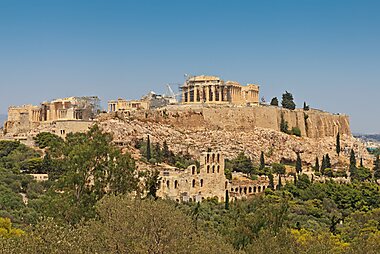
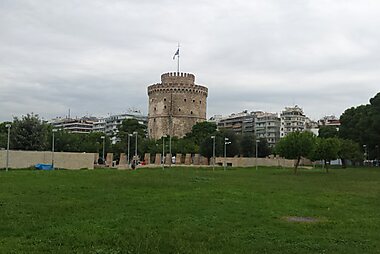
Athens and the mainland: Athens, the capital, is built around its ancient Acropolis and layered with millennia of history. Thessaloniki, in the north, has its own Byzantine and Ottoman-era landmarks and a lively food scene. The hilltop monasteries of Kalabaka rise dramatically from the plains of Meteora, and the small fortress town of Nafplio makes a good base for exploring the ancient sites of the Peloponnese.
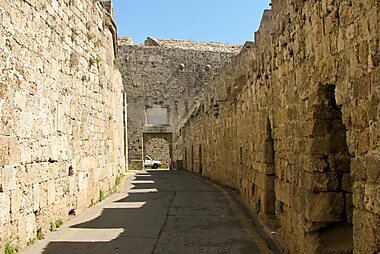
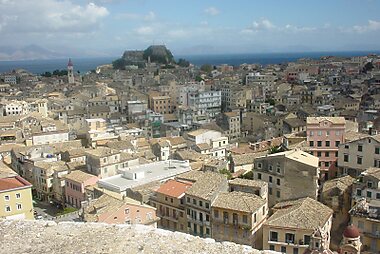
The islands: Mykonos and Santorini are the best known of the Cyclades, famous for whitewashed villages and sunset views, while Rhodes's medieval old town anchors the Dodecanese in the southeast. Heraklion is the gateway to Crete, Greece's largest island, and Corfu in the Ionian Sea has a distinct Venetian-influenced old town.
Griechenland – Plane deine Reise
Wähle die Orte aus, die du sehen möchtest, und Tripomatic erstellt daraus eine Route Tag für Tag – mit intelligenter Wegführung, Zeitschätzungen und allem für die perfekte Reise.




