


Brisbane
Brisbane sits on a looping river in Queensland's subtropics, warm and outdoor-oriented for most of the year. It has grown from a small river town into Australia's third-largest city, but keeps a relaxed, low-rise character next to Sydney and Melbourne. Visitors come for river life, contemporary art and museums clustered at South Bank, and quick access to beaches, rainforest, and islands within a couple of hours.
The Brisbane River loops through downtown and is used daily for commuting by ferry as much as for recreation. Riverside parklands, a free artificial swimming lagoon, and a compact, walkable city centre make Brisbane easy to explore on foot or by boat. The subtropical climate keeps outdoor life going nearly year-round.

Brisbane – Planning a Trip?
Build your day-by-day itinerary in the Tripomatic app.


When to visit
Brisbane's subtropical climate stays warm most of the year: winter (June to August) is mild, dry, and sunny, while summer (December to February) is hot, humid, and prone to sudden afternoon storms.
The city's biggest annual event is Riverfire, a fireworks and air display over the Brisbane River each September. It draws large crowds to the riverbanks each year.
Best time to visit: May, June, July, August, September, October
The dry winter months are the most comfortable for sightseeing outdoors, while summer brings the heaviest rain and humidity.
Top sights

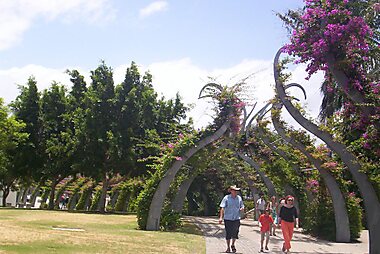

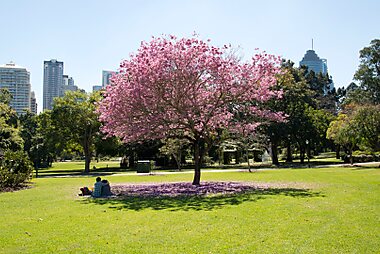
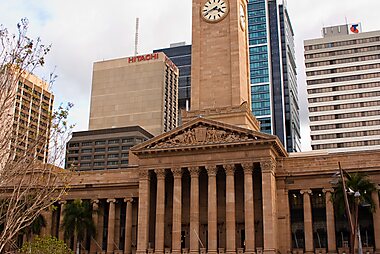
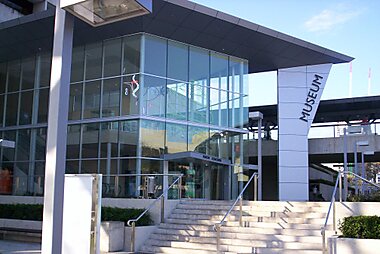
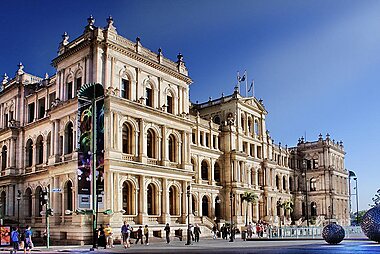
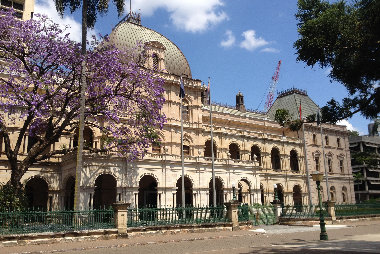
South Bank Parklands is Brisbane's main gathering spot: riverside parkland built on the site of the 1988 World Expo, with Streets Beach, a free artificial swimming lagoon in the middle of the city. Story Bridge, a steel cantilever bridge opened in 1940, links the city centre to Kangaroo Point. It is one of only three bridges in the world offering a guided climb to the top. City Botanic Gardens was planted in 1825 as a farm for the original penal colony. Shaded and mature, it sits right at the edge of downtown along the river.
Gallery of Modern Art is Australia's largest gallery of modern and contemporary art, part of the Queensland Cultural Centre at South Bank alongside Queensland Museum's natural history and cultural collections. Brisbane City Hall, a 1930s building modeled on the Roman Pantheon, is Brisbane's civic landmark; its observation deck and clock tower look out over King George Square.
Lone Pine Koala Sanctuary, founded in 1927, is the world's oldest and largest koala sanctuary. It's home to around 80 Australian species and offers hands-on animal encounters. Mount Coot-tha Lookout, on the summit of Mount Coot-tha, has been a public viewpoint since the 19th century. It gives a wide panorama of the city, river, and Moreton Bay, especially at sunset.
Featured Lists

Brisbane Unmissables
Brisbane's landscape is defined by the winding Brisbane River, featuring the South Bank Parklands with its man-made beach and the heritage-listed City Botanic Gardens. The city’s cultural hub includes the Gallery of Modern Art—Australia's largest—and the Queensland Museum. Historical landmarks like the 1930s City Hall and the steel cantilever Story Bridge anchor the urban center, while the Queen Street Mall provides a dedicated pedestrian shopping district. For sports and wildlife, the list features the iconic Gabba stadium and the world-renowned Lone Pine Koala Sanctuary.
10 places

Museums & Galleries
Brisbane’s cultural landscape centers on the South Bank precinct, home to the Queensland Art Gallery and Gallery of Modern Art (QAGOMA) and the Queensland Museum’s natural history collections. Beyond the riverfront, the city offers specialized sites like the Sir Thomas Brisbane Planetarium and the heritage-listed Commissariat Store, one of Brisbane’s oldest buildings. From maritime history at South Brisbane to military archives at Victoria Barracks and classical antiquities at the University of Queensland, these institutions preserve the state's scientific, artistic, and social heritage.
15 places

Religious Sites
Brisbane's religious landscape features a mix of historic architecture and modern community spaces. St John's Cathedral stands as a prominent example of 19th-century Neo-Gothic design, while Wat Thai Buddharam in Forestdale provides a center for Thai Buddhist practices. The collection also highlights the Anglican Church of the Resurrection and diverse suburban congregations, reflecting the city's spiritual variety across Catholic, Baptist, and Jehovah's Witness traditions.
8 placesWhat to experience
A few things define a visit to Brisbane beyond its sights.
- Abseil or rock-climb the sandstone cliffs at Kangaroo Point Park, a favorite after-work spot for local climbers just across the river from the city centre.
- Catch a cricket or Australian rules football match at Brisbane Cricket Ground, known to everyone simply as "the Gabba".
- Ride the free CityHopper ferry across the river at sunset for skyline views from the water.
- Swim at Streets Beach, a free artificial lagoon with sand and lifeguards inside South Bank Parklands.
- Have a meal or a drink at Howard Smith Wharves, a riverside dining precinct built into the cliff face right under Story Bridge.
- Browse the stalls and food trucks at a weekly night market along the riverfront.
Tours & Activities
Brisbane — Map

 Open the interactive map
 Day trips
Brisbane sits within reach of beaches, islands, and rainforest, making it an easy base for day trips.
- North Stradbroke Island — about 1 hour by car and ferry from Cleveland. Sand-island beaches and whale watching in season (June to November), a quieter alternative to the mainland coast.
- Gold Coast — about 1 to 1.5 hours by car or train. Australia's theme-park capital, alongside the famous surf beach at Surfers Paradise.
- Moreton Island — about 1.5 hours including the ferry from Brisbane. Sand dunes, snorkeling around the Tangalooma wrecks, and wild dolphin feeding at dusk.
- Sunshine Coast — about 1.5 hours by car. Beaches, the Glass House Mountains, and Australia Zoo, the wildlife park run by the Irwin family.
- The Scenic Rim, including Mt. Tamborine National Park and Lamington National Park — about 1.5 to 2 hours by car. A rainforest plateau with waterfalls and wineries, plus ancient rainforest with a treetop canopy walk.
Where to explore
Brisbane's home region of Queensland stretches along Australia's east coast, with easy access to beach cities and outdoor destinations.
- South along the coast, Gold Coast pairs surf beaches with Australia's biggest theme parks.
- North, Sunshine Coast is quieter and more laid-back, backed by the Glass House Mountains.
- In Moreton Bay, Moreton Island is almost entirely national park, reached by ferry and known for its sand dunes and shipwrecks.
Getting there
- By air: Brisbane Airport (BNE), about 13 km northeast of the city, is Queensland's main international and domestic gateway (Brisbane Airport). The Airtrain runs directly to the city centre in about 22 minutes, for around A$20 one-way.
- By train: Roma Street and Brisbane Central stations connect to Queensland Rail's network. Trains run south to the Gold Coast, north to the Sunshine Coast, and long-distance to Cairns and regional Queensland (Queensland Rail).
- By bus: Long-distance coaches arrive at the Roma Street transit centre, with services along the east coast to Sydney and beyond.
Getting around
- Public transit: TransLink runs buses, trains, and the CityCat/CityHopper ferries across the city. Tap a contactless bank card or phone directly at the bus, train, and ferry gates instead of buying a paper ticket — this is the easiest way for visitors to pay (TransLink).
- Taxi / ride-hailing: Uber and taxis operate throughout the city and are easy to find in the city centre and South Bank.
- On foot / cycling: The city centre, South Bank, and the river precincts are flat and walkable, linked by free pedestrian bridges. Dockless e-bike and e-scooter share (Beam, Neuron, Lime) is available across the city, and the riverside paths make cycling a pleasant way to get around.
Driving
- Side of the road: Australia drives on the left, opposite to the US and much of Europe.
- Is a car worth it?: Not for the city centre — parking is limited and public transit covers the CBD, South Bank, and inner suburbs well. A car becomes useful for day trips to the Gold Coast, Sunshine Coast, or Scenic Rim.
- Parking: Metered street parking and multi-storey car parks are common in the city centre; pay by app or meter. Expect A$10 to 20 or more per hour in the centre.
- Restrictions: None beyond normal traffic rules — Brisbane has no congestion charge or low-emission zone.
Food & drink
Brisbane's dining centres on its riverside precincts rather than one historic old town. South Bank and West End are both an easy walk from the city centre and packed with casual restaurants, cafes, and bars along the river. Chinatown in Fortitude Valley adds a concentration of Asian restaurants a short walk from downtown.
For something distinctly local, tour XXXX Brewery, home of the XXXX beer brand and one of Queensland's oldest working breweries.
Safety & health
Brisbane is a safe city for tourists by international standards. The most common issue is opportunistic theft and bag-snatching in busy nightlife areas like Fortitude Valley late at night — keep valuables close and avoid leaving bags unattended at outdoor cafes.
Sun exposure is the bigger everyday risk: the subtropical sun is strong even on overcast days, and UV levels are high most of the year. Wear sunscreen, a hat, and sunglasses, especially between 10am and 3pm.
History
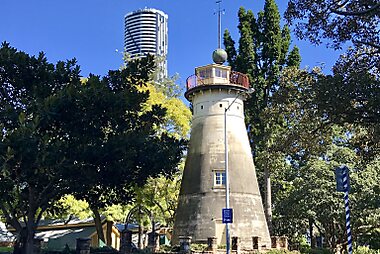
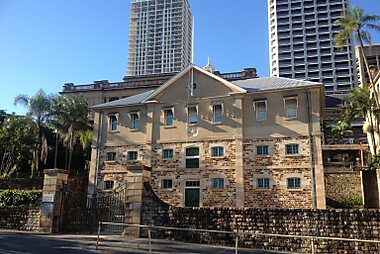
Brisbane began as a penal settlement in 1824, established to isolate the colony's most difficult convicts from Sydney. The The Old Windmill, built by convict labor from 1828, is Queensland's oldest surviving building. The nearby Commissariat Store, from the same era, is the oldest still in continuous use. Both are among the clearest traces of that era still standing in the city centre.
Free settlers arrived from 1842, and Queensland separated from New South Wales in 1859, with Brisbane as its capital. Parliament House and the nearby Treasury Building, both grand 19th-century buildings, date from the decades of growth that followed. The city's modern skyline and cultural precincts largely date from the 1980s, when Brisbane hosted the 1982 Commonwealth Games and the 1988 World Expo — the event that transformed the South Bank site into the parkland it is today.
Country facts
Quick practical facts for Australia at a glance:
- Currency
- Australian Dollar AUD A$ · Card payments · Widely accepted
- Emergency numbers
- 000 Police · Ambulance · Fire brigade
- Electricity
- 230 V · 50 HzType I
- Tap water
- Safe to drink
- Driving side
- Left
- Calling code
- +61


Brisbane – Plan Your Days
Turn the places from this guide into a real itinerary, with smart routing, time estimates, and everything you need for a perfect trip.