



Brixen
Brixen (Bressanone in Italian) sits where the Eisack and Rienz rivers meet, ringed by the peaks of the Dolomites and the Sarntal Alps. For more than 750 years it was the seat of a prince-bishopric, and its compact old town still centers on the cathedral and the bishops' palace. Brixen suits travelers who want a slower alpine city break: cobbled lanes, mountain views, and easy access to hiking and skiing, without the crowds of the bigger Dolomite resorts.
Street signs and menus appear in both German and Italian. Most locals speak German as a first language, a legacy of South Tyrol's history as part of Austria until 1919.

Brixen – Planning a Trip?
Build your day-by-day itinerary in the Tripomatic app.


When to visit
Spring and autumn are mild, good for walking and cycling in the valley. Summer stays comfortably warm for hiking higher up, with afternoon thunderstorms common in July and August. Winter is cold and snowy, and skiing on the nearby Plose mountain runs from December into March.
Time a visit around the Christmas market on Domplatz, which runs from late November into early January.
Top sights

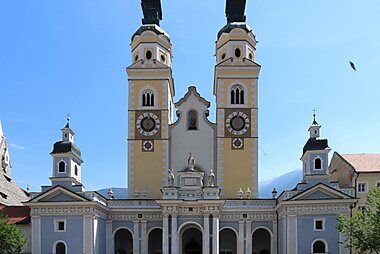


- Cathedral of Brixen anchors the old town. Its Romanesque core was rebuilt in Baroque style in the 18th century, though a crypt from the earlier church survives underneath.
- Next to it, Cathedral Cloister still shows faded medieval frescoes along its arcaded walkway, one of the best-preserved cloisters in the region.
- Hofburg Brixen was the prince-bishops' residence for centuries. Its halls now house Diocesan Museum, known for a large collection of hand-carved nativity cribs.
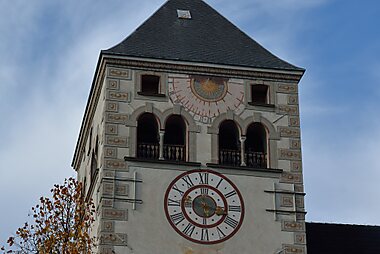
- White Tower is the bell tower of the parish church next to the cathedral, rebuilt in the 15th century. Climb it for one of the best views over the rooftops of the old town.
- A short trip north of the center, Neustift Abbey is a working Augustinian monastery with a Baroque library and its own winery, among the oldest in the Alps.
- Acquarena is a large indoor and outdoor water park, good for a relaxed afternoon with kids or after a day on the trails.
- Plose is the mountain massif rising directly above town, reachable by cable car, with hiking trails in summer and skiing in winter.
Featured Lists


Plose Mountain Vistas
The Plose massif, rising above Bressanone in South Tyrol, comprises a series of prominent peaks including the Telegraph, Pfannspitze, and the Großer Gabler—the group's highest point at 2,576 meters. This selection features high-altitude refuges like the 19th-century Plosehütte and the rustic Schatzerhütte, which serve traditional regional cuisine. Beyond the summits, the area contains unique geological formations such as the Weißlahn earth pyramids and expansive panoramic viewpoints overlooking the Odle and Peitlerkofel groups of the Dolomites.
10 placesWhat to experience
- Ride the cable car up to Plose for the view over the Dolomites, then hike back down, or in winter, ski or sled down.
- Join a Törggelen outing in autumn: visit a farmhouse tavern in the hills around Brixen to taste the new wine with roasted chestnuts, an Eisack Valley tradition.
- Browse the wooden stalls of the Christmas market on Domplatz on a cold December evening.
Tours & Activities
Brixen — Map

 Open the interactive map
 Day trips
Brixen makes a good base for day trips into the wider Dolomites and Eisack valley.
- Klausen — about 15 minutes by train. A small medieval town below a hilltop convent, known for its resident artists and antique shops.
- Bolzano — about 35 minutes by train. South Tyrol's capital, home to the Ötzi the Iceman mummy at the South Tyrol Museum of Archaeology.
- Vipiteno — about 35 minutes by train. A well-preserved medieval mining town near the Brenner Pass, with an arcaded main street.
- Alpe di Siusi and Ortisei — about 45 to 60 minutes by car or bus. Europe's largest high-alpine meadow, part of the UNESCO-listed Dolomites, with some of the region's best hiking and skiing.
Getting there
- By air: the nearest airport is Bolzano Airport, about 40 km away, with a handful of scheduled domestic flights. Most international travelers instead fly into Innsbruck, about 1.5 to 2 hours away by train, or Verona, roughly 2.5 to 3 hours away including the transfer from the airport.
- By train: Brixen station sits directly on the Brenner railway line between Munich, Innsbruck, Bolzano, and Verona. Regional and long-distance trains call here several times a day.
- By bus: regional buses connect Brixen to the Dolomite valleys, including Alpe di Siusi and Val Gardena, and to neighboring towns. Long-distance coaches link to cities in Germany and Austria.
Getting around
- Public transit: regional and city buses cover Brixen and nearby villages. Buy tickets from the driver, at machines, or through the südtirolmobil app before boarding. Südtirol Mobil
- On foot: the old town is compact and largely pedestrian, easy to cover on foot in an hour or two.
- Cycling: Brixen sits on the Eisack Valley cycle path, a flat, well-signed route running the length of the valley toward Bolzano.
Driving
- Is a car worth it?: not needed for the old town itself, but useful for reaching the Dolomite valleys and smaller villages at your own pace.
- Parking: park at the Parkhaus Brixen at the edge of the old town rather than looking for street parking; pay by card or app.
- Restrictions: the historic center is largely closed to non-resident traffic. Follow signs to the public car parks around its edge.
Food & drink
Brixen's food leans Tyrolean rather than typically Italian: expect speck (cured ham), Knödel dumplings, and Schlutzkrapfen (stuffed pasta pockets) alongside pizza and pasta. The surrounding Eisack Valley is a well-regarded white wine region; look for Kerner, Sylvaner, and Gewürztraminer from small local producers.
For a meal, head to the arcaded lanes around Domplatz and Große Lauben, where old-town restaurants and cafés cluster. Saturday brings a fresh produce market to the same streets.
Safety & health
Brixen is very safe for travelers. Petty crime is rare, even in peak season. Normal precautions apply: keep an eye on bags around the train station and in busy markets.
If hiking above town, especially up onto Plose, check the weather before setting out. Conditions on the massif change quickly, and sturdy boots are worth packing even in summer.
History
Brixen became a prince-bishopric in 1027, when Emperor Conrad II granted the local bishop control over the town and its surroundings. The bishops ruled here for more than 750 years, until the principality was dissolved in 1803. Hofburg Brixen was their seat, and today its halls hold Diocesan Museum. Cathedral of Brixen traces back to the same era, though the building seen today was rebuilt in Baroque style in the 18th century.
One local legend still marks the townscape: in 1551, an elephant given as a diplomatic gift passed through Brixen on its way to Vienna, and the inn where it stayed still carries its name today, the Hotel Elephant.
Country facts
Quick practical facts for Italy at a glance:
- Currency
- Euro EUR € · Card payments · Widely accepted
- Emergency numbers
- 112
- Electricity
- 230 V · 50 HzType C / Type F / Type L
- Languages
- Italian
- Tap water
- Safe to drink
- Driving side
- Right
- Calling code
- +39


Brixen – Plan Your Days
Turn the places from this guide into a real itinerary, with smart routing, time estimates, and everything you need for a perfect trip.




