



Busan
Busan is South Korea's second-largest city and its main port, built around a wide bay where mountains meet the sea. Unlike the dense, flat sprawl of Seoul, Busan rises and falls across steep hills, so beaches, working harbors, and skyscrapers sit only minutes apart.
The city suits travelers who want a beach break without leaving a major city. Mornings can start with a swim at Haeundae Beach, afternoons can be spent wandering a fish market or a hillside village, and evenings can end with dinner overlooking the water. Its wartime history as the country's last unconquered city and temporary capital still shapes several of its neighborhoods.

Busan – Planning a Trip?
Build your day-by-day itinerary in the Tripomatic app.


When to visit
Spring (March to May) and autumn (September to November) are mild and the most comfortable seasons for walking and beach visits. Summer (June to August) is hot and humid, with a monsoon season in July and typhoon risk in August and September. Winter (December to February) is cold by the sea but rarely freezing, and stays quieter for visitors.
Plan around the Busan International Film Festival in early October if you can. It is Asia's largest film festival, filling Haeundae and the Nampo-dong cinema district with premieres, outdoor screenings, and visiting directors and actors from across the world.
Best time to visit: May, June, September, October
Top sights
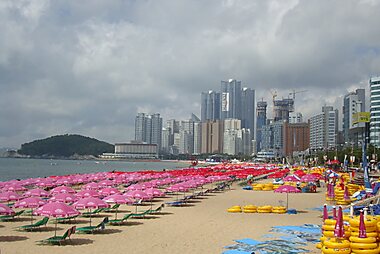
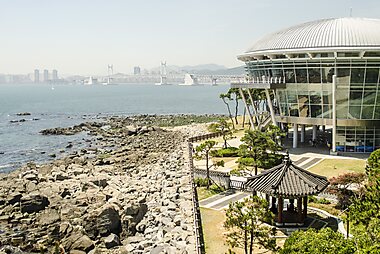
Haeundae Beach is Busan's most famous stretch of sand, backed by hotels and high-rises and busy with swimmers in summer and festival crowds in autumn.
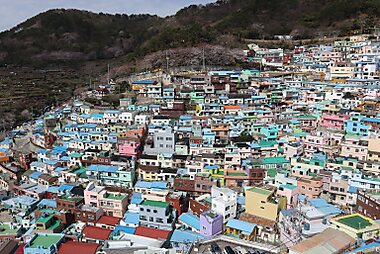
Gamcheon Culture Village is a hillside neighborhood of small, brightly painted houses stacked up a steep slope, built by refugees during the Korean War and now filled with murals, cafes, and viewpoints over the harbor.
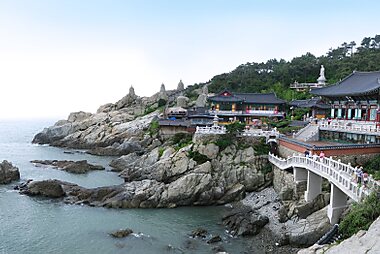
Haedong Yonggungsa is a rare sight in Korea: a Buddhist temple built directly on the rocks above the sea rather than in the mountains, connected to the shore by a stone bridge and especially striking at sunrise.
Jagalchi Fish Market is the country's largest fish market, with stalls of live seafood facing the harbor and upstairs restaurants that will cook your pick to order.
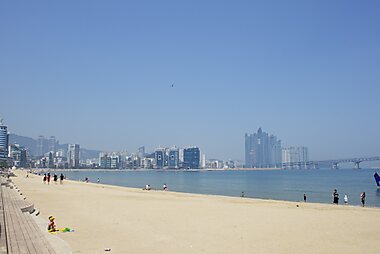
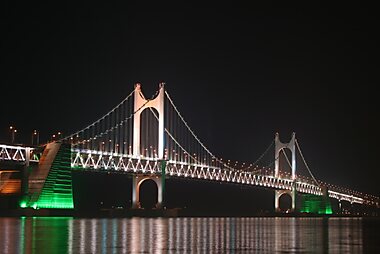
Gwangalli Beach draws a younger, café-lined crowd than Haeundae, and is best seen after dark, when the illuminated Gwangan Bridge arcs across the bay behind it.
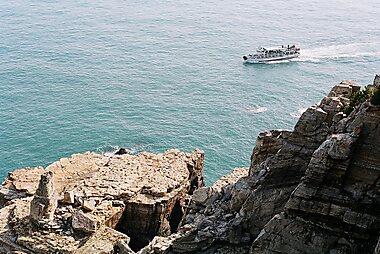
Taejongdae is a cliffside park at the southern tip of Yeongdo island, with pine forest trails, sea cliffs, and a small cruise-boat pier below the lighthouse.
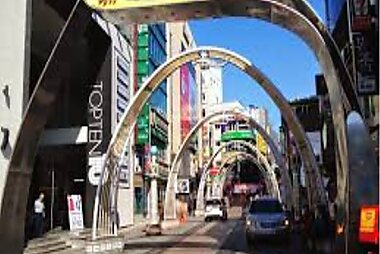
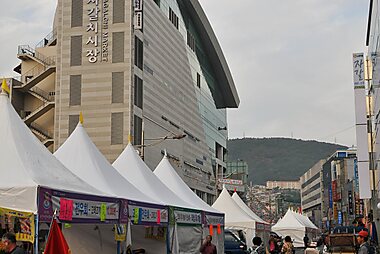
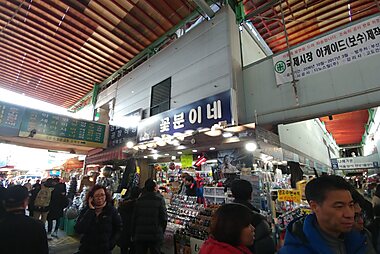
BIFF Square and the neighboring Gukje Market form Busan's old downtown around Nampo-dong, once the heart of the Busan International Film Festival and still full of street food stalls and small shops.
Busan Tower sits on Yongdusan Park above downtown and gives a wide view over the harbor and the hills behind it, best timed for sunset.
Featured Lists


What to experience
- Soak in a jjimjilbang: try a Korean bathhouse ritual of hot and cold pools, saunas, and a full-body scrub at Spaland Centum City, a large bathhouse and spa complex in Centum City.
- Catch the Busan International Film Festival: if your trip lands in early October, watch an outdoor screening or gala premiere at the Busan Cinema Center, or just join the crowds along the red carpet.
- Walk Dalmaji-gil at moonrise: its name means "greeting the moon", and this hillside road on the headland past Haeundae Beach, toward Cheongsapo village, is where locals go to watch it rise over the open sea, lined with cafes and small galleries.
Tours & Activities
Busan — Map

 Open the interactive map
 Day trips
Busan sits close to some of Korea's best day-trip country, from a quiet fishing town to an ancient royal capital.
- Tongyeong — around 1.5 to 2.5 hours by direct bus, depending on the terminal. A working fishing port on the south coast with a cable car up Mireuksan mountain and a cluster of small islands offshore; a good pick if you want the sea without the crowds.
- Gyeongju — about 30 minutes by KTX high-speed train, plus a short taxi or bus into town, or under 2 hours by direct intercity bus. The capital of the ancient Silla kingdom for nearly a thousand years, with royal burial mounds, the Bulguksa temple complex, and the Seokguram Grotto all within a short taxi ride of each other.
- Ulsan whale-watching coast — 20 minutes to Ulsan by KTX, or around 1.5 hours direct by bus. Home to Jangsaengpo, one of Korea's few whale-watching harbors, plus the dramatic sea cliffs of Ganjeolgot, the mainland's easternmost point.
Where to explore
Much of what travelers come to Busan for sits inside Haeundae, the district around Haeundae Beach. Beyond the beach itself, it is home to the glass towers of Centum City, the BEXCO convention center, and Busan's biggest shopping malls, making it a natural base for a first-time visit.
Getting there
- By air: Gimhae International Airport handles both international and domestic flights and sits about 20 km west of downtown. The Busan-Gimhae Light Rail reaches the subway network in about 15 minutes, with a further 15–60 minutes on the subway depending on the destination; a limousine bus direct to Haeundae or Seomyeon takes 40–60 minutes depending on traffic.
- By train: Busan Station is the southern terminus of the KTX high-speed line, with the fastest direct trains from Seoul in around 2 hours 15 minutes, and most others taking up to 2 hours 45 minutes; trains from Daegu take under an hour.
- By bus: Busan Central Bus Terminal, in the Nopo-dong district, has frequent intercity and express services from Seoul, Gyeongju, and most of the southeast coast.
Getting around
- Subway: four lines plus a light rail cover most tourist areas, including Haeundae, Nampo-dong, and Seomyeon. Buy a rechargeable T-money card at any convenience store or subway machine and tap in and out; single paper tickets are also sold at station machines for one-off trips. Route and fare information is on Busan Metro (Humetro).
- Buses: a dense city bus network fills the gaps the subway misses, especially along the coast toward Gwangalli and Songdo; the same T-money card works on board.
- Taxi: metered taxis are affordable and easy to hail; ride-hailing apps mainly show the same regulated taxi fleet rather than private drivers.
- On foot: downtown and the beach neighborhoods are walkable, but Busan's hills mean some routes, especially around Gamcheon Culture Village, involve steady climbing.
Driving
- Is a car worth it?: no. Busan's subway and buses cover the tourist areas well, and the city's hills, one-way streets, and heavy port traffic make driving stressful for a short stay.
- Parking: hotels in Haeundae and Nampo-dong offer paid parking, and public lots near major sights charge by the hour; street parking in the centre is scarce.
- Restrictions: none beyond normal traffic rules apply specifically to tourists.
Food & drink
As Korea's biggest port, Busan built its food culture around seafood. Look for dwaeji gukbap, a pork bone and rice soup native to the city, and milmyeon, cold wheat noodles that became a local staple after the Korean War. Sweet, filled hotteok pancakes sold from street carts around BIFF Square are a Busan specialty distinct from the plainer version found elsewhere in Korea.
For seafood, head straight to Jagalchi Fish Market, where you can buy fish, shellfish, or octopus fresh from the tanks downstairs and have it prepared upstairs for a small fee. Around the market and through Nampo-dong, street food stalls selling seafood pancakes and skewers cluster along the alleys leading from Gukje Market.
Safety & health
Busan is a safe city for tourists, with low rates of violent crime and a strong police and CCTV presence in busy areas. Petty theft is uncommon, but keep an eye on bags in crowded spots like the beaches, the fish market, and nightlife areas around Seomyeon and Gwangalli, especially late at night.
Summer brings high heat and humidity, so pace outdoor sightseeing and stay hydrated; typhoon season in August and September can bring sudden heavy rain and coastal closures.
History
Busan has been Korea's gateway to the sea for centuries, trading with Japan through the walled settlement of Dongnae long before it grew into a modern port. Its most defining modern history dates to the Korean War: when North Korean forces overran nearly the whole peninsula in 1950, Busan was the one major city that never fell, and it served as South Korea's temporary capital while the rest of the country was fought over.
Hundreds of thousands of refugees crowded into the city during the war, and many settled on the steep, unwanted hillsides above the port. Gamcheon Culture Village grew directly out of that history, its tightly packed houses climbing the slope exactly where wartime refugees first built them. The temple at Haedong Yonggungsa is far older, founded in 1376 during the Goryeo dynasty after a monk reportedly dreamed of a sea god telling him to build it there. Fire destroyed the original buildings centuries later, and the temple standing today was rebuilt in the early 1930s.
Country facts
Quick practical facts for South Korea at a glance:
- Currency
- South Korean Won KRW ₩ · Card payments · Widely accepted
- Electricity
- 220 V · 60 HzType C / Type F
- Languages
- Korean
- Tap water
- Safe to drink
- Driving side
- Right
- Calling code
- +82


Busan – Plan Your Days
Turn the places from this guide into a real itinerary, with smart routing, time estimates, and everything you need for a perfect trip.

