



China
China spans a huge range of landscapes and cultures, from the ancient capital of Beijing and the ultramodern skyline of Shanghai to the rice terraces of Yunnan and the high plateau of Tibet. Four thousand years of continuous history sit alongside some of the world's fastest trains and most advanced cities, and the contrast between old and new is one of the country's defining features. Standard Mandarin is the official language across mainland China, though Hong Kong and Macau have their own official languages, and regional cuisines, dialects, and traditions vary enormously between provinces.
China suits travelers who enjoy variety and don't mind some planning. The country is vast, so a single trip usually focuses on one region rather than trying to cover everything. First-time visitors often follow a classic route through Beijing, Xi'an, and Shanghai, which covers the Great Wall, the Terracotta Army, and modern city life in about two weeks. Independent travel is entirely possible, though a few practical hurdles — from internet access to payment apps — are worth preparing for before arrival.






China – Planning a Trip?
Build your day-by-day itinerary in the Tripomatic app.


Money & payments
China now runs on mobile payment. Alipay and WeChat Pay handle most transactions, from taxis to street food stalls, and both apps let foreign visitors link an international card and pay by scanning a QR code. Carry a little cash for small vendors and rural areas where mobile payment is not always accepted.
Foreign credit and debit cards work at hotels, larger stores, and ATMs, but many small shops and local restaurants cannot process them directly — this is a bigger gap than in most countries, so set up a payment app before you arrive.
Featured Lists


Historic Castles and Heritage Sites
This collection spans centuries of architectural and political history across Greater China, featuring imperial retreats, defensive fortifications, and communal dwellings. It highlights the massive Tibetan fortress of the Potala Palace, the unique Hakka earthen houses of Fujian, and the expansive Qing Dynasty mountain resort at Chengde. The list also includes Dutch colonial forts in Taiwan and archaeological ruins of ancient Silk Road cities, offering a comprehensive look at the region's diverse heritage and UNESCO-recognized landmarks.
14 places

Tours & Activities
China — Map

 Open the interactive map
 Tipping
Tipping is not part of local culture in mainland China, and offering one can confuse restaurant staff, taxi drivers, or hotel housekeeping. International luxury hotels are the main exception, where a small tip for porters is acceptable. On organized tours, a modest tip for the guide and driver is common practice and appreciated, though never required.
none — can confuse staff if offered
none
none
small tip for porters, mainly at international luxury hotels
a modest tip for the guide and driver on organized tours is common but never required
Electricity
China uses Type A, C, and I plugs at 220 V / 50 Hz. Type A (the same two flat pins as North America) and Type I (angled pins, as in Australia) are both common, so check your adapter covers both before you travel.
Language
Standard Mandarin is the official language in mainland China. Many regions also have strong local dialects. English is spoken in international hotels and by younger staff in major cities, but it is uncommon elsewhere, including in taxis and smaller restaurants. Menus and signage outside tourist areas are often Chinese-only.
Chinese is written in characters rather than an alphabet, so it cannot be sounded out the way Latin-script languages can. A translation app with offline support and a way to show Chinese characters, not just pinyin, makes independent travel much easier.
Staying connected
China blocks access to many foreign apps and websites, including Google (Search, Maps, Gmail), WhatsApp, Instagram, Facebook, and most Western news sites. A VPN is the standard workaround, but install and configure it before you arrive — VPN provider websites are themselves blocked once you're in the country.
A local SIM or eSIM requires passport registration, done in person at a phone shop or airport kiosk. An eSIM bought online before departure skips this step and activates on arrival. Alipay and WeChat both include maps, translation, and ride-hailing tools that work without needing any blocked foreign app.
Safety & emergencies
China is a safe country for tourists, with low rates of violent crime. Petty theft and scams targeting tourists exist mainly around major sights — overpriced tea-ceremony invitations and fake antique sales are the most common. Traffic is the bigger everyday risk: drivers do not always yield to pedestrians, so cross with care even at marked crossings.
Health
Tap water is not safe to drink; stick to bottled or boiled water, which is standard practice even for locals. Pharmacies are widely available in cities, though staff rarely speak English — bring any prescription medication in its original packaging with a doctor's note, since some common Western medicines are restricted or unavailable.
No vaccinations are required for entry, but check current recommendations with a travel clinic before departure, especially for rural or longer-stay itineraries.
Visas & entry
Most visitors need a visa to enter mainland China, arranged in advance through a Chinese embassy or consulate. Citizens of some countries can enter visa-free for short stays under recent unilateral exemptions, and many nationalities can also use short visa-free transit when connecting through major cities. Hong Kong and Macau have separate entry rules and are visa-free for most visitors regardless of mainland requirements.
Visa and entry requirements change frequently. Verify current requirements with the official immigration authority or your country's embassy before travel.
Etiquette
Queuing is expected, though queues can be less orderly than in Western countries — hold your place in line rather than expecting first-come order to be respected automatically. Loud conversation and slurping noodles are normal at the table and not considered rude.
At temples and religious sites, dress modestly and keep your voice down; photography is sometimes restricted inside halls with active worship, so watch for posted signs. Giving and receiving money, gifts, or business cards with both hands is a small courtesy that's well noticed. Avoid discussing politically sensitive topics with people you've just met, as some subjects remain genuinely sensitive locally.
Holidays & opening hours
Two nationwide holidays disrupt travel more than any other: Chinese New Year and the October National Day holiday week. Trains, flights, and hotels get booked out and prices spike well in advance, and many small businesses close for a week or more around Chinese New Year. Book transport and accommodation early if your trip overlaps with either period.
Shops and restaurants generally keep long hours, often open daily into the evening, with fewer fixed rest days than in Europe.
Getting around
- By train: China's high-speed rail network is extensive and fast, generally more convenient than flying between major cities. Book tickets through the official China Railway 12306 site or app; tickets for popular routes and holiday periods sell out days in advance.
- By air: Domestic flights make sense for longer distances not well served by rail, such as reaching Tibet or Yunnan from the east coast.
- By bus: Long-distance coaches reach smaller towns and rural areas that trains don't cover, though schedules and comfort vary.
- Ride-hailing: Didi is the dominant app; Uber does not operate in mainland China. Foreign visitors can register with an international phone number and a linked international card, though the app defaults to Chinese in some areas — allow time to set it up before relying on it.
Driving
- Speed limits: 60 km/h in cities, 80 km/h on rural roads, up to 120 km/h on expressways — always check posted signs, as limits vary by road.
- Foreign licenses: A standard foreign driver's license is not valid in mainland China; visitors need a temporary Chinese driving permit arranged in advance, which makes self-driving impractical for most short trips. Hiring a driver is the common workaround.
- Tolls: Expressways charge distance-based tolls at gates rather than a vignette — see the toll note below.
- Parking: Paid parking is standard in city centers, usually managed by app or attendant rather than coin meters.
- Fuel: Stations are attended, not self-service; pumps are labeled by octane rating rather than "petrol" — see the fuel names below.
- Electric vehicles: China has the world's largest EV charging network, though most charging apps are in Chinese, which makes things harder if you rent an EV specifically.
Food & drink
Breakfast is often savory: rice porridge, soy milk, and fried dough sticks, or a bowl of noodles from a street stall. Lunch and dinner are typically shared, with several dishes ordered for the table rather than one plate per person. Regional cuisine varies sharply: Sichuan and Hunan food is often spicy, Cantonese cooking favors lighter steamed and stir-fried dishes, and northern China leans toward wheat noodles and dumplings over rice.
Street food and snacks are a major part of eating in China, from skewers and dumplings to regional specialties sold at night markets. Tea is the default drink at most meals, poured continuously rather than ordered once, while baijiu, a strong grain spirit, appears at celebratory dinners for toasts.
Most everyday eating happens at small local restaurants and street stalls rather than sit-down establishments, and canteens are common near offices and universities. Picture menus, or ordering by pointing at a neighboring table's dish, are practical workarounds where English isn't spoken.
Where to explore
China's provinces vary enormously, so choosing a region shapes the whole trip.
Major cities
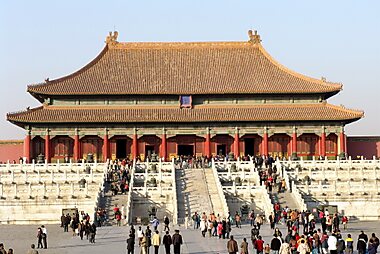
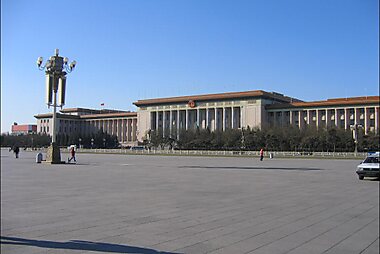
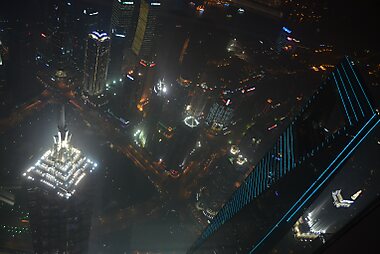
Shanghai pairs colonial-era riverfront architecture with a skyline of skyscrapers. Chongqing and Tianjin are enormous municipalities in their own right, each with a distinct character. Beijing, the capital, holds the Forbidden City, the Great Wall, and the bulk of China's imperial history.
Historic heartland
Shaanxi is home to the Terracotta Army near Xi'an. Shanxi preserves entire walled towns like Pingyao, and Henan and Hubei sit along the central plains that shaped early Chinese history.
Natural landscapes
Yunnan and Guizhou offer karst mountains, rice terraces, and ethnic minority villages. Hunan is home to the sandstone pillars of Zhangjiajie. Sichuan is the easiest place to see giant pandas, and Tibet and Qinghai cover the high Tibetan Plateau. Gansu follows the old Silk Road through desert oases.
Coast and islands
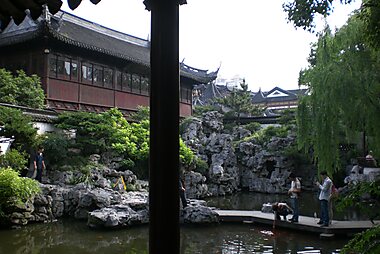
Zhejiang and Jiangsu hold classical gardens and canal towns near Shanghai. Xiamen sits on a mild southeastern coast, Qingdao is known for its German colonial architecture and beer, and Hainan is a tropical island with beach resorts.
North and frontier
Inner Mongolia has open grasslands and Gobi Desert scenery, while Jilin borders both North Korea and Russia, and Liaoning borders North Korea along the coast in China's industrial northeast.
China – Plan Your Trip
Pick the places you want to see and Tripomatic turns them into a day-by-day route, with smart routing, time estimates, and everything you need for a perfect trip.




